Energy minister says Saudi Arabia looking for comprehensive nuclear programme solely for civil purposes
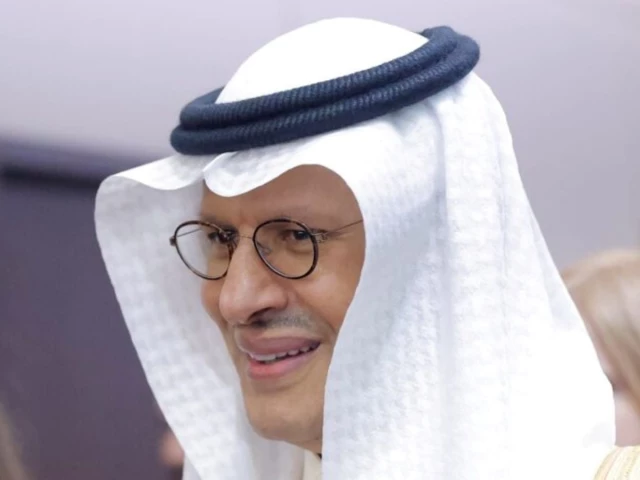
Saudi Arabia’s Energy Minister Prince Abdulaziz bin Salman walks during a meeting with Russia’s Deputy Prime Minister Alexander Novak at the St. Petersburg International Economic Forum (SPIEF) in Saint Petersburg, Russia June 16, 2022. REUTERS
Saudi Arabia has discovered 110 million tonnes of raw materials containing uranium concentrations in Madinah, the kingdom’s energy minister said at the IAEA General Conference in Vienna, Saudi state TV reported on Monday.
Speaking at the 70th Regular Session of the International Atomic Energy Agency General Conference, Energy Minister Prince Abdulaziz bin Salman said the kingdom does not develop its peaceful programme in isolation from the international community or through secret facilities deep within mountains without naming Iran.
#VIDEO: Saudi Energy Minister Prince Abdulaziz bin Salman says the Kingdom does not develop its peaceful nuclear program in isolation from the international community or through secret facilities hidden deep within mountains. pic.twitter.com/0ko8tQTz49
— Saudi Gazette (@Saudi_Gazette) September 14, 2026
Saudi Arabia was looking for a comprehensive nuclear programme solely for civil purposes.
According to Arab News, he announced the high concentrations of rare earth elements together with a high volume of uranium, confirmed by the geological studies and stratigraphy studies at Jabal Sayid, near Madinah.
🔴 BREAKING: Saudi Arabia has discovered 110 million tons of raw materials containing uranium concentrations in Medina, Saudi Energy Minister Prince Abdulaziz bin Salman says. pic.twitter.com/MVDRQV3LS4
— Al Arabiya English (@AlArabiya_Eng) September 14, 2026
The US and Saudi Arabia reached an agreement on civil nuclear power cooperation in July that would let Riyadh enrich uranium and build nuclear reactors using US technology.
Non-proliferation groups, such as the Arms Control Association, have criticised the planned “123 agreement” for not including the Additional Protocol, which grants the International Atomic Energy Agency extra powers such as the ability to carry out snap inspections at undeclared locations.