Says disparity in education is the bottleneck which has stalled educational progress in Pakistan
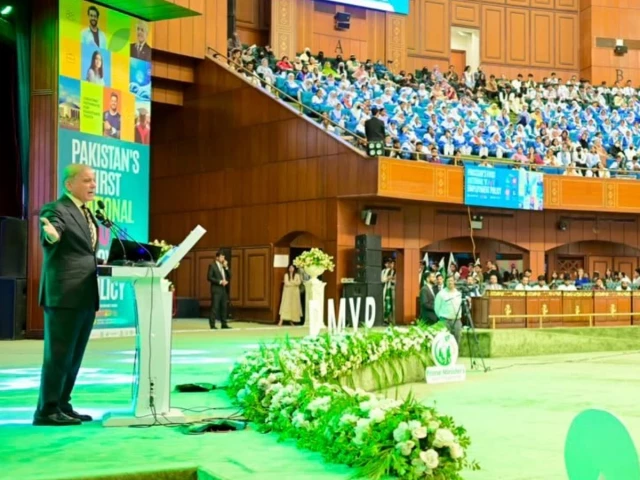
PM Shehbaz Sharif addressing a World Youth Day event attended by members of the government, students and families in Islamabad on August 12, 2026. Photo: PMO
Prime Minister Shehbaz Sharif on Wednesday said ending disparities in access to quality education was essential to transforming Pakistan into the welfare state envisioned by Quaid-e-Azam, stressing that millions of children remained deprived of opportunities enjoyed by pupils from privileged families.
He was addressing an International Youth Day 2026 event attended by members of the government, students and families in Islamabad.
“Pakistan cannot become a welfare state as envisioned by Quaid-e-Azam without ensuring standardised, quality education from Karachi to Peshawar,” the prime minister said during his address at the award distribution ceremony of meritorious students.
PM Shehbaz said he had tried his best to maintain Pakistan’s competitiveness in the education sector with other countries, but acknowledged a stark divide between children who had access to elite institutions and overseas education and those who could not even obtain basic educational opportunities.
“There is sheer misfortune that at one end we have Pakistan where pupils of privileged backgrounds receive the best education … and can even move overseas for better education in North America and the UK because of their family’s resources, while on the other hand there is another [face of] Pakistan where millions of pupils are deprived of even basic educational opportunities,” he said.
On International Youth Day, we celebrate the energy, talent and resolve of Pakistan’s youth. Our young people are the driving force of Pakistan’s progress and prosperity, with their innovation and leadership shaping a brighter future for our nation.
My government remains… pic.twitter.com/wAFS1rNqpY
— Shehbaz Sharif (@CMShehbaz) August 12, 2026
The prime minister pointed to a premier school in Lahore as an example of the disparity, saying children of parliamentarians, governors and other influential families studied there while underprivileged children could not even imagine enrolling in such institutions.
“This disparity is the bottleneck which has stalled educational progress in Pakistan,” he said.
On International Youth Day, we celebrate the energy, talent and resolve of Pakistan’s youth. Our young people are the driving force of Pakistan’s progress and prosperity, with their innovation and leadership shaping a brighter future for our nation.
My government remains… pic.twitter.com/wAFS1rNqpY
— Shehbaz Sharif (@CMShehbaz) August 12, 2026
First national youth policy
PM Shehbaz also announced what he described as Pakistan’s first national youth employment policy, saying the government wanted to move beyond merely preparing young people for jobs and instead help them create businesses and employment opportunities for others.
He said women would have a 35 per cent quota in the labour force under the policy, and at least 10% of the quota has been allocated for startups.
The prime minister said empowering young people through education, technology, entrepreneurship and equal access to opportunities was central to building the Pakistan envisioned by Quaid-e-Azam.
He called for a national commitment to narrowing the educational divide, arguing that children in villages and towns possessed immense intelligence and could compete with their counterparts anywhere in the country if provided with proper educational facilities.
The challenge, he said, was to ensure that talent rather than family background determined a young Pakistani’s prospects.
وزیراعظم محمد شہباز شریف نے پاکستان کی پہلی نیشنل یوتھ ایمپلائمنٹ پالیسی باضابطہ طور پر متعارف کرا دی ہے، جس کا مقصد نوجوانوں کو بہتر روزگار کے مواقع، مہارتوں کی ترقی، صنعت سے مؤثر روابط اور جدید ٹیکنالوجی سے ہم آہنگ صلاحیتیں فراہم کرنا ہے۔ وزیرِاعظم یوتھ پروگرام کے تحت تیار کی… pic.twitter.com/F4mVDEBRcW
— Government of Pakistan (@GovtofPakistan) August 12, 2026
Danish schools as welfare-state model
The premier said the government was seeking to address the imbalance by expanding the network of Danish Schools beyond Punjab to Azad Jammu and Kashmir, Gilgit-Baltistan, and Balochistan.
He said the objective was to provide disadvantaged children with education of a standard comparable to elite institutions, but free of cost.
The initiative, he stressed, was not charity but an effort to realise the principle of equal opportunity embedded in the welfare-state model envisioned by the country’s founder.
” پنجاب اور باقی صوبوں میں لاکھوں بچے اور بچیاں انتہائی قابل اور ذہین ہیں لیکن غریب والدین کے بچوں کو تعلیم کے بنیادی مواقع بھی میسر نہیں ہوتے۔
دانش اسکول کی بنیاد اس سوچ کے تحت رکھی کہ اگر ایچسن کالج میں صرف امیر کے بچے جا سکتے ہیں، تو قائداعظم کے پاکستان میں ہر بچے کو تعلیم… pic.twitter.com/ti2m6wyY3i
— Government of Pakistan (@GovtofPakistan) August 12, 2026
Narrating the story of an orphan from Rahim Yar Khan who secured admission to a Danish School on merit, the prime minister said the girl had described the institution as both a mother and father because it provided her with education and boarding.
Read: US, Iran agree to extend 60-day ceasefire ahead of August 17 deadline
Speaking on the educational enterprise his government has undertaken, PM Shehbaz said, “This initiative is not a favour to the children; it is their right.”
He warned that failure to provide young people with relevant modern education would be an “unforgivable” failure on the part of the government.
” آج کا دور تکنیکی تعلیم، آئی ٹی اور اے آئی کا دور ہے۔ اگر ہم نے جدید علوم کو اپنے سفر میں شامل نہ کیا تو ترقی کی دوڑ میں بہت پیچھے رہ جائیں گے۔
رحیم یار خان کے دانش اسکول کے دورے کے دوران میری ملاقات ایک بچی، عائشہ، سے ہوئی۔ اس نے بتایا کہ اسے پڑھنے کا بہت شوق تھا اور اس نے… pic.twitter.com/lfRHd3pkNf
— Government of Pakistan (@GovtofPakistan) August 12, 2026
Focus shifts to IT, AI and technical education
The prime minister said Pakistan’s education system also needed to respond to the rapidly changing global economy.
“This era is of technical education, Information Technology (IT) and Artificial Intelligence (AI). If we don’t include these latest disciplines in our journey, we will lag behind the rest of the world,” he said.
As part of the government’s initiatives, he said, 1,000 students had been sent to China the previous year to acquire knowledge in agricultural technology.
This year, he added, high-achieving matriculation and intermediate students would be selected for education and training in IT and AI in China.
He also announced the establishment of a Danish University in Islamabad, describing it as a flagship institution that would offer education in emerging disciplines. Classes at the university are scheduled to begin next year, he said.
Read more: DPM Dar condemns Houthi attack, orders repatriation of three Pakistanis’ remains
The prime minister said the government had so far distributed around 700,000 laptops among meritorious students, while another 250,000 laptops would be given to high achievers this year.
The laptop scheme, he said, had enabled young people to enter the “digital era” and earn livelihoods using technology.