Report says defence budgets are not ‘subject to adequate parliamentary or civilian public oversight’
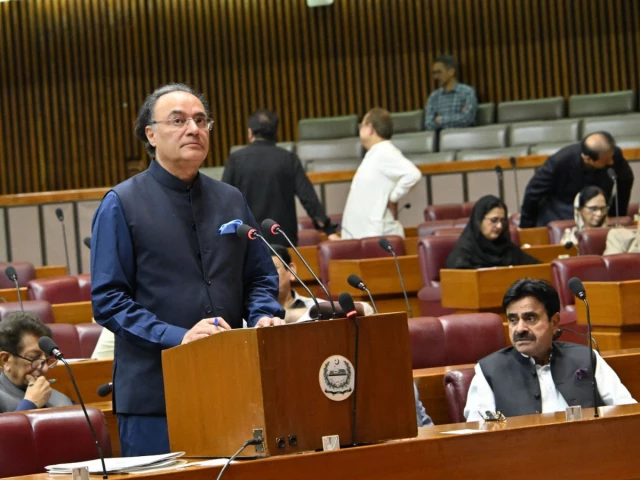
Finance Minister Muhammad Auranzgeb presenting demands for grants under budget FY26-27 at the National Assembly. PHOTO: NA/FACEBOOK
The United States State Department said on Wednesday that Pakistan needed to increase civilian oversight of public finances to improve its fiscal transparency.
According to the State Department, fiscal transparency informs citizens how government and tax revenues were spent and was a critical element of effective public financial management. Transparency provides citizens a window into government budgets and those citizens, in turn, hold governments accountable.
The National Assembly passed the Rs18.8 trillion Finance Bill 2026-27 in June. The defence budget was approved at Rs3 trillion, including at least Rs335 billion provincial contribution.
In its 2026 Fiscal Transparency Report: Pakistan, the State Department noted that Pakistan continued to lag in disclosing key financial data, including debt obligations and the budgets of military and intelligence agencies.
The report added that the government did not “publish its executive budget proposal within a reasonable period” and that it made only “limited information on debt obligations, including major state-owned enterprise debt, publicly available”. In addition, it said that the military and intelligence budgets were not “subject to adequate parliamentary or civilian public oversight”.
The report also identified some positive steps and stated that during the review period, the government made its “enacted budget and end-of-year report widely and easily accessible to the public, including online”.
According to the report, publicly available budget documents provided a “substantially complete picture of most of the government’s planned expenditures and revenues, including natural resource revenues”.
It further stated that the information in the budget was considered “generally reliable and subject to audit by the supreme audit institution” and that the supreme audit institution met “international standards of independence”.
The State Department also noted that audit reports were made publicly available within a reasonable period and provided substantive findings, and that the “government specified in law or regulation, and appeared to follow in practice, the criteria and procedures for awarding natural resource extraction contracts and licenses”.
“The government made basic information on natural resource extraction awards publicly available. The sovereign wealth fund had a sound legal framework, and the government published accessible information on public procurement contracts,” it further said.
The report also recommended steps that Pakistan could take to improve fiscal transparency, which include “making its executive budget proposal publicly available within a reasonable period”, “disclosing detailed information on government debt obligations, including for state-owned enterprises, and “subjecting the military and intelligence agencies’ budgets to parliamentary or civilian public oversight”.
Foreign Office (FO) Spokesperson Tahir Andrabi, while responding to a question on the report during his weekly press briefing today, acknowledged that “this is a development that took place yesterday”.
Andrabi said that while Pakistan adhered to internationally established best practices regarding fiscal transparency, budgeting processes and financial disclosure, it was simultaneously bound by its own constitutional, legislative and regulatory frameworks.
He further added that Pakistan was “currently in an IMF (International Monetary Fund) programme, which, by its design, is focused on structural reform and improving fiscal management. Pakistan has completed three IMF reviews, and its reform process and the measures taken under the process have been widely appreciated, including the credit rating upgrades by the three international rating agencies, as well as by the IMF”.
: