Share spot with Saudi King Salman, Crown Prince Mohammed bin Salman, Turkish President Recep Tayyip Erdogan
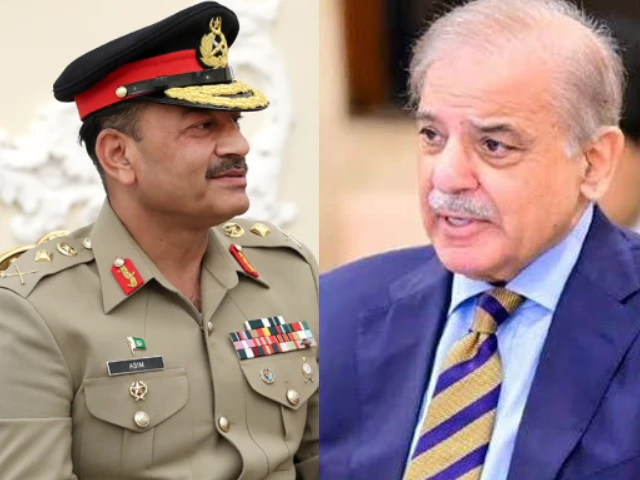
COAS Field Marshal Asim Munir and Prime Minister Shehbaz Sharif. Photo: File
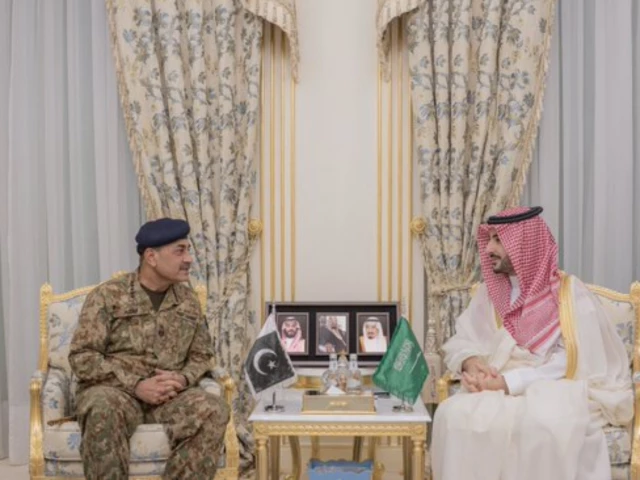
Prime Minister Shehbaz Sharif and Chief of Defence Forces and Chief of Army Staff Field Marshal Asim Munir shared the top spot in the 2027 edition of “The Muslim 500”, an annual list of the world’s most influential Muslims, alongside Saudi King Salman, Crown Prince Mohammed bin Salman and Turkish President Recep Tayyip Erdogan.
The 18th edition, compiled by the Royal Islamic Strategic Studies Centre (RISSC), a research institute based in Amman, Jordan, named a joint number one for the first time. The report listed the five leaders in three entries, with the prime minister and the field marshal jointly representing Pakistan.
The decision was linked to the Makkah Joint Defence Agreement, signed by Saudi Arabia, Turkiye and Pakistan on August 7. The agreement, the report said, was “modelled on a ‘one for all, all for one’ approach to security” and had “completely reshaped regional politics”.
According to the annual list, “For the first time ever, The Muslim 500 has named a joint Number 1 for its 2027 edition,” the report said, adding that the edition “captures a historic turning point, highlighting five leaders whose shared vision for collective security has completely transformed modern Islamic diplomacy.”
Both PM Shehbaz and CDF Munir were in the unranked section of last year’s list.
On PM Shehbaz, the report noted his previous tenure as Punjab chief minister, describing him as “known to be a workaholic and a rigorous administrator”. It credited his government for “successfully pulling back from the brink of default”, while noting that he had “firmly championed the pact as a purely defensive instrument of solidarity”.
The publication also highlighted his role in mediating during the crisis involving the United States, Israel and Iran, saying he had “successfully positioned Pakistan as an indispensable, neutral peace mediator”.
At home, however, it noted the political challenges facing his administration, which “remains deeply polarized by the persistent popularity and digital influence of imprisoned former Prime Minister Imran Khan”.
CDF Munir’s ranking was based in part on his military position and growing influence in national affairs. The report noted that he was “commanding the world’s sixth-largest military and its only Muslim nuclear weapons power” and had “consolidated an unprecedented level of political, military, and constitutional authority over a nation of 250 million Muslims”.
It credited him with securing a ceasefire on May 10, 2025, following the conflict with India, and called him “a premier architect of transnational Islamic unity”. The report also pointed out that he was “the only military officer to have chaired both Military Intelligence (MI) and the Inter-Services Intelligence (ISI)”.
Read: Türkiye publishes law approving ratification of Makkah joint defence pact
A separate assessment of Pakistan in the publication noted the country’s economic and diplomatic challenges over the past year, saying it had “navigated an intricate set of economic stabilisation challenges, regional security pressures, and major-power diplomatic balancing acts”.
“Islamabad maintains strategic partnership with Riyadh while keeping open diplomatic channels and border communication with Tehran,” it added.
Beyond the five leaders sharing the top position, Iran’s Supreme Leader Ayatollah Mojtaba Khamenei was ranked fourth. Having succeeded his father in March, he “assumed absolute constitutional authority” on March 8, 2026, according to the report.
Jordan’s King Abdullah II followed at fifth, described as “one of the world’s most proactive diplomatic and humanitarian anchors”. Qatar’s Emir Sheikh Tamim bin Hamad Al-Thani was ranked sixth, down from the top position last year.
Pakistani scholar Justice Muhammad Taqi Usmani was placed seventh and described as “widely considered the intellectual head of the Deobandi school of Islamic learning”.
Among other entries, Egyptian footballer Mohamed Salah was ranked 39th, while New York Mayor Zohran Mamdani came in at 49th, having previously featured in the unranked section.
Read more: Pakistan ready to take ‘all necessary defensive measures’ to protect Saudi Arabia: DG ISPR
Mamdani was sworn in on January 1, as “the first Muslim and first Asian American to lead the metropolis”, the report said, adding that he had “become a powerful source of inspiration for Muslims worldwide”.
Abdul El-Sayed featured in the honourable mentions. The report said he won Michigan’s US Senate election on November 3, “becoming the first Muslim American ever elected to the United States Senate”.
It also noted that he had faced “intense, bad-faith Islamophobic attacks from political opponents and right-wing figures”, while having “consistently re-focused public attention onto practical issues impacting ordinary citizens”.
The Muslim 500 ranks 50 individuals, while listing another 450 without numerical rankings across 13 categories of influence, including scholarly, political, business, arts and culture, media, and sports. A smaller number are included in an honourable mentions section.
The editors say the selection is not based solely on influence during the preceding year. “The achievements of a lifetime are given more weight than achievements within the current year,” they said, adding that they also considered “people breaking barriers and local influence as well as global influence”.
The publication named Dr Hussam Abu Safiya, a paediatrician and director of Kamal Adwan Hospital in northern Gaza, as Man of the Year.
Also Read: CDF Munir vows to hit terror outfits hard
It described him as “a doctor who refused to abandon his patients, buried his son and returned to the wards, and has now spent more than six hundred days in Israeli custody without charge or trial”.
The report noted that Israel maintained its detention practices complied with the law.
“A man with no army, no office and no freedom has done more than most governments to remind the world what courage and integrity look like,” it said.
Fatemeh Zahra Sheikhabadi, a survivor of the February attack on a school in Minab, Iran, was named Woman of the Year. She had addressed the UN Human Rights Council in Geneva, where she “asked the representatives of the world’s governments to hear the voices of the children of Minab”.
A UN fact-finding mission found reasonable grounds to believe US forces were responsible for the attack, the report said, adding that the United States had not published its own findings.
Sheikhabadi was honoured “not as a symbol of a war, but as herself.”