Both discuss ‘sinful attacks’ that targeted Makkah, civilian and economic facilities in the Kingdom
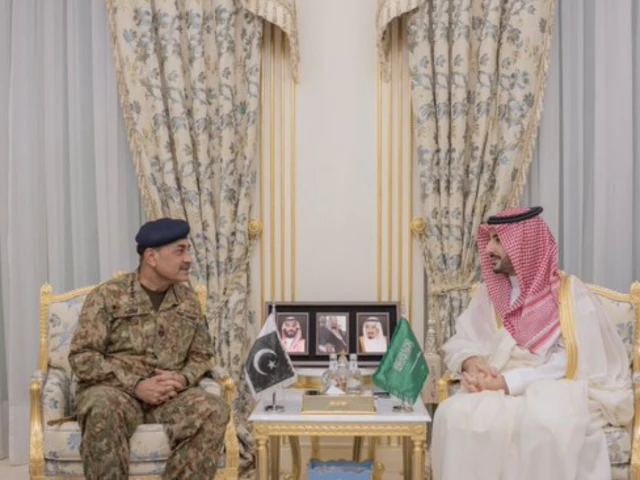
Chief of Defence Forces and Chief of Army Staff Field Marshal Syed Asim Munir met Saudi Defence Minister Prince Khalid bin Salman in Riyadh. Photo: X
Saudi Defence Minister Prince Khalid bin Salman reaffirmed continued joint efforts to confront attacks targeting Makkah and civilian and economic facilities in the Kingdom during a meeting with the Chief of Defence Forces (CDF) and Chief of Army Staff, Field Marshal Asim Munir.
The meeting came after top military commanders from Pakistan, Saudi Arabia and Turkiye held an urgent meeting in Riyadh under the Makkah Joint Defence Agreement (MJDA), marking the first exclusive high-level military coordination between the three countries since the trilateral defence pact was signed last month.
According to the statement issued by the Saudi defence minister, he held a meeting with CDF Munir in Riyadh, where they discussed matters of mutual interest, including the Makkah pact.
“I met with His Excellency the Commander of the Defence Forces and Chief of the Pakistan Army, Field Marshal Asim Munir. We praised the outcomes of the meeting of the chiefs of staff of the countries party to the Makkah Joint Defence Agreement, and discussed the sinful attacks that targeted Makkah and civilian and economic facilities in the Kingdom,” Khalid said in a post on X.
He further added that “We affirmed continuing joint efforts to confront these attacks in accordance with the MJDA.”
Met with Pakistan’s Chief of Army Staff and Chief of Defense Forces, Field Marshal Asim Munir. We welcomed the outcomes of the Chiefs of Staff meeting under the Makkah Joint Defense Agreement, and discussed the heinous attacks targeting the holy city of Makkah and the Kingdom’s… pic.twitter.com/fKviJMjcP8
— Khalid bin Salman خالد بن سلمان (@kbsalsaud) September 25, 2026
Saudi Minister of State, Cabinet Member and National Security Adviser Dr Musaad bin Mohammed Al-Aiban, Chief of General Staff General Fayyadh bin Hamed Al-Ruwaili, and the Minister of Defence’s adviser for intelligence affairs, Hisham bin Abdulaziz bin Saif, among other senior officials, also attended the meeting, according to the post.
In August, Pakistan and Saudi Arabia signed a landmark “Strategic Mutual Defence Agreement”, declaring that “any aggression against either country shall be considered an aggression against both”.
On August 7, Pakistan, Saudi Arabia and Turkiye formalised their longstanding strategic relationship through the newly signed Makkah pact, a trilateral security framework that its proponents describe as a defensive arrangement aimed at strengthening collective deterrence, enhancing military cooperation and promoting regional stability.
The conflict in the Middle East has deepened following attacks by Yemen’s Houthi group targeting Saudi Arabia, prompting Pakistan to condemn the attacks and warn that the escalation could further threaten regional peace and stability.
In mid-September, Saudi Arabia’s air defences intercepted and destroyed a Houthi drone south of Makkah before it entered prohibited airspace over the holy city, while the Saudi-led coalition said the security of the Two Holy Mosques and pilgrims was a “red line,” vowing that the coalition would take measures to deter further attacks.
Earlier, Houthis also attacked the southern Saudi cities of Abha, Khamis Mushait, Jazan and Najran, injuring 73 people. Women and children were among those injured.
The attacks also triggered fires at some energy facilities, where operations were subsequently halted as firefighting and emergency teams worked to contain the blazes and assess the damage.
The latest attacks were not the first time the Houthis had targeted Saudi Arabia’s energy interests. On 23 July, the group said it had struck two Saudi oil tankers in what it described as part of a naval blockade against the kingdom.