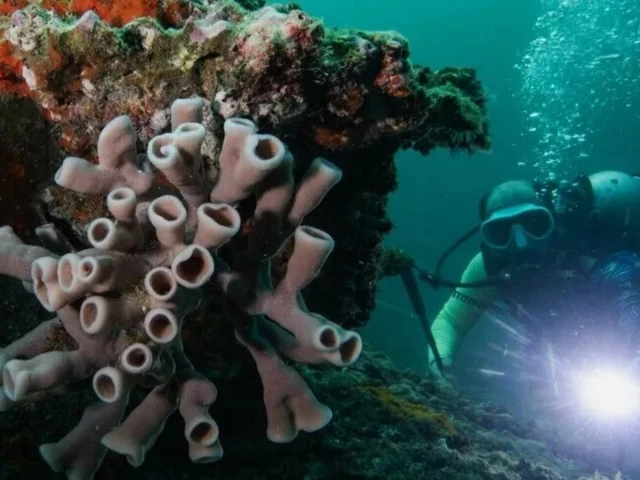
Biofouling, consisting of marine microorganisms, algae, invertebrates, can develop on hulls of stationary ships
The marine organisms accumulating on the hulls of more than 1,500 ships stranded due to the closure of the Strait of Hormuz amid tensions between the United States and Iran could be transported to different parts of the world once the vessels resume their voyages, potentially creating a global “super-spreader” effect for biological invasions.
A study published in the journal Biological Invasions found that biofouling, consisting of marine microorganisms, algae, and invertebrates, can rapidly develop on the hulls of ships that remain stationary for extended periods.
According to the study, more than 1,500 large commercial vessels have becomes stranded following the closure of the Strait of Hormuz on February 28.
The prolonged presence of these ships in the region allows local organisms to colonise their hulls, while also bringing together communities of organisms from different parts of the world on the same vessels.
Read: Hormuz shipping traffic capped amid competing claims from US and Iran
Professor Mario Tamburri of the University of Maryland, the study’s lead author, told Anadolu that the current situation represents a “worst-case scenario” compared with previous instances of ships being forced to wait for extended periods.
Tamburri said the risk stems from several factors occurring simultaneously. “First, the number and size of the ships that have remained stationary, and second, the fact that this coincides with spring and summer, when marine organisms are in their growth and reproductive season,” he said.
Pointing out that marine organisms in the region are adapted to challenging environmental conditions, including high temperatures and salinity, Tamburri said these characteristics could increase the likelihood of such organisms becoming invasive when transported to other regions.
Tamburri also noted that options for safely and effectively managing biofouling on stationary vessels in the Gulf are limited. He noted that the risk could increase further once the ships leave the region and reach ports around the world.
‘The longer ships remain stationary, the more biofouling develops’
Tamburri said the length of time a vessel remains stationary is critical in determining the amount and diversity of biofouling. “The longer they remain stationary during periods of productive growth and reproduction, the more extensive and diverse the biofouling on the ships becomes,” he said.
The study notes that biofouling on submerged ship surfaces can enter a phase of rapid growth within about 10 days. If ships remain stationary for 18 to 30 days, measures to manage the biofouling should be considered. Ships stationary for more than 30 days were strongly advised to take immediate action to clean the hull before starting their next voyage.
The study stresses that vessels in the Gulf have remained stationary far longer than normal port waiting periods, creating favorable conditions for invasive species to reproduce on their hulls and be transported to other regions.
Example of the Asian green mussel
Tamburri said it is difficult to predict with certainty which species will be spread by ships, as the risk depends on numerous variables involving both the species and the environmental conditions to which they are transported.
However, he pointed to species such as the Asian green mussel, which is native to the Gulf, as an example illustrating the scale of the potential risk. The species has been transported to Florida and the Caribbean, as well as Australia and South America.
Read More: War threatens Gulf’s dugongs, turtles and birds
In some areas, Asian green mussels compete with native bivalve species and can clog piping systems at power plants and desalination facilities.
The study also notes that species transported through biofouling can affect not only ecosystems but also economic activities, while certain parasites and pathogens may threaten commercially important species.
Short-distance routes increase the risk
The study emphasises that the first ports visited by ships departing the Strait of Hormuz are particularly important for the establishment of invasive species. For this reason, the researchers warn that these vessels could function as “super-spreaders” of biological invasions, transporting invasive species to different parts of the world.
Tamburri attributed the high risk associated with ports such as Jeddah, Mumbai, Colombo, Singapore, Alexandria, Piraeus, Algeciras, and Rotterdam to the relatively short voyage times from the Gulf to these ports and the similarity of environmental conditions, particularly temperature and salinity.
The researchers therefore recommend implementing early-warning and rapid-response systems at the first ports visited by these vessels after they leave the Gulf.
The international maritime community is not sufficiently prepared
Tamburri said the international maritime community is not yet sufficiently prepared to address the biosecurity risks that could arise from prolonged and large-scale disruptions to shipping.
“Regulations are being developed through the International Maritime Organisation (IMO), but it will take several years for them to be fully developed and approved. Very little attention has so far been paid to the biosecurity risks that could result from prolonged and large-scale disruptions to maritime transportation,” Professor Tamburri said.
Also Read: Hormuz tensions rise as Iran warns Gulf
He explained that this was why the researchers felt the need to conduct the study, emphasising that reducing the risk will require a coordinated international effort bringing together the fields of biological invasion science, maritime logistics, and regulation.
The researchers recommend cleaning the biofouling from ships’ hulls before they leave the Gulf as the ideal solution. However, they note that applying this measure to every vessel would be difficult because the region has limited capacity for such operations and ships may need to leave quickly for security, logistical, and operational reasons.