
ISLAMABAD:
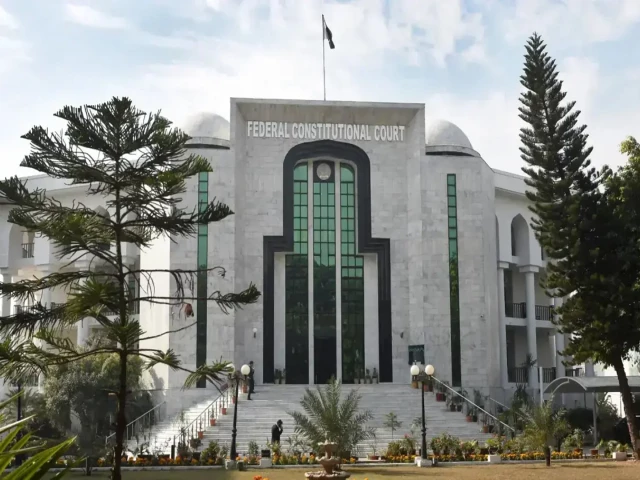
The Federal Constitutional Court (FCC) has held that any observation made by it in a judgment or order, which decides a question of law or enunciates a legal principle, will have binding effect on all courts, including the Supreme Court, under Article 189 of the Constitution.
“When any observation made by this Court in any judgment or order has the effect of deciding a question of law or is based upon or enunciates a principle of law, it shall be binding on all courts, including the Supreme Court,” says a 16-page judgment authored by Justice Aamer Farooq.
The judgment was issued by a three-member FCC bench headed by Chief Justice Amin-ud-Din Khan while deciding a matter concerning two permanent appointments in the Islamabad Capital Territory Private Educational Institutions Regulatory Authority (ICT-PEIRA).
The court observed that Article 189(1), as amended by the 27th Constitutional Amendment, clearly stipulates that its judgments, to the extent that they decide questions of law or enunciate principles of law, are binding on all other courts in Pakistan, including the Supreme Court.
“In this context, the binding effect of the judgments of this Court is not only confined to the ratio decidendi but also obiter dicta,” the judgment states.
The ruling comes amid an apparent lack of clarity over the relationship between the Supreme Court and the FCC following the 27th Constitutional Amendment.
The FCC earlier summoned the record of a case concerning the transfer of former prime minister Imran Khan to Shifa International Hospital for medical treatment while hearing the three-prisoners case.
Subsequently, a three-member Supreme Court bench raised questions over the FCC’s decision and adjourned the proceedings for three weeks. Neither court has since resumed hearing the matter.
A senior law officer believes that the Supreme Court has yet to transfer the relevant case record to the FCC in compliance with its judicial order.
The FCC has repeatedly asserted that its judgments are binding on the Supreme Court. It has also recently maintained that Supreme Court judgments are not binding on it, although they may carry persuasive value.
The latest judgment addresses the legal status of appointments made under the Islamabad Capital Territory Private Educational Institutions Ordinance, 2009, following its repeal and the subsequent enactment of the Islamabad Capital Territory Private Educational Institutions (Registration and Regulation) Act, 2013, which did not expressly save previous actions taken under the ordinance.
The court examined whether appointments made under the repealed ordinance continued to remain valid after the new law came into force.
Referring to Article 89 of the Constitution, the judgment explained that a presidential ordinance initially remains in force for 120 days from its promulgation unless a resolution disapproving it is passed by either House of Parliament before that period expires.
It further noted that an ordinance may be extended for another 120 days through a resolution of either House, but such an extension can be granted only once. The ordinance stands repealed upon expiry of the original or extended period, or earlier if a resolution disapproving it is passed. The president also has the authority to withdraw an ordinance at any time.
The judgment also referred to Section 6 of the General Clauses Act, 1897, which provides that the repeal of an enactment does not ordinarily destroy any right, privilege, liability or interest acquired under it.
In this regard, the FCC discussed a 2018 Supreme Court judgment authored by former chief justice Mian Saqib Nisar, which held that amendments, insertions or substitutions introduced through an amending ordinance would remain effective only for 120 days, or a maximum of 240 days if extended, unless Parliament subsequently gave them permanent legal effect through an Act. The earlier judgment had held that amendments introduced through an ordinance could not survive after the ordinance lapsed or was repealed.
It had further observed that allowing such amendments to retain permanent effect after the expiry of an ordinance would effectively grant the executive unlimited legislative powers, enabling it to bypass Parliament and undermine the constitutional principle of separation of powers.
The Supreme Court had also held that the ordinance-making authority under Article 89, or Article 128 in the case of provincial governors, did not make the president or a governor an independent or parallel legislative authority.