Says that Imran’s recent letter to judges also an attempt to influence judicial proceedings
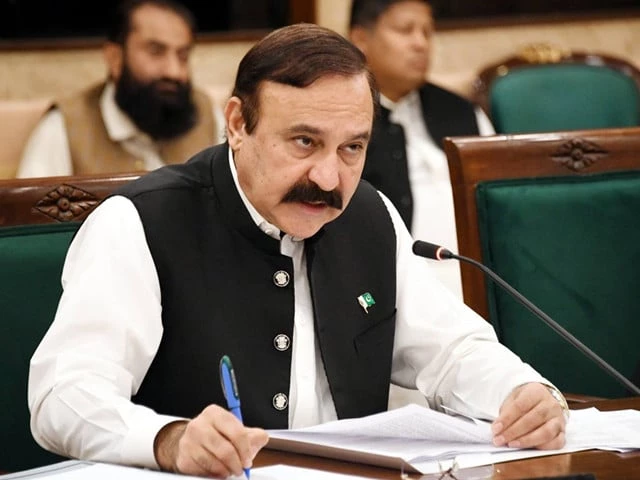
Federal Minister for Parliamentary Affairs Tariq Fazal Chaudhry. Photo: File
ISLAMABAD:
Minister for Parliamentary Affairs Tariq Fazal Chaudhry on Wednesday alleged that Pakistan Tehreek-e-Insaf founder Imran Khan had instructed his legal team to resort to delaying tactics in the £190 million case instead of arguing on merit, claiming that his recent letter to the country’s top judges was also an attempt to influence judicial proceedings.
The minister’s remarks came after PTI lawyers Sardar Latif Khosa and Barrister Salman Safdar met party founder Imran Khan at Adiala jail in Rawalpindi last week following an Islamabad High Court order and the release of Noreen Niazi and Uzma after remaining in detention for 50 days under the Maintenance of Public Order (MPO) law.
Speaking to the media at Parliament House, Chaudhry said the IHC was hearing the case concerning Imran’s conviction in the £190 million case.
“However, during the latest meeting Imran Khan had with his legal team in jail, he instructed them to create a commotion in court and resort to delaying tactics rather than arguing the case on merit,” he alleged.
He said the trial court had handed down its verdict after considering all the relevant points and evidence presented in the case. “Therefore, there are strong chances that this conviction will also be upheld by the IHC,” he said.
Read: ‘I may not return alive’: Imran urges top judges to enforce court orders, ensure medical treatment
Chaudhry said that Imran’s health was being politicised, with different excuses being raised over his treatment and conditions in jail.
“Sometimes politics is being made over Imran’s health, sometimes there is an excuse that he is not being provided with his preferred food, and sometimes that he is not being given his preferred doctor,” he said.
“At times, ridiculous allegations are made, such as a snake having emerged from Bushra Bibi’s cell. All these allegations and false narratives are intended to influence judicial proceedings,” he added.
He said that the former premier’s legal team was now acting like a “drama team”, accusing them of intending to prolong the case.
“The case will be decided on merit, regardless of how many delaying tactics they employ or how much they politicise Imran’s health,” he said. “The courts will conduct their proceedings on merit and in accordance with solid legal evidence,” he added.
In a letter dated November 16 (Monday) addressed to the country’s top judges, Imran urged the judiciary to ensure the implementation of court orders regarding his medical treatment and prison conditions. He said that he had been kept in solitary confinement, denied access to his family and lawyers, and deprived of proper medical care, warning that his health was deteriorating and he might not “return alive”.
Read more: Tariq Fazal Chaudhry rules out any ‘deal, leniency’ for PTI after release of Imran’s sisters
Referring to Imran’s letter, Chaudhry dubbed the action an attempt to influence judicial proceedings. “If the government has refused, attempts are now being made to obtain an NRO from the courts,” he said.
He urged Imran and his legal team to present substantial evidence and legal arguments before the court and argue the case on merit.
“They should focus on solid evidence, legal points and the merits of the case in court,” he said. “The tactics they are employing to influence judicial proceedings will neither prove effective nor will their attempts succeed,” he added.
Last week, the court-mandated meeting between Imran and his lawyers lasted between three and four hours, during which the lawyers discussed the couple’s health and legal cases. Safdar said the meeting had been held to obtain legal instructions, adding that “comprehensive legal instructions” had been given by both Imran and Bushra Bibi.
After the meeting, Khosa said Imran’s blood pressure continued to fluctuate and had reached a “frightening level”, while his eye-related problems also persisted.
However, he said the former prime minister remained “completely alert,” and his spirits were strong. Khosa also confirmed that the possible 28th Constitutional Amendment had been discussed, but declined to share further details.
The IHC had directed authorities to facilitate the meeting while hearing appeals filed by Imran and Bushra against their convictions in the £190 million Al-Qadir Trust case, and directed their counsel to begin arguments at the next hearing.
Imran and Bushra Bibi remain incarcerated in Rawalpindi’s Adiala Jail. They were sentenced on December 20, 2025, to 17 years in prison in the Toshakhana-II case, which pertains to allegations that the couple unlawfully retained a Bulgari jewellery set gifted by the Saudi crown prince during an official visit to Saudi Arabia.
Imran has been in custody since August 2023, serving a sentence in a £190 million corruption case. He also faces pending trials under the Anti-Terrorism Act in connection with protests on May 9, 2023.
The case
Imran and Bushra Bibi are facing a £190 million graft case linked to the Al-Qadir Trust, a welfare organisation they established in 2018. The trust, which runs a university outside Islamabad focused on spirituality and Islamic teachings, is accused of being used as a front to receive land worth millions of dollars from a real estate tycoon.
The government claims the donations were in exchange for Imran’s administration using repatriated UK funds to pay fines against the businessman, instead of depositing the money into Pakistan’s treasury.
Imran has denied any wrongdoing, insisting neither he nor his wife gained financially from the trust or related transactions. In his written response to the IHC, he claimed the case is politically motivated, alleging a corruption reference against Punjab Chief Minister Maryam Nawaz led to a fabricated case against Bushra Bibi.
He challenged the prosecution’s evidence, highlighted inconsistencies in witness statements, and accused the National Accountability Bureau (NAB) of destroying key records related to political leaders.
Imran has argued that amendments to the National Accountability Ordinance (NAO), 1999 protect cabinet decisions from prosecution unless there is proof of personal gain. The IHC has acknowledged the “substance” of this claim and directed the trial court to consider it while deciding the matter.
He subsequently filed a civil miscellaneous application in the IHC seeking a hearing of his appeals against the accountability court verdict, which convicted him and his wife in the £190 million corruption case.