Experts urge stronger oversight, content moderation to tackle online threats without stifling innovation, free speech
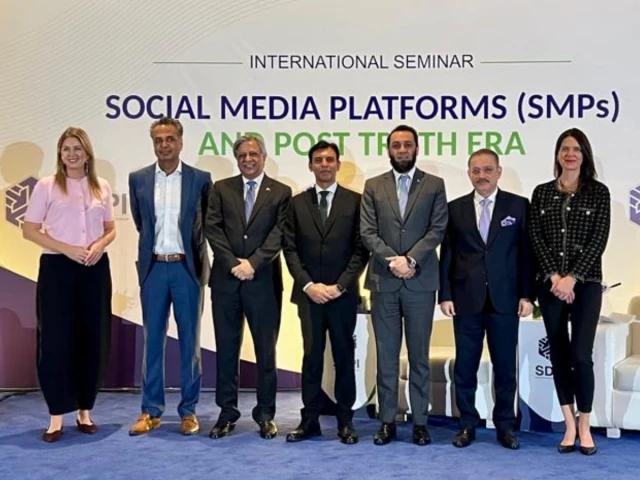
A group photo of speakers with moderator at the Social Media Platforms (SMPs) and Post-Truth Era seminar held in Islamabad on November 24, 2026. Photo: APP
Speakers at an international seminar on social media platforms (SMPs) and the post-truth era on Tuesday called for greater accountability of digital platforms, transparent content moderation and balanced regulation to curb disinformation and extremist content without compromising freedom of expression or technological innovation.
Addressing a session titled “When virality outruns truth: Disinformation, public trust and post-truth era”, organised by the Sustainable Development Policy Institute (SDPI), the speakers stressed the need for stronger cooperation among governments, technology companies, journalists and citizens to tackle growing digital threats.
Information Minister Attaullah Tarar said Pakistan had nearly 100 million social media users and around 160 million smartphone users, making the spread of unverified information a major challenge.
He said the shift from traditional to social media had transformed the information landscape, allowing anyone with a smartphone to produce and disseminate content and making verification increasingly difficult.
Sindh Senior Minister for Transport, Mass Transit and Information Sharjeel Inam Memon described disinformation as a global challenge requiring collective action.
Recalling an incident in which false videos linked him to a murder case in Karachi, Memon said he had approached the National Cyber Crime Investigation Agency (NCCIA), following which the videos were removed.
He said misinformation could damage reputations and endanger lives, adding that freedom of expression should not be used to spread propaganda, promote terrorism or create disorder in society.
Memon urged social media platforms to deploy artificial intelligence and other tools to identify harmful content, particularly material inciting violence.
National security and foreign policy expert Laurie A Watkins stressed the importance of timely verification and transparent communication during security crises, warning that manipulated videos and unverified claims could escalate tensions and endanger communities.
She called on major platforms operating in Pakistan to appoint local representatives with the authority and resources to respond to complaints and lawful requests. She also proposed complaint mechanisms in local languages, meaningful appeals against content moderation decisions and regular disclosure of complaint-handling timelines and outcomes.
SDPI Executive Director Dr Abid Qaiyum Suleri said social media had democratised access to information and enabled citizens to challenge authority, but had also increased the need for verification and source transparency.
He warned that terrorist organisations were exploiting digital platforms for propaganda, recruitment and the glorification of violence.
In a separate session titled “Global platforms and local laws: How to ensure digital accountability”, Federal Minister for Information Technology and Telecommunication Shaza Fatima Khawaja called for stronger coordination between social media companies and regulatory institutions to address online harassment, security-related complaints and harmful content.
She said differences between local laws and platforms’ community guidelines often complicated content moderation, stressing that complaints should include relevant legal provisions and sufficient local context.
Shaza also highlighted gender-related concerns, particularly online harassment and targeted campaigns against public figures, saying these required serious attention and proper contextualisation to ensure an effective response from social media platforms.
She said institutions such as the Pakistan Telecommunication Authority (PTA) and the NCCIA could help improve coordination with digital platforms. Banning or shutting down platforms, she added, should remain a last resort, with engagement and corrective measures prioritised.
Highlighting the economic importance of the technology sector, the minister said Pakistan’s technology exports had exceeded $4.6 billion, stressing that regulation should protect citizens and national security without stifling innovation.
Canadian journalist Tanya Goudsouzian said digital platforms and artificial intelligence had significantly increased the speed and scale of misinformation, while algorithms increasingly determined what information reached audiences.
She said professional journalists had a responsibility to verify information, fact-check claims and disseminate credible news, adding that algorithms had increasingly replaced editors in determining what content reached audiences.
Meta Pakistan Head of Public Policy Dania Mukhtar said the company prohibited content supporting or glorifying dangerous organisations and individuals under its Dangerous Organisations and Individuals policy.
“Meta maintains Global Community Standards while respecting local laws,” she said.
Dania said government requests were assessed against Meta’s Community Standards and subjected to legal and due diligence reviews, including considerations of international human rights principles, necessity and proportionality.
She added that content could be restricted in specific countries following the review, with affected users notified.
Fahad Muhammad Khan Niazi, ByteDance/TikTok’s Head of Public Policy and Government Relations for Emerging Markets, said cooperation among technology companies, governments, civil society and users was essential to creating safer digital spaces.
He said TikTok had removed 33 million pieces of content in Pakistan during the second quarter of 2026, representing 1.1% of the total content uploaded during the period.
He added that the platform provided reporting and transparency tools and was working with the PTA and the Ministry of Information Technology and Telecommunication under a memorandum of understanding.