Rezaei says restricted zone to be announced around Strait of Hormuz, ships entering zone to be added to sanctions list
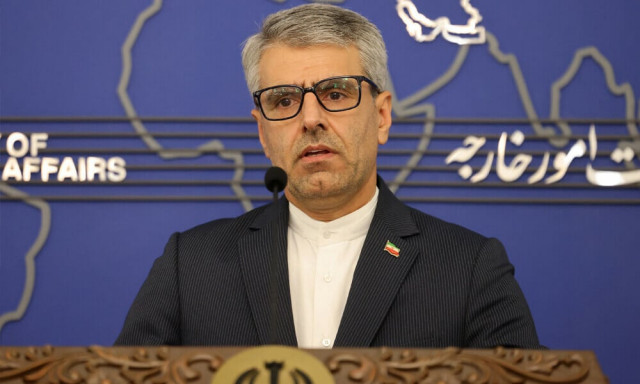
Iranian Foreign Ministry spokesperson Esmaeil Baghaei. — AFP
Iran’s Foreign Ministry spokesperson Esmaeil Baghaei said on Monday that South Korea’s military participation or presence in operations in the Gulf and Strait of Hormuz would be regarded as support for United States “aggression” and would “lead to serious consequences.”
In a post on X, Baghaei noted, “The relationship between Iran and the Republic of Korea has a history spanning more than 64 years, and the ties between the two countries have consistently developed on the basis of mutual respect.” He added that “Iran places great importance on its friendly relations with the Republic of Korea.”
However, the spokesperson stated that at present, “the Iranian people are defending themselves against America’s aggressive actions, and in the situation where they are resolutely responding to America’s war crimes against women and children.”
이란과 대한민국의 관계는 64년이 넘는 역사를 지니고 있으며, 양국 관계는 줄곧 상호 존중을 바탕으로 발전해 왔습니다. 이란은 대한민국과의 우호 관계를 매우 중요하게 여기고 있습니다.
그러나 현재 이란 국민이 미국의 침략적 행위에 맞서 자위하고 있으며, 여성과 어린이를 상대로 한 미국의… pic.twitter.com/ThlIXzIyIN
— Esmaeil Baqaei (@IRIMFA_SPOX) September 7, 2026
Baghaei added that “any other country maintaining a military presence or participating in operations in the Persian Gulf and the Strait of Hormuz can only be regarded as directly supporting the perpetrators of the aggression, and it will lead to serious consequences.”
“No sovereign and responsible country should yield to America’s pressure and threats and become complicit in the aggressive acts and horrific crimes against the great Iranian people,” he concluded his post.
Rezaei says restricted zone to be announced around Strait of Hormuz
Earlier, Secretary of Iran’s Supreme National Security Council Mohsin Rezaei said on Sunday that a restricted zone will be announced around the Strait of Hormuz in the coming days, Iranian state media reported.
Rezaei added that the zone would would include areas in the Gulf. Few details were provided on the plan initially, but Rezaei said any ship entering the new zone would be added to a sanctions list.
Iran’s security chief Mohsen Rezaei says Tehran will announce a restricted zone around the Strait of Hormuz and parts of the Gulf, with ships entering the zone to be placed on a sanctions list. pic.twitter.com/KqjOZL8GZw
— Al Jazeera English (@AJEnglish) September 7, 2026
Separately, Baghaei said Sunday night that the strait was wide open until February 28, when the US and Israel attacked Tehran.
“Washington unleashed an unlawful and savage war on the region and disrupted the normal flow of commercial shipping; tankers are halted, trade is disrupted, and energy prices are rising,” Baghaei said. He added that the “US is now trying to present the world with the bill for a disruption of its own making — and put Iran’s name on it.”
According to the spokesman, “In Washington’s narrative, a war started by the United States must somehow be recast as the cost of Iran’s behaviour to the world.”
“America started the war but expects the whole world to pay the bill, while portraying Iran as the one that caused this chaos. That is utterly preposterous!” Baghaei concluded.
The Strait of #Hormuz was wide open until 28 February, when the #USrael attacked Iran. Washington unleashed an unlawful and savage war on the region and disrupted the normal flow of commercial shipping; tankers are halted, trade is disrupted, and energy prices are rising.
The US… pic.twitter.com/ll5oHCQoEv
— Esmaeil Baqaei (@IRIMFA_SPOX) September 6, 2026
Earlier, Iran said it would step up efforts to tackle problems created by United States sanctions that are crippling its economy, while a senior Iranian official warned of a “painful response” if it comes under further attack.
Six months after US-Israeli strikes on Iran launched the war, the conflict appears to be at a stalemate. A preliminary ceasefire accord reached in June has unravelled, and little progress has been made in diplomatic efforts to get the peace process back on track.
After a pause in military action for much of August, tit-for-tat strikes have resumed with US Central Command saying it hit three Iranian tankers on Saturday after Iran’s Islamic Revolutionary Guard Corps launched ballistic missiles at two US Navy ships.
Following the attacks, Iran’s Parliament Speaker Mohammad Bagher Ghalibaf said on Sunday that the US should understand that the rules of the game have changed “before it is too late”.
“From now on, any attack against Iran’s interests and security will receive a faster, heavier and more painful response,” he said in a speech published on his Telegram channel.
Tehran has shown it retains the capability to attack US interests in neighbouring countries and to shut down oil flows through the Strait of Hormuz, through which a fifth of global oil supplies flowed prior to the conflict.
Sanctions, oil blockade squeeze economy
However, the US campaign to throttle Iran’s economy by blockading its oil exports and stopping sanctions evasion is growing increasingly difficult to withstand, three senior Iranian sources have said.
In his speech on Sunday, Ghalibaf added that alongside the military front, Iran’s main battle was now over production and people’s livelihoods. He cited sharp currency fluctuations, inflation, unemployment and market management as major challenges, adding Iranians could tolerate hardship but not mismanagement or inaction and expected the government to act quickly.
Iran’s Economy Minister Ali Madanizadeh said that Tehran planned to respond to US economic pressure with reforms and rejected the notion that sanctions would cause it to change course, according to state media on Sunday.
Read: Iran’s army chief says US seeking to offset battlefield setbacks through economic pressure
“They speak of economic pressure and isolation, of breaking off financial ties and they think that by pressuring the economy of a country they can change the decisions of its people,” Madanizadeh said. “I have to clarify one point: The responsibility of reforming Iran’s economy is with its government and people, not with the US Treasury.”
Separately, Economy Ministry Deputy Morteza Zamanian said on Sunday that the ministry’s “Economic War Headquarters” was doubling down on its work to resolve problems caused by the war, according to the semi-official Tasnim news agency.
Kharg Island hit 550 times in prior months, Iran says
Iran is the third-largest producer in the Organisation of the Petroleum Exporting Countries and exported 90% of its crude via its Kharg Island export hub before the war. Flows have been disrupted since a US blockade of Iranian oil exports began in mid-April.
US Central Command said on X that as of Sunday it had redirected 92 commercial vessels, disabled three and boarded two to ensure strict compliance with its blockade.
On August 31, US President Donald Trump issued a one-line social media post accompanied by an AI-generated video depicting Kharg Island being “blown to smithereens.” Iranian authorities have vowed a strong response if Kharg is attacked.
In an interview aired on state TV on Sunday, Iran’s Oil Minister Mohsen Paknejad said the island had been hit around 550 times in previous months but continued to operate.
Iran has also imposed a blockade on the Strait of Hormuz, creating an issue for Trump by pushing up fuel prices globally as his Republican Party heads into elections in November when control of Congress is at stake.
However, US Energy Secretary Chris Wright said oil was getting through the waterway. “Our transits through the Strait are averaging over 9 million barrels a day now, and with the access pipelines that go around the strait, we’re probably two-thirds or more of pre-conflict flows. So Iranians are still causing trouble, but the United States Navy is winning that battle,” he told CNN.
On Saturday, US Central Command said it struck three Iranian vessels, including one off the coast of Kharg Island, after Iran’s Islamic Revolutionary Guard Corps launched ballistic missiles at two US Navy ships.