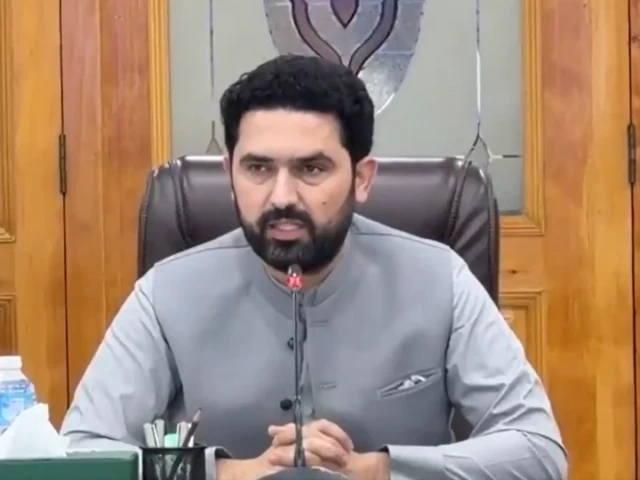
Khyber-Pakhtunkhwa Chief Minister Sohail Afridi addresses a provincial cabinet meeting in Peshawar on Wednesday. SCREENGRAB
ISLAMABAD:
The placement of a sitting chief minister in protective custody has raised serious questions about democratic norms and constitutional authority, with experts questioning the move against the Khyber Pakhtunkhwa (K-P) government and calling on the courts to examine its legality.
Former justice Wajihuddin Ahmed said the courts had the power to take cognisance of the matter, while senior journalist Mazhar Abbas questioned the justification for targeting the PTI-led provincial government in the name of counterterrorism.
Questions have also been raised over the constitutional basis of the move, the status of the Khyber Pakhtunkhwa Assembly and its implications for the upcoming Senate elections.
Senior journalist Mazhar Abbas said the issue was not the rise in terrorism in Khyber Pakhtunkhwa, which has remained a longstanding problem across the country since the September 11 attacks and the ensuing war on terror, but the politicisation of terrorism against the Pakistan Tehreek-e-Insaf (PTI).
He alleged that the security situation was being used as a pretext to target the party.
Abbas said all major political parties were signatories to the National Action Plan (NAP), but none had implemented it in letter and spirit while in power.
He questioned why only the PTI-led government in K-P was being targeted. In reality, he said, the entire provincial government and assembly had been held in abeyance along with the chief minister, who continued to hold the office in name only.
Justice (r) Wajihuddin Ahmed said the constitutional court had the power to take cognisance of the protective custody of the K-P chief minister.
Asked whether the law provided for suo motu action in the matter, he said the court still had considerable powers at its disposal and should exercise them to safeguard the spirit of the Constitution.
He said there was no provision in law allowing the arrest of a chief minister, in any form, in such circumstances. Placing both a speaker and a chief minister in custody was unimaginable under any democratic dispensation, he said, adding that the imposition of emergency should be questioned by the courts.
However, Abbas disagreed with Justice (r) Wajihuddin Ahmed’s view that the courts could take up the matter, saying that no court would examine it because the judiciary had been brought within the ambit of the government’s authority.
He argued that terrorism was not the actual reason for the measures and that, under such regimes, reasons were used merely to satisfy paperwork. Even when terrorism was cited as the justification on paper, he said, history had shown that such measures had never produced positive results.