FO warns of forceful response to any attack, urges New Delhi to abandon its belligerent posture and dangerous rhetoric
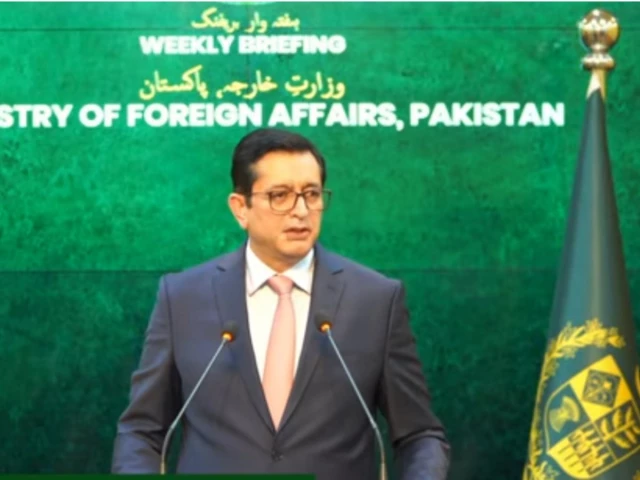
Foreign Office spokesperson Sajjad Haider Khan. Photo: Screengrab
Pakistan on Friday rejected and condemned “provocative remarks” by India’s defence minister threatening aggression against Pakistan, warning that any military action would be met with a forceful response.
“Restraint and commitment to peace must never be mistaken for weakness. Any aggression will be met with a forceful response,” Foreign Office spokesperson Ambassador Sajjad Haider Khan said during the weekly press briefing.
He said the remarks reflected India’s “hegemonistic mindset” and the risks its “belligerent posture” posed to regional peace and stability in South Asia.
Khan reminded India of the consequences of its military aggression in May 2025, saying Pakistan had demonstrated its capability and resolve to defend its sovereignty and territorial integrity and had delivered a befitting response.
“Let there be no ambiguity. Pakistan remains fully prepared to safeguard its sovereignty and territorial integrity against any ill-advised aggression,” he said.
He urged India to draw appropriate lessons from last year’s events, abandon its belligerent posture and dangerous rhetoric, and act responsibly to ensure lasting peace in the region.
🔴LIVE: Spokesperson’s Weekly Press Briefing 16-10-2026 at Ministry of Foreign Affairs, Islamabad https://t.co/QHDzTMW4b7
— Ministry of Foreign Affairs – Pakistan (@ForeignOfficePk) October 16, 2026
Pakistan also strongly condemned the latest Houthi attack targeting King Khalid International Airport in Riyadh, reaffirming its support for Saudi Arabia’s sovereignty, territorial integrity and security.
Khan said Pakistan remained deeply concerned over continuing attacks against Saudi Arabia and reiterated Islamabad’s solidarity with the kingdom. “Pakistan underscores that attacks against civilian populations and critical infrastructure are unacceptable and constitute a grave threat to regional peace and security,” he said.
The spokesperson said Pakistan, Saudi Arabia, Egypt and Türkiye had issued a joint statement on October 11 under the R4 Group Framework, condemning continuing Houthi attacks, including the strike on King Khalid International Airport.
The four countries reaffirmed their solidarity with Saudi Arabia, supported its measures to protect its territory and population, and called for an immediate and unconditional cessation of the attacks.
On Palestine, Khan said Pakistan had joined the foreign ministers of 18 other countries in condemning Colombia’s inauguration of its embassy in Jerusalem, describing the move as contrary to relevant United Nations Security Council resolutions and detrimental to the two-state solution.
In a joint statement issued on Friday, the foreign ministers of Pakistan, Algeria, Djibouti, Egypt, Indonesia, Jordan, Kuwait, Lebanon, Libya, Malaysia, Oman, Palestine, Qatar, Saudi Arabia, Somalia, Syria, Sudan and Türkiye rejected the move.
🔊PR No.2️⃣9️⃣0️⃣/2️⃣0️⃣2️⃣6️⃣
Joint Statement by the Foreign Ministers of the Islamic Republic of Pakistan, Algeria, Djibouti, Egypt, Indonesia, Jordan, Kuwait, Lebanon, Libya, Malaysia, Oman, Palestine, Qatar, Saudi Arabia, Somalia, Syria, Sudan and Türkiye
🔗⬇️ pic.twitter.com/DEkSfSUmsE
— Ministry of Foreign Affairs – Pakistan (@ForeignOfficePk) October 16, 2026
Pakistan urges Kabul to act against terrorists
Highlighting Pakistan’s counterterrorism efforts, Khan said Dar had addressed an international conference on Pakistan’s evolving counterterrorism landscape, the Tehreek-e-Taliban Pakistan (TTP), cross-border threats and regional security, organised by the Institute of Strategic Studies Islamabad on October 12.
According to the spokesperson, Dar reaffirmed Pakistan’s resolve to combat terrorism in all its forms and called on Afghan authorities to take “concrete, verifiable and irreversible action against groups operating from Afghan soil” against Pakistan.
He also highlighted the threat posed by “Indian-sponsored terrorist groups operating against Pakistan”, including those originating from Afghan territory.
Khan said the deputy prime minister had outlined counterterrorism measures, including the implementation of the National Action Plan, Operation Azm-e-Istehkam and enhanced intelligence coordination. He also paid tribute to the armed forces and law enforcement agencies for their sacrifices.
Pakistan, Oman agree to expand cooperation
Turning to bilateral relations, the spokesperson said Omani Foreign Minister Sayyid Badr bin Hamad bin Hamoud Al-Busaidy visited Pakistan from October 13 to 14 at the invitation of Deputy Prime Minister and Foreign Minister Senator Mohammad Ishaq Dar.
The two foreign ministers co-chaired the eighth session of the Pakistan-Oman Joint Ministerial Commission, reviewing bilateral relations and agreeing to enhance cooperation in trade, investment, energy, maritime connectivity, information technology and workforce mobility.
Five agreements and memorandums of understanding were signed during the visit, along with a protocol recording the proceedings of the commission’s session.
The two sides also exchanged views on regional and international developments and reaffirmed their commitment to strengthening longstanding ties.
Separately, Dar met Russian Interior Minister Vladimir Kolokoltsev on October 14. Interior Minister Mohsin Naqvi and Minister of State for Interior Talal Chaudhry also attended the meeting.
The meeting reviewed the positive trajectory of Pakistan-Russia relations, with both sides discussing greater cooperation in trade, investment, culture, tourism and people-to-people exchanges. They also underscored the importance of continued coordination at multilateral forums, including the Shanghai Cooperation Organisation (SCO).
Dar holds calls with regional counterparts
The spokesperson said Dar held a telephone conversation with Maldivian Foreign Minister Ertugrul Hisham Adem on October 10 to discuss preparations for President Mohamed Muizzu’s forthcoming visit to Pakistan.
Both sides reaffirmed their commitment to strengthening bilateral relations and agreed to remain in close coordination to ensure a substantive and productive visit.
On October 15, Dar held separate telephone conversations with Egyptian Foreign Minister Badr Abdelatty and Turkish Foreign Minister Hakan Fidan to discuss regional and international developments.
During his conversation with Abdelatty, Dar emphasised the importance of dialogue and diplomacy in addressing regional challenges and reaffirmed Pakistan’s support for de-escalation efforts.
His discussion with Fidan covered the situation in Gaza and Palestine, as well as preparations and strategy for the forthcoming Organisation of Islamic Cooperation (OIC) Council of Foreign Ministers meeting in Iraq.
The spokesperson said both conversations underscored the importance of continued engagement and close coordination to promote peace and stability.
Pakistan, EU discuss legal migration pathways
On Pakistan’s engagement with the European Union, the spokesperson said Dar met European Commissioner for Internal Affairs and Migration Magnus Brunner in Islamabad on October 13.
The two sides reviewed bilateral relations and discussed cooperation on migration and mobility under the Pakistan-EU Strategic Engagement Plan.
Dar highlighted Pakistan’s efforts to combat irregular migration, migrant smuggling and human trafficking, stressing that these measures should be accompanied by greater opportunities for legal migration for skilled Pakistani workers and professionals.
Brunner appreciated Pakistan’s progress in curbing irregular migration and acknowledged the potential for expanding legal migration pathways, Khan said.
IAEA completes first nuclear security mission in Pakistan
The spokesperson also announced the successful conclusion of the International Atomic Energy Agency’s (IAEA) International Physical Protection Advisory Service (IPPAS) mission to Pakistan on October 9.
The mission reviewed Pakistan’s national legal and regulatory framework governing nuclear security. The IAEA team appreciated the country’s cooperation, transparency and professionalism during the review.
Khan said the completion of the first-ever IPPAS mission to Pakistan reflected Islamabad’s commitment to strengthening nuclear security and promoting international cooperation for the safe, secure and peaceful application of nuclear technology.
Digital reforms to facilitate document attestation
Separately, Dar witnessed the signing of a memorandum of understanding between the Ministry of Foreign Affairs, the Higher Education Commission and the Inter-Boards Coordination Commission to integrate their databases.
The initiative aims to streamline the attestation and verification of educational documents, improve transparency and expand access to digital services for Pakistanis at home and abroad.
The spokesperson said the initiative would reduce delays and eliminate the need for physical visits, making consular services more accessible and efficient.
Dar reiterated that improving consular services remained a priority, citing the introduction of Pakistan’s apostille system in 2024 as part of the government’s efforts to facilitate citizens.
Khan concluded by saying that Ambassador Asim Iftikhar Ahmed had called on Dar on October 12 after formally assuming charge at the Foreign Office. Dar appreciated Ahmed’s contributions during his tenure as Pakistan’s permanent representative to the United Nations in New York and wished him success in his new responsibilities.