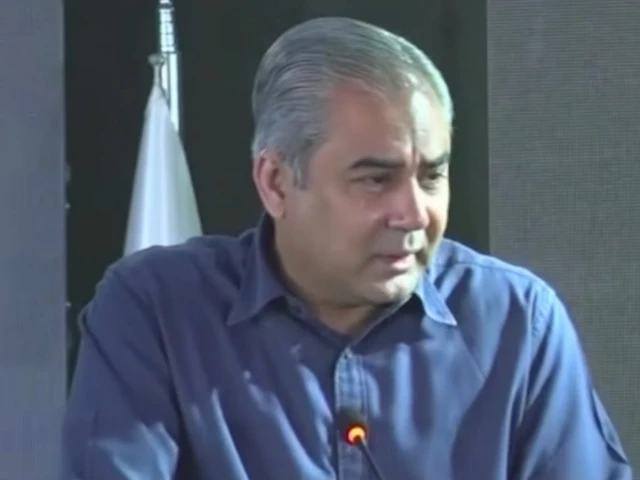
Interior Minister Mohsin Naqvi on Saturday said he would continue to support the creation of new provinces and administrative units, regardless of whether he remained in office, stressing that any such decision should ultimately be based on the will of the people and not emotions.
“Whether I remain in office or not, I will not back down from this,” Naqvi said, referring to the demand for new provinces that has gained traction over the past few weeks, adding that the will of the people holds more importance than the will of those in office.
Speaking at an event titled National Policy Dialogue in Lahore, Naqvi also urged the political actors and some factions of the public not to become overly reactive, saying, “Do not get emotional about the issue. This is not something that is going to happen tomorrow or the day after.”
Highlighting the importance of new administrative units to ensure holistic development across the country, Naqvi questioned whether provinces had cities comparable to Lahore in Punjab, Karachi in Sindh, Peshawar in Khyber-Pakhtunkhwa and Quetta in Balochistan in terms of their administrative and economic significance.
Read: MQM-P has not backed away from demand for new provinces, says Mustafa Kamal
“If new administrative units are necessary for the betterment of the people, and the people also want them, then there should be no obstacle to their creation,” he said.
The interior minister stressed that the creation of new provinces would have to be carried out within the framework of the Constitution. He asserted that the decision should not be imposed by any government or political party, but should reflect the wishes of the people.
“If the people of Pakistan want new administrative units, these should be created. Otherwise not. Why do some people feel threatened by the will of the masses?”
The interior minister underscored that the people should be told about the “pros and cons” and the matter should then be forwarded to them to decide whether or not they approve the creation of new provinces.
Clarifying his earlier remarks calling for a “reset”, the interior minister said his comments were not directed at any political party or arrangement.
“It never meant breaking the administrative system. I was talking about course correcting the system that has failed to deliver in 79 years,” he elaborated.
He said there is a need to respect the allowance granted by the constitution for the creation of a new province.
“A single person, a government or a political party should not dictate to the people on this issue. We must let the people choose for themselves.”
Read more: Asif slams PPP over ‘two-faced’ policy on new provinces, calls devolution of powers ‘inevitable’
He said Pakistan is now the fifth most populous country in the world, and yet some people dismiss the idea of restructuring the system. He said that everyone agrees to make new districts and tehsils and then refuses to devolve power to them.
Just like people engage in discussion to improve the system in their houses and enterprises to ascertain maximum utilisation of resources, we must engage in a discussion to improve the country, which has not achieved its full potential in 79 years despite the presence of ample resources, Naqvi explained during his speech.
“Governments and policies change. New budgets and projects are presented. But our delivery is questionable in the end,” he lamented.
Outlining the provision of basic amenities, Naqvi said, whether it is education, healthcare, potable water or access to justice, “Everyone should have it.”
Accepting the failure on behalf of the governments, the interior minister said governments over the past 79 years failed to deliver these basic amenities to every citizen of Pakistan.
Exemplifying Mayors Mamdani, Sadiq Khan and Erdogan, the interior minister said those who efficiently run the office of the mayor know how to run the country way better than those lacking its experience.
“Such mayors are bound to come and rule,” he remarked, outlining their arrival as inevitable.
Naqvi vowed to continue raising his voice for the creation of new administrative units regardless of his political standing.
“I may or may not remain in this job, but I will not back down from this issue, whatever the consequences may be,” he reiterated.
The minister also said he was a strong advocate of making Islamabad a province. He pointed out that Islamabad was the only city in Pakistan without a budget and that the Capital Development Authority (CDA) was managing the system by selling land.
People of Islamabad do not have any share in the NFC award, he detailed.
He said the current NFC award policy incentivises “an increase in population for a greater share of resources”, asking, “Is this not a ticking bomb foretelling impending collapse? Shouldn’t we alter this approach?”
The minister also criticised the state of education in the country, saying that even a fifth-grader was sometimes unable to read simple sentences and that only mayors could solve the issues faced at the grassroots level, thereby urging devolution of power for all-encompassing development.
Highlighting bottlenecks experienced within the system, Naqvi said he failed to visit all districts of Punjab in spite of great determination to do so while in office. The minister explained that the country was “huge” and “beyond the control” of a few people in offices. Building on his argument, Naqvi said even a bureaucrat lacked capacity and time to cater to such a large population.
“It is humanely not possible! Therefore, if the people expect Pakistan to progress with an inflexible approach of not allowing changes in the system, it will yield no result,” he warned.
In his concluding remarks, Naqvi pointed out that even Quaid-e-Azam was wary of “provincialism and groupism” and had cautioned the new nation in 1948 that it could lead to the collapse of Pakistan. According to Naqvi, the founder of Pakistan demanded loyalty towards the country as one instead of leaning towards narrow affiliations of languages, tribes and regions.