Says he is answerable only to the prime minister and will advise him to review ministers’ performance
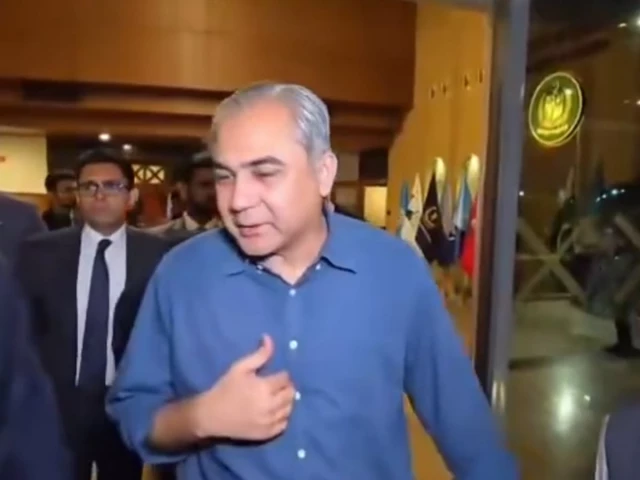
Interior Minister Mohsin Naqvi speaks to reporters in Lahore on Wednesday. SCREEENGRAB
Interior Minister Mohsin Naqvi on Wednesday said the government would complete its constitutional five-year term, asserting that Prime Minister Shehbaz Sharif would remain in office for the full tenure.
Speaking to reporters in Lahore, Naqvi dismissed speculation about the government’s future, saying the current system was “going nowhere”.
“The government will complete its five-year constitutional term,” he said. “Shehbaz Sahib will remain prime minister for five years. People can say whatever they want or interpret my remarks however they like, but he will complete his term as prime minister.”
Read: Governance system has collapsed: Naqvi
Responding to a question about his absence from a cabinet meeting and criticism of his performance, Naqvi said he was answerable only to the prime minister.
“I would request the prime minister to conduct an audit of all ministries and evaluate the performance of each ministry. Whatever the results are, they should be made public so that people can see which ministry is performing and to what extent,” he said, adding that his attendance at cabinet meetings was around 70 per cent.
He said he had not issued a charge sheet against the government, as he himself was part of it.
He also stood by his earlier remarks about the collapse of the system, saying he had been referring to a system that had deteriorated over the past 80 years.
“First of all, I still stand by my view that the system has been destroyed. I was referring to an 80-year-old system that has deteriorated, and I still believe that the system built over these 80 years is broken because if it had been functioning properly, the country would have progressed much further,” he said.
Also Read: If reset is needed for good governance, then it should happen: DG ISPR
He praised Shehbaz’s work ethic, saying the premier worked between 14 and 16 hours a day.
“The point is that if we have a prime minister who works 14 to 16 hours a day and the system improves, the results will be a thousand times better,” he said.
The interior minister said the country had made progress despite difficult circumstances, citing reforms in the Federal Board of Revenue (FBR), improvements brought about by the prime minister and diplomatic achievements.
“Even under the worst circumstances, the prime minister introduced reforms in the FBR, brought about change, we won a war and elevated Pakistan diplomatically. So many reforms have taken place,” he said.
Naqvi said he believed Pakistan could have progressed much faster if the prime minister had inherited a properly functioning system.
“Even today, I believe that if the prime minister had been given a better system, he would have moved the country forward 100 times faster,” he said.
He claimed that many people wished to see his relations with the prime minister deteriorate.
His comments came a week after he called for the creation of additional administrative units or provinces to overhaul what he described as the country’s outdated governance system.
Read More: ‘Better late than never’: Khawaja Asif supports Naqvi’s call for system overhaul
Addressing the Pakistan Economic Summit 2026 in Islamabad, he argued that Pakistan’s existing governance model had effectively “collapsed” after decades of failing to deliver and said decentralisation was essential to improve public services, ensure timely justice and create opportunities for young people.
Inter-Services Public Relations (ISPR) Director General Lt Gen Ahmed Sharif Chaudhry also appeared to support Naqvi’s call the next day, saying an administrative reset, if required, should be undertaken to ensure good governance.
He stressed that any such change must be carried out through constitutional and legal means and in accordance with the will of the people.
“The will of the people of Pakistan is supreme. If good governance requires an administrative reset, then it has to be done through constitutional methods, legal procedures and political representatives,” he said while addressing a press briefing on Friday.
However, when asked whether he agreed with Naqvi’s remarks that the governance system in Balochistan had failed, the DG ISPR declined to comment on the minister’s statement.
Naqvi’s remarks drew mixed reactions, with several Pakistan Muslim League-Nawaz leaders criticising him and describing him as one of the beneficiaries of the existing system.
Among them was PML-N leader and Prime Minister’s Adviser Rana Sanaullah, who questioned how Naqvi could criticise the current political system after rising to the office of interior minister through the same system in just three and a half years.
However, Defence Minister Khawaja Asif, also a PML-N leader, took a different position from his party colleague, saying he largely agreed with the interior minister’s assessment.
“Mohsin Naqvi Sahib expressed his views on the system’s shortcomings. Personally, I largely agree with these views,” the minister said in a post on X.
He, however, said that if the objective was to strengthen the system and bring about fundamental change, the appropriate forum for such a debate was parliament — of which Naqvi is a member — or the federal cabinet.
Calling Naqvi “a highly respected and credible member” of the cabinet, Asif said the interior minister had held some of the country’s most influential positions over the past three and a half years and could have raised or pursued the issue of systemic reform during that period.