For 51 years, Salahuddin has kept analogue broadcasting alive despite parts growing scarce
QUETTA:
In an age when smartphones, streaming platforms, YouTube and podcasts have largely silenced the crackle of traditional radio, one man in Quetta refuses to let the medium fade completely. Salahuddin, known locally as Sheikh Ustad, has been repairing radios continuously for 51 years, preserving a craft that once formed the soundtrack of daily life across Pakistan.
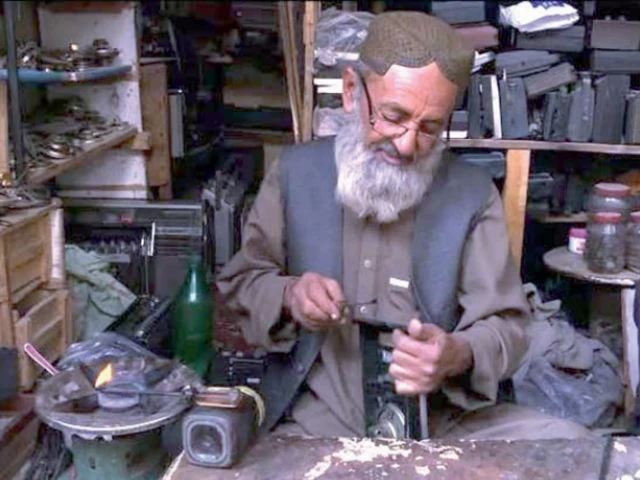
Every day he makes the short journey from his home in Balili to his modest workshop. He first opened for business on 6 February 1975, a time when almost every household, shop and office kept a radio. News bulletins, morning transmissions and popular music filled rooms; a broken set was quickly carried to a skilled mechanic. Today Salahuddin believes he is the last person in Quetta still practising the trade. Customers still travel from across Balochistan, bringing sets that are 40, 50 or even older years old, hoping he can restore them.
Step inside his shop and the modern world seems to slow. Dusty valve radios, transistor sets, tangled wires, soldering irons and carefully sorted spare parts line the shelves. The atmosphere is that of a living museum dedicated to an almost vanished skill. For Salahuddin, the work is far more than a livelihood. It is a craft bound up with more than five decades of personal memory.
Yet the future of that craft looks uncertain. Genuine spare parts and specialised tools have become increasingly difficult to find. After half a century of steady labour, he now watches the tools of his trade disappear. The scarcity causes him genuine sorrow; he feels he is witnessing the slow erasure of a lifetime’s expertise.
Radio once held a privileged place in Pakistani homes. Its voice marked the start of the day, delivered the news, and gathered families around a single set. Digital alternatives have eroded that role, pushing conventional radio listening to the margins. Still, a stubborn affection remains. Some owners treat their old radios as sentimental heirlooms rather than mere machines. Others simply prefer the distinctive sound and simplicity of analogue broadcasting. These devotees keep Salahuddin’s workshop busy.
His story is a quiet counterpoint to the rush of technological change. While the wider world moves on to algorithms and on-demand audio, one craftsman in Quetta continues to coax sound from ageing circuits, determined that the radio’s voice will not fall completely silent.