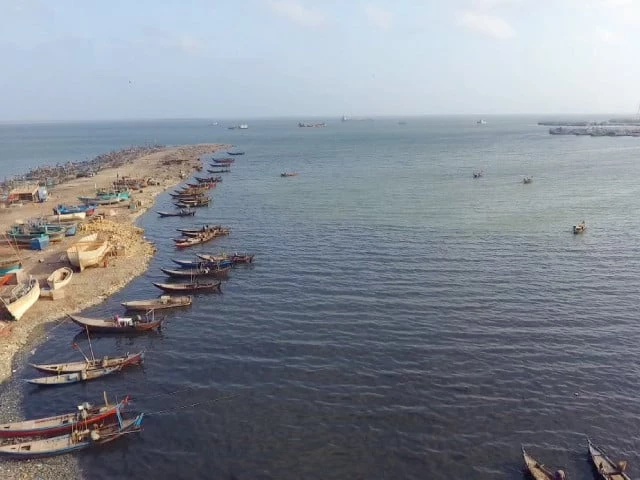
maritime security: A plan to install Vessel Monitoring Systems (VMS) on fishing boats has been finalised to curb illegal activities at sea. photo: express
Qatar will fully resume maritime navigation activities for all types of vessels starting on Sunday, ending a two-week suspension imposed amid heightened security tensions in the Gulf and the Strait of Hormuz.
The transport ministry announced the decision on Saturday in a brief statement posted on X, calling on all entities and individuals to comply with applicable maritime regulations and instructions to ensure the highest levels of safety and security for all sea voyages.
The ministry did not provide further details about the regulations or explain the reason for resuming maritime traffic in full.
The ministry suspended all maritime navigation activities on July 12 amid continuing regional tensions. It had previously halted maritime traffic on June 29 before partially restoring operations on July 5.
During the latest military confrontation between the US and Iran, several shipping companies instructed some vessels to remain outside the Strait of Hormuz because of security concerns linked to the regional escalation.
Iran says progress made in talks with Oman on Hormuz shipping mechanisms
Iran said on Sunday it made progress in talks with Oman on operational mechanisms to ensure the safe passage of ships through the Strait of Hormuz, stressing there has been no change in maritime traffic through the strategic waterway.
Foreign Ministry spokesman Esmaeil Baqaei said several rounds of talks were held in Tehran on Friday and Saturday between Iranian and Omani deputy foreign ministers.
“The two sides exchanged views on common principles and operational mechanisms for the safe passage of ships in the Strait of Hormuz,” Baqaei said, according to the semi-official Fars news agency.
He described the talks as “productive,” saying progress had been made during the discussions.
Baqaei said the Omani delegation left Tehran on Saturday evening, and that technical and political consultations between the two countries remain ongoing.
Iranian army says situation “chaotic and undesirable” for US
General Abolfazl Shekarchi, the spokesperson for Iran’s army, has said the US has failed to achieve its goals “in the Strait of Hormuz and in weakening Iran,” Al Jazeera reported.
“The situation is chaotic and undesirable for America,” he said in remarks quoted by Iranian state TV.
Shekarchi added that the US was looking for a “new strategy” and that the possibility of Washington withdrawing from the war was “conditional on the Zionists’ permission”, in an apparent reference to Israel.
Kuwait condemns Houthi Red Sea attacks, backs Saudi response
The Kuwaiti Ministry of Foreign Affairs has expressed its “condemnation and strong denunciation” of the Houthi attacks against ships in the Red Sea, Al Jazeera reported.
In a statement, the ministry described the attack on the Saudi vessel NCC MASA in the Red Sea on Saturday as a “flagrant violation of international law and a direct threat to the security and freedom of maritime navigation and the safety of international trade”.
The ministry affirmed its “full solidarity” with Saudi Arabia and said it supports “all measures taken by the Kingdom to safeguard its sovereignty and protect its security and interests”.
The attacks followed the Houthis’ declaration of a naval blockade on Saudi Arabia last week, after an attack on Sanaa International Airport.
Riyadh responded by launching strikes on the Houthi-held city of Hodeidah, after which the Yemeni group claimed attacks on Saudi oil facilities.
IRGC threatens UK over support for US attacks on Iran
An IRGC spokesperson has told Iran’s state broadcaster IRIB that “any country, whether the UK, the Gulf Coast countries, or others” would become a “legitimate target” if they support the US in its attacks on Iran, Al Jazeera reported.
The unnamed spokesperson pointed to the UK’s role, claiming that American B-1 bombers used British airports to carry out recent attacks.
“If they cooperate with the US, they will be our definite and legitimate target,” the spokesperson said.
Iran says US bases in Jordan, Kuwait and Bahrain targeted in retaliatory action
Brigadier General Mohammad Reza Akraminia has said Tehran “took action to assert its rights” over the Strait of Hormuz after the “US violated its commitments and tried to create a fake and illegal route in the Strait of Hormuz” against the MoU signed in June.
“In these operations, the Islamic Republic of Iran’s army placed US bases in Jordan, Kuwait and Bahrain – which are considered among the most important bases of this country in the region – at the centre of its operations,” he said in remarks quoted by the Tasnim news agency.
Kuwait denies involvement in US attacks on Iran
Kuwait’s ambassador to the US has denied a Wall Street Journal report claiming that the Gulf state sent fighter jets to attack Iran, Al Jazeera reported
Ambassador Sheikha Al-Zain Al-Sabah wrote to the newspaper’s editorial board to reject the report, calling it “utterly and completely baseless”, according to the official Kuwait News Agency.
“She affirmed that Kuwait has not participated in any military operations against Iran and has not allowed the use of its territory, airspace, or territorial waters to launch offensive operations,” it said.
The Wall Street Journal reported on Friday that Kuwait and Bahrain sent fighter jets to strike sites inside Iran after Tehran launched missile and drone attacks on what it described as US military assets in the Gulf countries. Iran said the attacks were in retaliation for the US’s strikes on its cities.
Trump reportedly pauses further US strikes on Iran after 13 days
US President Donald Trump has reportedly decided to pause plans for further strikes on Iran following 13 consecutive days of attacks, The New York Times and Axios reported, according to the Al Jazeera.
The New York Times, citing Trump administration officials, said the decision was driven by concerns that an escalation could “dangerously drain the Pentagon’s already diminished stockpile of Patriot antimissile interceptors and other air defense munitions in the Middle East”. The report said the decision followed a meeting between Trump, his senior advisers and cabinet members on Friday.
Axios, citing two anonymous sources familiar with the matter, reported that it remains unclear whether the pause is temporary or marks a broader halt to US strikes. The outlet said the decision “reflects both his willingness to provide more space for diplomacy and a recognition that — short of a return to major combat operations — the current level of US strikes has reached the limit of its effectiveness”.
According to Axios, the US military is also preparing contingency plans for a possible return to major combat operations.
US says naval blockade against Iran remains in effect
A US naval blockade against Iran remains in full effect, the US military’s Central Command (CENTCOM) said on Saturday.
As of July 25, US forces had redirected 12 commercial vessels attempting to breach the blockade, disabled two that failed to comply and boarded two others to verify compliance, CENTCOM said in a statement on X.
US forces completed a verification boarding of the Comoros-flagged oil tanker M/T Charminar in the Arabian Sea earlier Saturday, after which the vessel continued its journey, according to the command.
The U.S. naval blockade against Iran remains in full effect. As of July 25, CENTCOM has redirected 12 commercial vessels trying to run the blockade, disabled 2 that didn’t comply, and boarded 2 to ensure total compliance.
Earlier today, U.S. forces completed a verification… pic.twitter.com/eyp1N2B9sO
— U.S. Central Command (@CENTCOM) July 25, 2026
CENTCOM also said US forces disabled the Mozambique-flagged M/T Lavine in the Gulf of Oman on Friday after its crew repeatedly attempted to violate the blockade and ignored multiple warnings.
The vessel is no longer heading toward Iran, it added.
Iranian army claims “almost all” US infrastructure in Iraq’s Erbil destroyed
The Iranian army claimed on Saturday that “almost all” US military infrastructure in Iraq’s Erbil had been destroyed during the recent conflict and said Tehran was now deploying attack drones more advanced than the Arash-2.
Speaking to Iranian state television, army spokesman Brig. Gen. Mohammad Reza Akraminia claimed Iran had inflicted serious damage on US military bases across the region, saying many of them had lost much of their operational capability.
He claimed that “almost all” US infrastructure in Erbil had been destroyed and that anti-Iran groups operating there were no longer capable of carrying out operations.
Akraminia said the US possessed extensive military capabilities, equipment and bases across the region, as well as in southern Europe and the Mediterranean, and was attempting to replace its losses.
He warned that Iran was prepared to continue military operations if the conflict resumed “until the Americans realise they cannot impose their will on the Iranian nation through aggression.”
The spokesman also claimed that while the Iranian military used Arash-2 drones during the 40-day war, it is now deploying newer drones with greater destructive power, accuracy and range. He said details of the new drones have not yet been made public.