
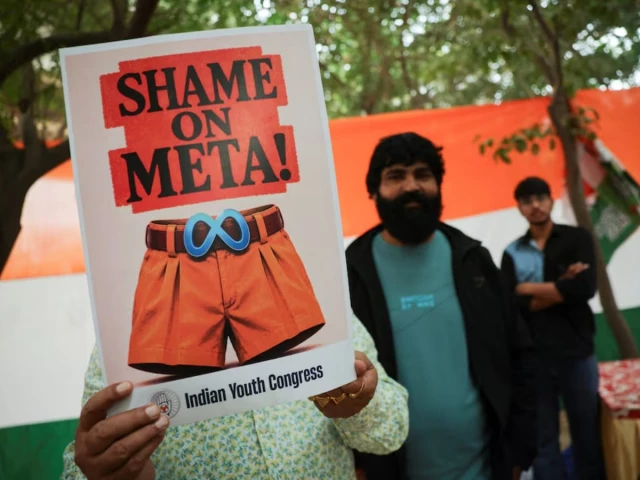
Congress youth activists protest outside Meta offices, accusing it of favouring Modi’s BJP in India
A member of the youth wing of India’s main opposition Congress party holds a placard and attends a protest against Meta’s removal of some accounts and posts of party members, near Meta’s office in Gurugram, India, November 28, 2026. REUTERS
Police in the northern Indian state of Haryana used a water cannon to disperse activists from the main opposition Congress party protesting outside Meta’s offices over allegations that the company is censoring opposition voices.
Activists from the youth wing of the Congress party have staged massive protests outside Meta offices, accusing the company of acting in the interests of Prime Minister Narendra Modi’s Bharatiya Janata Party, in what has become one of the Facebook and Instagram parent’s biggest challenges in its largest market by users.
Meta says that it restricts content in India in accordance with local laws. The company has not commented publicly on the protests, but in a closed-door meeting with Congress has conveyed that it remains neutral towards all political parties, according to people familiar with the matter.
Read More: What is Modi’s automated takedown law, which has embroiled Meta in a political storm?
The opposition party’s youth wing has sued Meta and the Indian government, seeking to strike down a rule that has sharply expanded content restrictions by requiring automated sweeps to remove copies of posts flagged in individual takedown orders.
Congress’ youth wing posted on X that its party activists were hit with a water cannon and drenched with “filthy” water by police during a protest outside Meta’s office in Gurugram, accusing the government of using force against demonstrators demanding freedom of expression.
#BREAKING: What could be more shameful than a government turning filthy water and police force against its own young people?
Youth Congress President @UdayBhanuIYC ji and IYC workers were met with water cannons and drenched in filthy water by the BJP’s police outside META office… pic.twitter.com/v6xHxKmbWP
— Indian Youth Congress (@IYC) November 28, 2026
Police detained a few party supporters, but they were later released, a Reuters witness said.
Congress, the main opposition party to Modi’s government, says the content restrictions put it at a disadvantage ahead of state elections next year, when Facebook and Instagram are expected to be key campaigning platforms.