CM Azar says the exemptions, secured from the federal govt, would benefit traders and the wider public
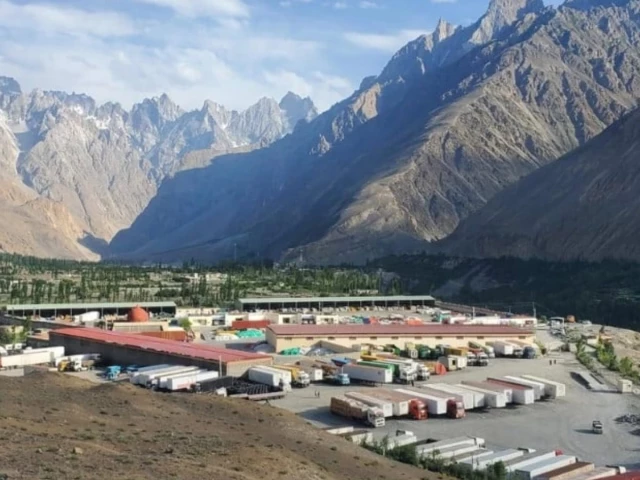
A view of shipments at Sost Dry Port from China. Photo: Express/Ibrar Khan
GILGIT:
Gilgit-Baltistan (G-B) Chief Minister Amjad Hussain Azar formally launched the Gilgit-Baltistan Traders’ Registration and Tax Exemption System (GB-TERS), an online platform aimed at facilitating local traders in accessing tax exemptions on goods imported from China.
Speaking at the inauguration ceremony, the chief minister said, “The exemptions, secured from the federal government, would benefit traders and the wider public in G-B.”
The arrangement follows an agreement reached in September 2025 after a 68-day protest by traders at Sost Dry Port. The protest blocked the Karakoram Highway, disrupting trade between Pakistan and China through the Khunjerab Pass.
Under the agreement, goods imported through Sost for local consumption in G-B are exempt from sales tax, income tax and federal excise duty, subject to eligibility criteria and an annual exemption ceiling of Rs4 billion.
Read: PPP wants provincial status for G-B: CM
CM Azar said the provincial government had introduced a transparent online system to ensure fair access to the exemptions, simplify the registration process and prevent discrimination.
He highlighted that the applicants must operate a registered firm or partnership to qualify for the exemption.
“The scheme is intended to support local traders and residents while boosting economic activity in the region,” the chief minister stated further.
Pakistan People’s Party-backed CM Azar also directed the provincial secretary for minerals and industries to urgently prepare proposals for establishing a trade-free zone in Gilgit to facilitate local and international traders.
“The provincial government would establish the zone using its own resources.”
The relief package
The federal government approved a tax relief package for G-B in September last year, allowing duty- and tax-free imports of hundreds of items through the Sost Customs Dry Port, subject to an annual exemption ceiling of Rs4 billion.
The Federal Board of Revenue (FBR) introduced the facility through a notification issued under the Customs Act 1969, Sales Tax Act 1990, Federal Excise Act 2005 and Income Tax Ordinance 2001.
Read more: Traders end 68-day sit-in at Pak–China border after deal with government
Under the rules, only goods imported through the Silk Route Dry Port at Sost and falling under specified Pakistan Customs Tariff codes are eligible for the exemption. The facility covers sales tax, income tax and federal excise duty, provided each consignment has online authorisation from the notified Gilgit-Baltistan government authority and the importing firm is wholly owned by individuals holding G-B domicile.
The exemption is granted on a first-come, first-served basis, with all subsequent imports becoming taxable once the annual limit is exhausted.
The rules also require the provincial government to ensure that goods imported under the scheme are consumed within the region.