Reaffirm consensus and agree on a framework for future cooperation under Commission
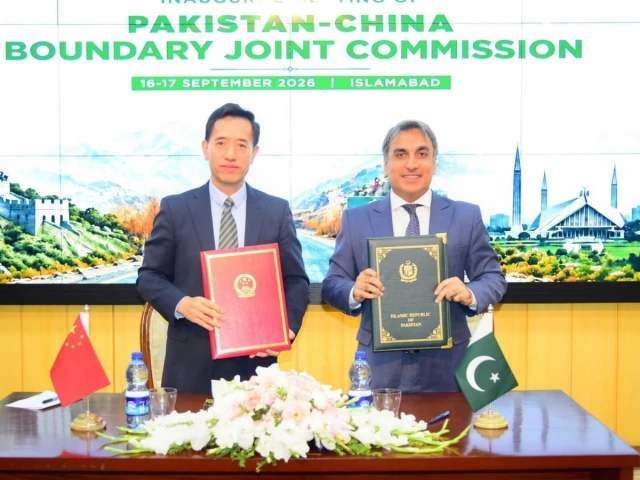
Bilal Mahmood Chaudhary, Director General (China) at the Ministry of Foreign Affairs, and Li Ya, Deputy Director General of the Department of Boundary and Ocean Affairs at China’s Ministry of Foreign Affairs, pose for a photograph after signing the minutes of the inaugural Pakistan-China Boundary Joint Commission meeting in Islamabad. Photo: FO
Pakistan and China have reaffirmed their consensus and agreed on a framework for future cooperation under the Pakistan-China Boundary Joint Commission (BJC), the Foreign Office said on Thursday.
The inaugural meeting of the commission was held in Islamabad on Sept 16-17, formally activating a mechanism envisaged under a 2013 boundary management agreement between the two countries, the ministry said in a statement.
“Both sides described the establishment of the Commission as a vital milestone in further strengthening the Pakistan-China All-Weather Strategic Cooperative Partnership,” the statement said.
The FO said discussions at the inaugural meeting covered a wide range of matters related to border management and cooperation, including cross-border coordination, movement of goods and people, joint border surveys and people-to-people linkages.
The meeting concluded with the signing of minutes to reaffirm the mutual consensus and set out the framework for future cooperation under the commission, it added.
“Both sides agreed to hold the next meeting of the commission in China at mutually convenient dates,” the FO said.
The two-day inaugural meeting of the Pakistan-China Boundary Joint Commission concluded today with a signing ceremony at the Ministry of Foreign Affairs, Islamabad. Both sides signed the minutes, reaffirming their consensus and setting out the framework for future cooperation. pic.twitter.com/jr4srpDi7k
— Ministry of Foreign Affairs – Pakistan (@ForeignOfficePk) September 17, 2026
The Pakistani delegation was led by Bilal Mahmood Chaudhary, director general (China) at the Ministry of Foreign Affairs, while the Chinese delegation was led by Li Ya, deputy director general of the Department of Boundary and Ocean Affairs of the Ministry of Foreign Affairs.
Senior representatives from various ministries and departments participated from both sides, including the ministries of foreign affairs, defence, interior, commerce and communications, as well as relevant customs, survey and other boundary management authorities.
India rejected the Pakistan-China Boundary Joint Commission, saying the commission lacked a legal basis and that no boundary existed between Pakistan and China.
Responding to the objections, Foreign Office spokesperson Sajjad Haider Khan rejected India’s assertions at his weekly news briefing.
“Pakistan categorically rejects India’s baseless and legally untenable assertions concerning the Pakistan-China Boundary Agreement of 1963 and the Pakistan-China Boundary Joint Commission,” he said.
“China is not only our neighbour but also an all-weather strategic cooperative partner. Our ironclad friendship has withstood the test of time,” he added.
The spokesperson said the 1963 agreement was a valid arrangement concluded between Pakistan and China.
He said India’s claims regarding Jammu and Kashmir were equally untenable, as the region remained an internationally recognised disputed territory whose final disposition was to be determined in accordance with United Nations Security Council resolutions and the aspirations of the Kashmiri people.
“This is to be done through a UN-led process, under the auspices of the United Nations, through a plebiscite,” he said.
Haider criticised India’s assertion, saying it was a “mockery of international law” for India to speak of legality while challenging the validity of the Boundary Joint Commission.
“India must carry out its own introspection, especially regarding its illegal and unilateral decisions of 5 August 2019,” he said.
He called on India to rescind what he described as illegal decisions, saying they were “in utter violation of the UN Security Council resolutions”.
“Instead of advancing fictitious territorial claims, India should end its illegal occupation of Jammu and Kashmir and faithfully implement the UN Security Council resolutions,” the spokesperson said.