
US air power stationed at land bases below March levels despite more than 200 aerial refuelling aircraft present
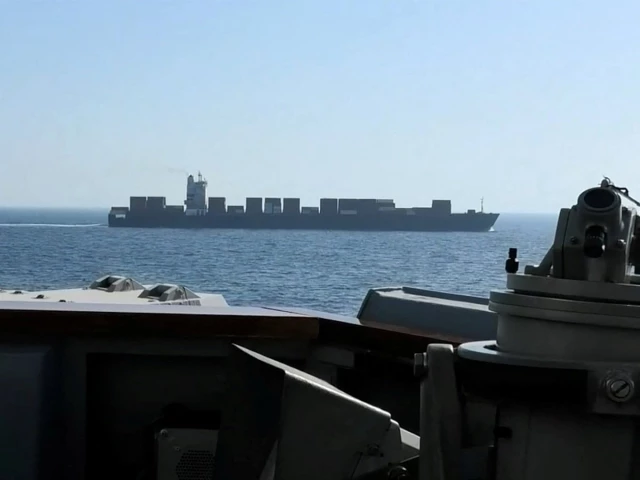
A view of Iranian-flagged cargo ship M/V Touska as the US Navy Arleigh Burke-class Aegis guided missile destroyer USS Spruance conducts its interception in a location given as the north Arabian Seaon April 19, 2026. Photo: Reuters
The current US naval presence in the Middle East region exceeds the level recorded during the peak of the US-Israeli war on Iran in February and March, an Israeli security institute said on Tuesday.
The Institute for National Security Studies (INSS) said in a statement that it compiled open-source data on the current number of US forces and naval vessels deployed in the Gulf, the Arabian Sea, the Red Sea and the Mediterranean.
“The current US naval presence exceeds the size of the forces deployed during Operation Epic Fury, providing greater offensive capabilities and broader missile-interception capacity,” the institute said.
It did not provide a figure for the current number of US forces or naval vessels deployed in the region.
The US and Israel launched a war against Iran on February 28, while Tehran responded with attacks on Israel and what it says are US military facilities in Arab countries.
According to an interactive map published by the institute, US aircraft carriers George Washington, George H.W. Bush and Theodore Roosevelt are currently deployed in the region, along with several other military vessels.
On November 9, US President Donald Trump said the war in Iran “militarily is effectively over,” adding that the “history’s greatest Naval Blockade” would remain in place to exert economic pressure on Tehran.
Read: Iran claims drone attack on US radar system at Bahrain air base
Despite the presence of more than 200 aerial refuelling aircraft in the region, US air power stationed at land bases remains below March levels, according to the institute.
“Aircraft have been repositioned farther west within the Middle East or transferred to Europe, reflecting the vulnerability of forward bases to Iranian attacks,” it said.
“However, aircraft can be redeployed much more quickly than naval forces, meaning the balance of air power in the region could change rapidly,” the institute added.
Washington and Tehran signed a memorandum of understanding in June, but its implementation stalled amid disagreements over guaranteeing freedom and security of navigation in the Strait of Hormuz, a strategic route for energy supplies and goods.
Since July, confrontations between the US and Iran have periodically resumed despite continued diplomatic efforts to end the conflict, which has had significant economic and political repercussions across the region and internationally.
Washington and Tel Aviv accuse Tehran, without evidence, of maintaining nuclear programs that threaten Israel and regional countries allied with the US, while Iran maintains its nuclear program is for peaceful purposes.


