Meeting expected to focus on postwar strategy as US president’s administration works on day-after plan
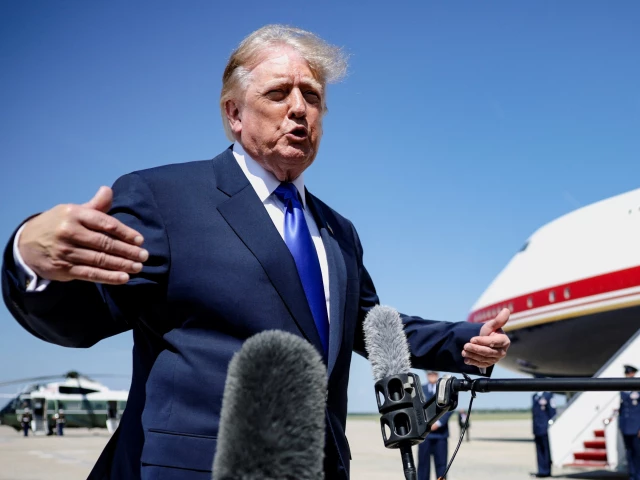
US President Donald Trump speaks to the media before boarding Air Force One for a trip to the Republican National Midterm Convention, at Joint Base Andrews, Maryland, US September 9, 2026. Photo: Reuters
US President Donald Trump is expected to meet with Gulf leaders on the sidelines of the UN General Assembly in New York next Tuesday to discuss next steps in the war with Iran, the Axios news site reported Wednesday, citing, but not naming, three sources with direct knowledge.
Axios said the meeting is expected to focus on US ideas for a postwar strategy, with the Trump administration working on a broader “day-after” plan expected to be finalised after the US midterm elections in November.
Leaders or foreign ministers from the Gulf Cooperation Council countries — Saudi Arabia, the United Arab Emirates, Qatar, Bahrain, Kuwait and Oman — are expected to attend, according to the report.
The meeting could expand to include other Arab and Muslim leaders, it added.
The State Department sent initial invitations Wednesday, Axios reported.
Read: Iran’s Araghchi says new regional order should exclude foreign forces
Israeli Prime Minister Benjamin Netanyahu also wants to meet with Trump in New York, but no meeting has been scheduled, according to the report.
South Korean foreign minister leaves for crucial US visit amid Hormuz pressure
South Korea’s top diplomat, Cho Hyun, flew out for a three-day visit to Washington on Thursday for talks with Secretary of State Marco Rubio, expected to focus on bilateral economic and security arrangements, North Korea, and the raging Middle East conflict, local media reported.
Cho is scheduled to hold talks with Rubio on Friday, US time, Seoul-based Yonhap News reported, citing the country’s Foreign Ministry.
“We will have in-depth discussions on various pending issues between the two nations, as well as consultations on issues concerning the Korean Peninsula, regional affairs and the international situation,” Cho told reporters before departing from Incheon International Airport, west of Seoul.
The meeting comes as Seoul and Washington have differing positions on a slew of outstanding issues, notably South Korea’s role in securing the near-closed Strait of Hormuz and its US-bound investment plans.
US President Donald Trump has been pressuring Seoul to contribute to efforts to restore freedom of navigation through the strategic waterway.
Squeezed by opposition at home and warnings from Iran, President Lee Jae Myung’s government is weighing whether to deploy military assets to the region.
“Our position remains that no decision has been made yet, and we are reviewing all relevant factors. In doing so, we will prioritise international cooperation while giving foremost consideration to the safety of our people and freedom of navigation through the Strait of Hormuz,” Cho said.
The two nations also have yet to finalise details of an agreement under which South Korea has pledged to invest $350 billion in the US in return for lower tariff rates.
Trump hopes Iran war nearing end as Houthi-Saudi fighting escalates
Trump said he hoped an end to the war against Iran was near, as the conflict, in its seventh month, escalated with Saudi aircraft pounding Yemen and Houthi fighters launching drones and missiles at Saudi cities.
The Iran-backed Houthis’ lightning advance in Yemen along the Red Sea and their attacks on Saudi Arabia, along with attacks that damaged Saudi Arabia’s East-West oil pipeline, have extended Tehran’s reach in the war and heightened global oil-supply risks.
As the war expands into a new theatre, the United States tightened its travel warning for Saudi Arabia, banning government employees from travelling within 20 miles (30 km) of the Yemen border.
Still, just hours after reports of the Houthis and Saudi Arabia fighting, Trump told reporters on Wednesday evening: “Well, hopefully we are towards the end of the war.”
Trump says Iran wants deal, oil still elevated
“They want to make a deal. We’ll see how that works out,” he said, referring to Iran, reiterating past comments. Trump also said he had heard from Iran “directly”, without elaborating.
Trump has offered shifting goals and timelines for the war that began on February 28, when the US and Israel attacked Iran and Tehran struck Israel and US bases in Gulf states.
The extension of the war into Yemen threatens to worsen the global energy-supply shortage caused by the war, which has disrupted shipping through the Strait of Hormuz. The strait carried about 20% of global oil and LNG before the conflict.
Read more: Ministry finds LPG price exploitation
Traders say a prolonged closure of Saudi Arabia’s East-West pipeline could cut off as much as 4% of global oil supply. Saudi Arabia has not said when operations might resume.
The price of Brent crude hovered around $108 a barrel on Wednesday, close to its highest levels since May. The politically sensitive average retail price of diesel fuel in the US hit another all-time high, above $6.30 a gallon for the first time.
But oil prices fell in early Thursday trade as reports of Saudi Arabia offering extra crude cargoes through Oman reduced fears of supply disruptions in the Middle East.
Brent crude futures dropped $1.24, or 1.2%, to $104.59 a barrel by 0049 GMT, while US West Texas Intermediate futures were down $1.14, or 1.1%, at $101.29.
The rise in oil and gas prices due to the US-Israeli war on Iran has become a major issue for Trump’s Republican Party in the lead-up to November midterm elections.