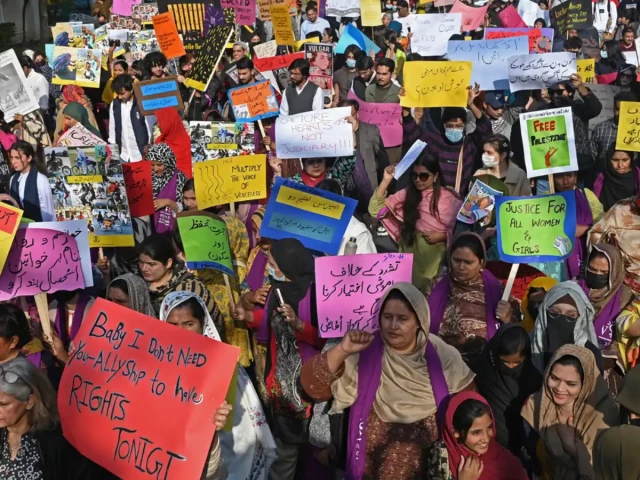
FILE: Activists of ‘Aurat March’ group take part in a rally to mark Pakistan’s National Women’s Day, in Lahore on February 12, 2025 PHOTO: AFP
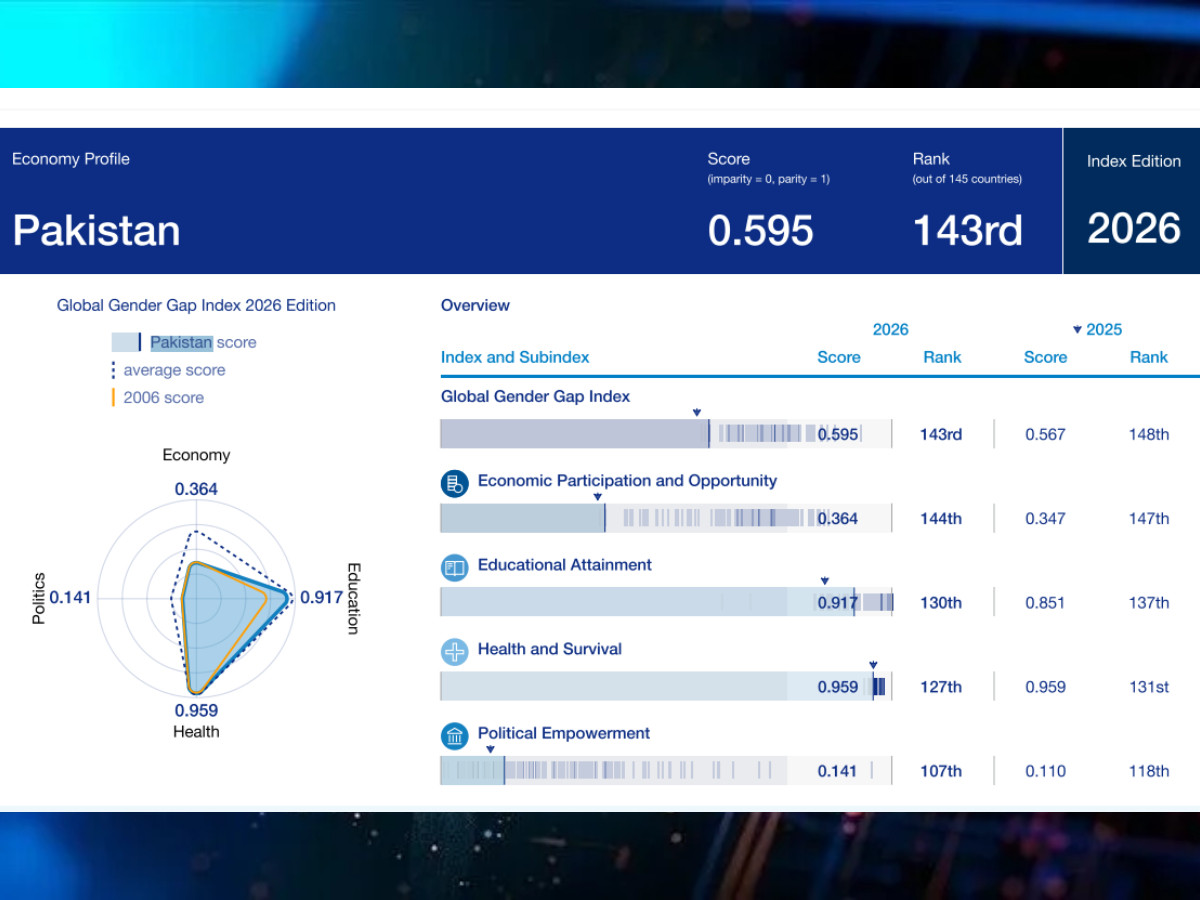
Pakistan has climbed to 143rd out of 145 economies in the World Economic Forum’s (WEF) Global Gender Gap Index 2026, with the country closing 59.5% of its gender gap after a slight overall improvement was recorded in education and political sectors.
Last year, Pakistan attained the lowest score among 148 countries scored by the WEF on gender mainstreaming.
According to the WEF’s latest Global Gender Gap Report, Pakistan registered an improvement of 2.8% compared to its last year’s score of 56.7%. The country’s score has risen by 5.2 percentage points since the index was first published in 2006, when Pakistan stood at 54.3%.
The report said, “The 2026 edition marks its strongest year-on-year improvement in a decade [for Pakistan], driven primarily by substantial gains in Educational Attainment.”
It also said that Economic Participation and Opportunity remained Pakistan’s “weakest-performing subindex and the principal constraint” on overall gender parity.
Compared to other South Asian countries, Pakistan ranked last on the gender gap index in the region despite the registered slight improvement. India ranked second last in the region while Bangladesh assumed the regional lead with its 79th overall rank.
Pakistan remains among the five lowest-ranked economies globally, ahead of only Algeria, the Democratic Republic of the Congo, Iran and Chad in the 2026 ranking.
Education emerges as the strongest area
In global rankings, Pakistan leads the world in terms of female enrolment in tertiary education.
Pakistan’s Educational Attainment score jumped to a record 91.7%, up by more than six percentage points from the previous edition. The improvement has been substantial over the longer term as well. Pakistan’s education parity score has risen from 70.6% in 2006 to 91.7% in 2026, a gain of 21 percentage points.
The WEF said improvements across primary, secondary and tertiary enrolment have been the principal driver of Pakistan’s progress in the overall index, with parity across these education indicators increasing by about 20 percentage points over the past two decades.
The sharp improvement in education contrasts with Pakistan’s continuing difficulties in translating gains in schooling into greater participation in the economy.
Economy remains Pakistan’s biggest gender gap
Pakistan recorded a score of just 36.4% in Economic Participation and Opportunity, placing it 144th globally and last in South Asia.
The score nevertheless increased by 1.6 percentage points from the previous edition.
The WEF estimates that Pakistan has the “eighth-largest workforce gender gap” among the economies covered by the index. Gender parity in labour-force participation stands at only 34.6%.
Read: Pakistan ranks last in Global Gender Gap Index 2025
Women account for 44.9% of professional and technical workers, but their representation falls sharply in senior positions. Women constitute just 6.5% of legislators, senior officials and managers, although the WEF notes that the latter’s proportion had tripled over time.
The estimated earned-income parity score is even lower, at 26.3%. The report says this measure has actually declined by 7.7 percentage points since 2006, highlighting the persistent gap between women and men in economic returns.
Political representation shows improvement
Pakistan’s Political Empowerment score rose to 14.1%, placing the country 107th globally and fourth in South Asia.
Compared with the previous edition, parity in parliamentary representation increased by 7.1 percentage points, while parity in ministerial representation rose by 3.6 percentage points.
However, Pakistan’s scores in both areas remain below their historical peaks.
The WEF also notes that the country’s head-of-state indicator has remained at 0.104 since 2010, as the country only saw Benazir Bhutto as the country’s only legislative leader for two separate office terms.
Health gap remains comparatively narrow
Pakistan performed considerably better on Health and Survival, recording a gender parity score of 95.9%.
The country ranked first on the index in terms of sex ratio at birth, which stood at a remarkable 94.4%.
The WEF said the subindex has improved by 0.8 percentage points since 2006, with the long-term change attributed to better parity in healthy life expectancy.
Currently, Pakistan ranks 135th among all the countries analysed by the WEF.
A question of real progress?
Pakistan’s latest result marks a notable improvement from its position in the 2025 report, when it ranked 148th out of 148 economies. The result had represented a second consecutive decline from Pakistan’s 2023 score of 57.7%.
The 2026 figures therefore represent a reversal of that recent decline. But the country’s performance remains uneven: education and health show substantially higher levels of gender parity, while economic participation remains particularly weak.
Globally, the WEF estimates that 69.2% of the gender gap has been closed across the 145 economies included in the 2026 index. No economy has yet achieved complete gender parity.
Iceland, which assumed the top spot in the latest index, scored 93%, followed by Finland 87.2%, Norway 85.7%, Namibia 84.5% and the United Kingdom 84.2%.
Meanwhile, the United States ranked 47th on the list, Israel 71st, China 96th, Saudi Arabia 137th, and Iran 144th.