ISLAMABAD:
Within days of the US and Israeli strikes on Iran in late February, officials from key Muslim countries, including Pakistan, Saudi Arabia and Turkey, were already scrambling to assess the potential fallout.
As the bombing continued and it became increasingly clear that neither Iran’s regime nor its core security structures were going to collapse, the focus among regional powers shifted to what could come next.
The fear was simple: a wider regional conflagration that could engulf countries far beyond the immediate battlefield.
It was against this backdrop that the idea of Muslim countries joining hands to protect their collective interests began to take shape.
“In the current situation, we… Pakistan, Saudi Arabia and Turkiye… will have to work together,” a senior diplomat had told The Express Tribune several months ago, when discussions about what eventually became the Makkah defence arrangement were still in their infancy.
The diplomat, who spoke on condition of anonymity, had also predicted that Pakistan, Saudi Arabia and Turkiye would eventually have to speak to Iran together.
That prediction materialised on Monday when Chief of Defence Forces and Chief of Army Staff Field Marshal Asim Munir, Saudi Defence Minister Prince Khalid bin Salman and Turkish intelligence chief Ibrahim Kalin travelled to Tehran for an unprecedented meeting with the Iranian leadership.
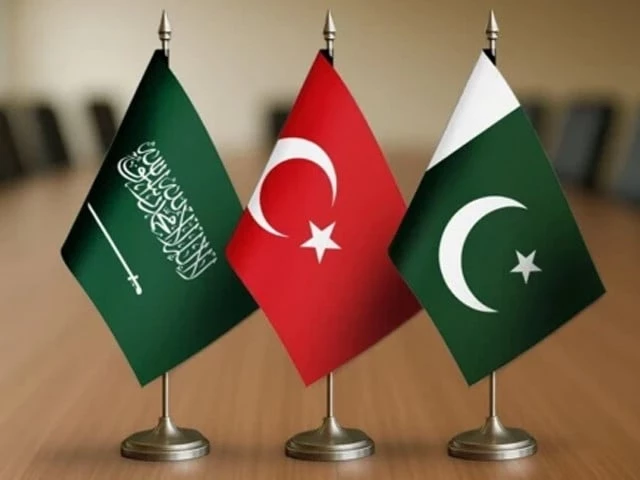
The gathering brought together the three members of the Makkah Joint Defence Agreement and Iran at a time when the region remains on edge. The pact, signed in August by Pakistan, Saudi Arabia and Turkiye, provides that an armed attack on one member would be treated as an attack on all.
But the significance of the Tehran meeting went beyond the formal defence arrangement.
Diplomatic sources familiar with the discussions described the atmosphere as “very cordial and positive”, saying Pakistan had played a key role in bringing the Makkah defence partners and Iran to the same table.
“This would not have been possible without Pakistan’s effort,” one source said.
While details of the discussions were kept closely guarded, the talks were described as having gone “very well”. The decision to continue dialogue in the same format was seen as an important development, particularly given the competing interests of the four countries.
The Saudi decision to send its defence minister to Tehran was considered particularly significant.
For Riyadh, the timing could hardly be more sensitive. The kingdom is facing growing security concerns linked to Yemen, where Houthi attacks have intensified. The issue has become one of the major concerns for Saudi Arabia and was expected to figure prominently in the discussions with Tehran.
Iran, meanwhile, has consistently argued for a regional security mechanism that does not depend on outside powers. Iranian officials have framed such efforts around the concept of “endogenous security” for the region.
The Tehran meeting came amid renewed fears of another round of US military action against Iran and growing tensions across the Middle East.
For Pakistan, Saudi Arabia and Turkiye, the immediate challenge was therefore to establish a channel with Tehran before the situation spiralled further.
The discussions, according to the diplomatic sources, produced some understandings and commitments. But there was also recognition that reaching an understanding was only the beginning.
“The real test is implementation,” one source cautioned.
The four countries, however, are coming to the table with very different concerns.
For Saudi Arabia, the immediate worry is Yemen and the threat posed by Houthi attacks. Riyadh wants greater security along its southern flank and has little interest in seeing the conflict in Yemen spill over again.
Iran, meanwhile, remains deeply wary of regional security arrangements involving Saudi Arabia and Turkiye, particularly when those arrangements are being backed by Pakistan and carry a collective-defence component.
That makes the Pakistani role somewhat unusual.
Islamabad has close defence ties with Riyadh and Ankara, but it has also maintained working relations with Tehran. Pakistan shares a border with Iran and has tried to keep communication channels open even during periods of serious tensions between Iran and Saudi Arabia.
Those relationships gave Islamabad some room to manoeuvre.
The objective, according to the sources, was not to bring the four countries together around a common position on every regional dispute. It was to get them talking directly, particularly at a time when the possibility of another US-Iran confrontation is raising concerns across the region.