Prices have surged since October 17, when two Iranian border crossings closed, halting imports, according to traders
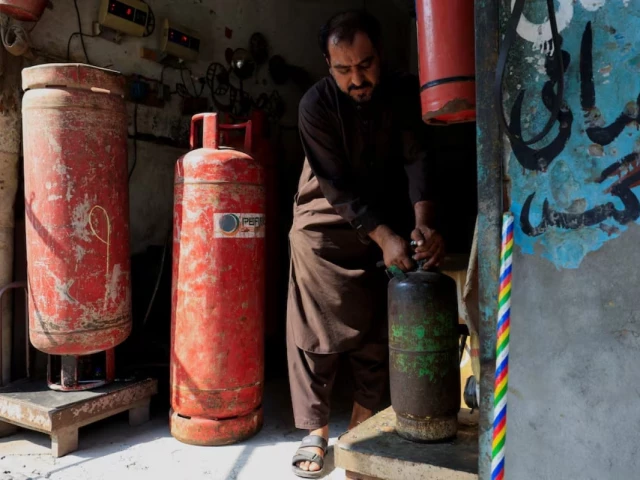
Hameed Khan, 40, fills a cylinder with liquefied petroleum gas (LPG) at his shop in Lahore, Pakistan, October 30, 2026. REUTERS
For 13 years, Rashid Ali has driven a three-wheeled motorised rickshaw around Lahore.
His day starts at 6am and sometimes does not end until midnight, but he was long able to make $6.50 a day — enough for his family’s bare essentials. Now, with liquefied petroleum gas (LPG) prices surging, he doesn’t even make half that.
Ali, 33, is among thousands of Pakistani drivers who run their vehicles on LPG, which is sold in cylinders and mainly used for cooking and heating.
Majeed Ghauri, chairman of the Awami Rickshaw Union, calls it “the fuel of the poor”. He said about 70% of its members’ 43,000 auto-rickshaws and nearly 8,000 Qingqis — motorcycle-based three-wheelers that carry several passengers on set routes — run on LPG.
Read: LPG hits Rs550/kg as price spiral deepens
Regional tensions are hitting Pakistani households. Cooking gas prices have risen after the closure of key border crossings with Iran. Pakistan relies heavily on imported LPG, and Iran is one of its biggest suppliers. pic.twitter.com/WVgfGp7MOW
— TRT World (@trtworld) November 3, 2026
LPG prices have surged since October 17, when two Iranian border crossings closed, halting imports, traders say, in the latest energy shock since the US-Iran war began in February.
With Ali now lucky to make $3 a day, his family has cut back on meals, eating only twice a day.
“Previously, when LPG was cheap, we could earn a decent income,” Ali said. “Now, it’s just not possible to get by on seven or eight hundred [rupees], is it?”
Before the border closures, Pakistan imported about 7,000 metric tonnes of LPG a day from Iran, the Pakistan LPG Association said.
Traders said the price of a 12-kg cylinder jumped 56% within days of the closure to Rs7,000 or about 583 rupees per kg in the open market.
The Balochistan government cited security and smuggling for the decision, while Iran’s foreign ministry said technical issues were to blame. Iran’s ambassador later said Iran had imposed no restrictions, including on LPG exports, and blamed changes in Pakistan’s import paperwork.
Read More: Iran ships some LPG, jet fuel despite US blockade, data shows
Walking away
Ali pays Rs600 a day to rent his rickshaw, filling up with gas four or five times a day, at Rs300 to 400 a time.
As well as daily expenses, Ali also pays Rs11,000 a month for his home and has two young children to support.
Adding to his problems, passengers, he said, do not want to pay higher fares.
“For a trip that should cost Rs200 or 250, they might only offer Rs80, 100, or 150,” Ali said.
Passenger Mohammad Ramzan said when a driver asked Rs500 for a ride in the city, he offered half that. When the driver declined, he walked away, he said.
Inflation hit 9.6% in October, and the central bank last week raised interest rates to 12%, citing energy and wheat prices. Petrol hit a record Rs458 per litre on April 3 and remains about 40% above its pre-war price.
Back home at midday, Ali said his two boys still needed their lunch. He would go out again until late at night, he said, hoping to make enough to bring something for the children to eat at night.