Naqvi says ‘not everything will change in single day’ as first time in two years Centre and province are on same page
Khyber-Pakhtunkhwa (K-P) Governor Faisal Karim Kundi and Interior Minister Mohsin Naqvi on Monday called for closer Centre-province coordination against terrorism as K-P held its first Apex Committee meeting after the imposition of emergency measures and governor’s rule.
A day earlier, Kundi had convened the first Apex Committee meeting after the federal government formed an 11-member advisory council to oversee administrative affairs in K-P. The K-P governor also chaired the advisory council’s inaugural meeting, where he said the state was determined to rid the province of terrorism.
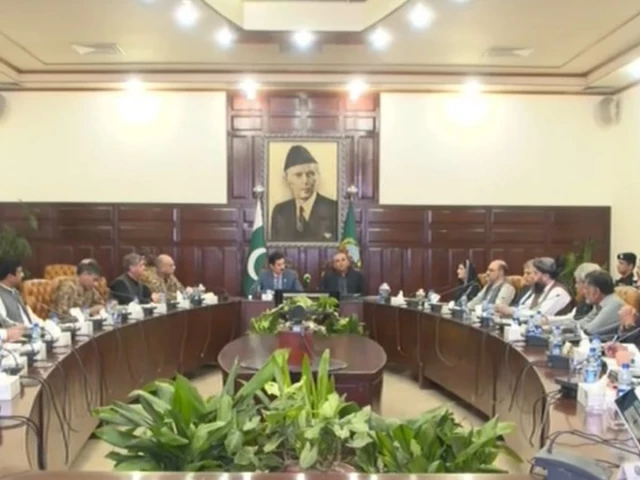
Today, Governor Faisal Karim Kundi and Interior Minister Mohsin Naqvi co-chaired the provincial Apex Committee meeting at Governor’s House, which was attended by members of the Advisory Council and senior officials.
“There are many other issues, but our first priority is to eliminate terrorism. We can sacrifice development, but we cannot compromise on security,” Kundi said, calling for greater coordination between the federal and provincial governments and stronger support for law enforcement agencies.
He said the police and the Counter-Terrorism Department (CTD) needed the resources and facilities required to confront terrorist threats. “We have to fulfil their demands because they are our frontline force,” he said.
“We should focus on result-oriented measures, not cosmetic steps to show that we are working for peace. Fewer things may be done, but the results should be visible,” he added
Kundi further stated that people in the province wanted “peace, development and prosperity,” but insecurity had prevented many from living freely and travelling without fear.
“They see people elsewhere living freely, conducting business and going about their lives. We have to create the same conditions here,” he said.
According to Kundi, lasting peace would also help attract investment and support economic activity, pointing to the province’s natural resources, agriculture, energy potential and tourism opportunities.
He called for close coordination between the federal and provincial administrations, saying the government would continue working through the relevant committees to address security gaps and ensure that institutions worked together.
“There should be no situation in which we are not on the same page,” he said.
Naqvi addresses Apex Committee
Naqvi said the meeting marked the first time in two-and-a-half years that he could confidently say “the federal and provincial governments are on one page.”
“The hardest task was faced by the people who were fighting this war. There were times when people would not even attend the funerals of those who had been martyred,” he said.
Naqvi paid tribute to security personnel who “fought terrorists even without the necessary support from the government” and said that a government had to lead the fight against terrorism rather than leave security forces to carry the burden alone.
“No matter how many resources you provide, a war cannot be won unless the government there leads it,” he said.
Naqvi added the authorities had repeatedly asked the provincial government to cooperate in counter-terrorism efforts over the past two-and-a-half years, but the necessary coordination had not materialised.
“The people have not changed. They are the same people. But when the government leads, you will see how much better the results can be,” he said.
Naqvi cautioned that “not everything will change in a single day” and that the hardest times may still come, but the governor, the police, the advisers and the federal government will face them together.
“If we stand together, there is no way they can defeat us,” he added.
The interior minister also called for a return to a five-district security plan, under which police and other relevant institutions would receive additional support in phases.
“If you cannot provide protection or facilities to a police officer, and your opponent has modern weapons while the officer has only a pistol, how can you expect that officer to fight effectively?” Naqvi said.
He welcomed the work being undertaken by the relevant security authorities to strengthen the police, saying the proposed measures could prove to be a turning point for the force. Naqvi also praised the public for remaining peaceful over the preceding 24 hours, saying there had been concerns that protests might disrupt life across the province.
“The province is largely peaceful, and the people want peace. Their expectations are clear; now it is up to us to deliver,” he said.
He urged the new administration and security institutions to work together, expressing confidence that improved coordination and sustained efforts would produce results.
Federal imposes emergency, governor’s rule
The federal government imposed emergency measures and governor’s rule in K-P on Sunday after the federal cabinet approved the recommendation and Prime Minister Shehbaz Sharif advised President Asif Ali Zardari to invoke Articles 232 and 234 of the Constitution. Zardari signed the summary, transferring executive authority from the provincial government to Governor Faisal Karim Kundi.
The government cited escalating terrorist attacks, threats to lives and property, attacks on government installations and law-enforcement personnel, and what it said was the provincial government’s failure to take adequate measures against terrorism.
The two constitutional provisions serve different purposes. Article 232 provides for the proclamation of an emergency in circumstances including war, external aggression or internal disturbance beyond the control of a provincial government. Article 234, meanwhile, provides for intervention when the constitutional machinery of a province cannot be carried on in accordance with the Constitution.
The proclamation invoked Articles 232(1) and 234(1), stating that the provincial government could not function constitutionally under the prevailing circumstances. Under the new arrangement, the federal government could direct the governor to assume some or all functions of the provincial government, while the powers of the provincial assembly would be exercised by Parliament or under its authority. The chief minister, provincial ministers, advisers, special assistants and advocate general ceased to hold office with immediate effect.
The emergency was declared in 12 districts, rather than across the entire province. These comprised the eight merged tribal districts — Bajaur, Mohmand, Khyber, Kurram, Orakzai, North Waziristan, South Waziristan Upper and South Waziristan Lower — and Dera Ismail Khan, Tank, Bannu and Lakki Marwat.
Read more: K-P experiences fourth spell of governor’s rule
The emergency covered the Bannu and Dera Ismail Khan divisions in full and parts of the Peshawar, Kohat and Malakand divisions, while Hazara and Mardan divisions were exempted. The federal government also authorised the deployment of Pakistan Army troops and assets under Article 245 to assist the civil administration and protect citizens, property and government installations.
To assist Kundi in administering the province, the federal government constituted an 11-member advisory council. Its members are Tariq Mahmood Pasha, Dr Aamir Abdullah, retired Lieutenant General Nigar Johar, Samar Bilour, Dr Sarfaraz Ali, Aamir Javed, Dr M Irshad, Kifayatullah, Tayyab Qureshi, Usman Saifullah Khan and Asif Rafiq. Sanaullah Advocate was appointed the provincial advocate general. The council is intended to support the governor in overseeing provincial administrative affairs under the new arrangement.
Alongside the province-wide transfer of executive authority, the federal government ordered the establishment of an Area Development Secretariat to oversee administration, security, law enforcement and development in the 12 designated districts. The secretariat is to operate under an Area Representative and Development Council, with the additional chief secretary for the designated districts also serving as their administrator.
Under the federal order, the administrator can direct civil administration, police and military authorities, supervise relevant departments and order the allocation or transfer of funds. The order also places provincial officers and personnel serving in those districts under the secretariat’s administrative and operational control.