PTI-led set-up in flux as Centre-province rift widens, Governor’s rule, emergency under consideration
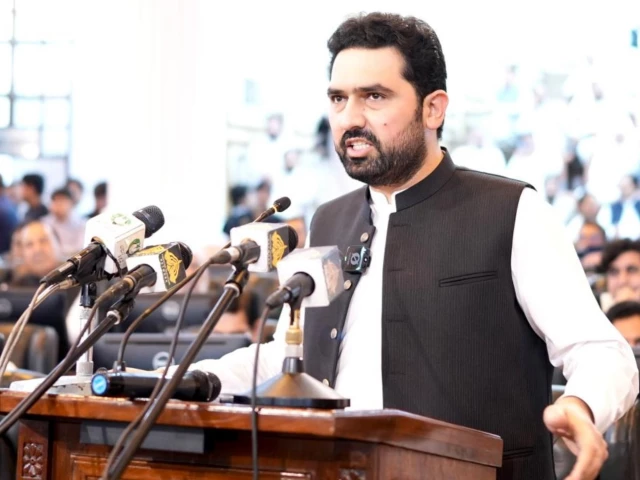
Khyber Pakhtunkhwa Chief Minister Sohail Afridi presents the provincial budget for fiscal year 2026-27 in the assembly on Friday. Photo: X
PESHAWAR:
Political uncertainty deepened in Khyber-Pakhtunkhwa (K-P) on Sunday amid growing tensions between the federal and provincial governments, with the Centre considering governor’s rule and emergency as possible options, while Pakistan Tehreek-e-Insaf (PTI) is also weighing its options in response.
According to sources, the federal government is considering imposing governor’s rule or emergency in the province amid a deteriorating security and political situation. The PTI, which is governing the province, is also considering an in-house change or dissolution of the provincial assembly.
The developments come amid continued tensions following PTI’s announcement of an Islamabad march. Although the protest was postponed from September 27 to October 4, the standoff between the federal and provincial governments remains unresolved, the sources said.
Reports have also emerged about the possible disqualification of the chief minister, his replacement, an in-house change, dissolution of the assembly and a no-confidence motion against him under Article 136 of the Constitution.
The no-confidence motion can be submitted to the assembly secretariat with signatures of 20% of the total membership, following which an assembly session is to be convened within three to seven days on a single-point agenda.
The assembly rules lay down the procedure for a no-confidence motion. After the motion is moved in the house, voting is held through a secret ballot, with members expressing their choice in two separate lobbies. If the motion succeeds, the speaker will issue a schedule for the election of a new chief minister.
The Constitution also provides for the governor to require the chief minister to seek a vote of confidence under Article 130(7). If the governor believes the chief minister has lost the confidence of the majority in the house, the chief minister is required to demonstrate his numerical strength in the assembly.
Amid these speculations, Chief Minister Sohail Afridi said the provincial government did not want confrontation with the federation but wanted terrorism eliminated, peace established and the lives of soldiers, police personnel and civilians protected.
Addressing a press conference during a visit to Dera Ismail Khan, he said the objective was not merely to criticise the federal government but to establish peace and ensure that the voice of K-P, which continued to bear the greatest burden of terrorism, was part of the policy response.
Afridi said the fight against terrorism could be won if the federal government took the K-P government and its people into confidence, accepted the province’s proposals and adopted an effective policy to eliminate terrorism.
At the outset of his press conference, he described the terrorist incident in Dera Ismail Khan as deeply tragic and strongly condemnable. He said terrorism was not only affecting the youth of K-P but soldiers serving from across Pakistan were also losing their lives, alongside police personnel and civilians.
“They are all our own people, part of the same society, irrespective of their province, sect or uniform,” the chief minister said. “The people and youth of K-P understand how the present situation had emerged and who are paying the price.”
Afridi said his government had consistently criticised every policy that harmed the people and Pakistan and voiced its opposition to policies being formulated behind closed doors. He said statements by representatives of the federal government and “those imposed in Punjab” were sufficient to demonstrate their lack of seriousness.
He referred to the Punjab chief minister’s statement that there was no threat from India but from the other three provinces, as well as a statement by a Punjab minister describing the people of K-P as terrorists. He said other pro-government representatives were also making similar statements on television.
In contrast, Afridi said the seriousness of the K-P government was evident from its actions. Immediately after assuming office, the government allocated Rs35 billion for peace and security to provide resources to the police and other law-enforcement agencies and strengthen their infrastructure and capacity.
He also questioned the seriousness of the federal government and its institutions, citing the case of Heavy Industries Taxila (HIT), a federal institution that had received payment from the K-P government last year for the procurement of armoured personnel carriers (APCs), but had yet to provide the required equipment.
Similarly, he said, the National Radio and Telecommunication Corporation (NRTC), another federal institution, had been provided the necessary funds but had still not provided the deliverables. “I have raised the matter during recent meetings with federal institutions,” he said.
He said modern APCs were available in Islamabad and were being used in operations against PTI, while K-P had repeatedly requested APCs for the fight against terrorism and had already made the payments. He said federal authorities had been asked to provide those APCs to K-P so they could be used against terrorism.
He said false narratives could no longer mislead the people of K-P or Pakistan, who were fully aware of the reality. He warned that language promoting hatred was deepening divisions and could have extremely harmful consequences.
“Pakistan is already facing difficult circumstances,” he said, adding that any agenda or narrative creating hatred among provinces and people should be avoided because further escalation would harm everyone. He said policies formulated behind closed doors had not proved effective.
Over the past 22 years, around 22 major operations and 14,000 intelligence-based operations had been conducted, yet terrorism had not been eliminated and was instead increasing. “This demonstrated the need for a policy shift based on ground realities,” he said.
He urged the federal government to exercise wisdom, recognise the gravity of the situation and consult those who understood the issue.
During his visit to Dera Ismail Khan, Afridi also visited a hospital and inquired after the health of people injured in the terrorist attack on Aman Mela Check Post. He was briefed on the treatment being provided to the injured. Former chief minister Ali Amin Khan Gandapur also accompanied Afridi during the visit.