Polling in four remaining constituencies will proceed as scheduled on August 10, election commission says
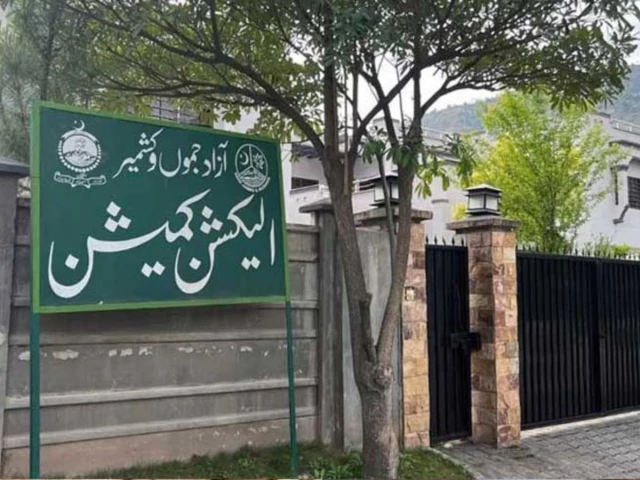
A picture showing the branch of the Azad Jammu and Kashmir Election Commission. — FILE PHOTO
ISLAMABAD:
The Election Commission of Azad Jammu and Kashmir (AJK) on Friday postponed polling in seven constituencies of Poonch Division scheduled for August 10, citing the prevailing law and order situation, while confirming that voting would proceed as planned in the remaining four constituencies.
The AJK general elections were scheduled to be held in three phases after the Election Commission revised the polling plan, with voting in Mirpur Division held on July 27, followed by Muzaffarabad Division and the 12 constituencies reserved for Kashmiri refugees settled in Pakistan on August 2, while Poonch Division is due to vote on August 10.
In a statement, the commission said the decision was taken after reviewing a report submitted by the AJK home secretary, which highlighted security concerns in parts of Poonch and Sudhnoti districts. It added that several political leaders and candidates had also requested that polling in the affected constituencies be deferred.
The Election Commission said a revised polling date and election schedule for the postponed constituencies would be announced after reviewing the security situation and other relevant matters.
Polling was deferred in five constituencies of Poonch district — Rawalakot, Pachhiot, Ali Sojal, Hajira and Abbaspur — and two constituencies of Sudhnoti district, Palandri and Baloch.
Polling will, however, proceed as scheduled in the three constituencies of Bagh district — Bagh Central, Bagh East and Bagh West — and the Haveli constituency, making them the only four constituencies to vote in the third phase of the AJK general elections.
According to election officials, the four constituencies have a combined electorate of 460,371 registered voters, while 803 polling stations have been established for the exercise.
The commission said the decision to postpone polling was taken solely in view of the prevailing law and order situation to ensure the elections are conducted in a free, fair, transparent and peaceful manner.
The first phase concluded with polling across Mirpur Division, while the second phase covered nine constituencies in Muzaffarabad Division and 12 refugee seats, bringing 21 constituencies to the polls. However, voting in LA-27 Muzaffarabad-I and LA-28 Muzaffarabad-II was postponed after heavy rain, landslides and adverse weather prevented election staff and polling material from reaching several polling stations.
Polling in the two delayed constituencies was held on Tuesday under heightened security arrangements, with the PML-N winning LA-27 Muzaffarabad-I and the PPP securing LA-28 Muzaffarabad-II, formally bringing the second phase of the elections to a close. The Election Commission subsequently notified the results of all 21 constituencies contested in the second phase.
Following the completion of the first two phases, the Pakistan Muslim League-Nawaz (PML-N) emerged as the largest party with 24 seats, while the Pakistan Peoples Party (PPP) became the second-largest parliamentary force with 10 seats.
The postponement came against the backdrop of deteriorating security conditions in Poonch Division, where tensions have persisted since late July. Violent clashes erupted in Rawalakot between police and members of the proscribed Joint Awami Action Committee (JAAC) after the group attempted to enter the city during the first phase of the AJK elections.
Several videos circulating online showed scenes of unrest, with claims of violence and casualties, though the details could not be independently verified.
Authorities said JAAC supporters opened fire on police after refusing to disperse, injuring officers, while the group alleged security forces had used excessive force, claiming multiple fatalities among its supporters. Since then, the government has maintained that the law and order situation in parts of Poonch and Sudhnoti remained fragile.
Background
AJK’s 53-member legislative assembly includes 12 seats reserved for Kashmiri refugees — people who fled Indian Illegally Occupied Jammu and Kashmir (IIOJK) in 1947 and 1965 and are now scattered across Pakistan. Six seats represent refugees from the Jammu division (~434,000 people) and six from the Kashmir Valley (~30,000 people) — an already lopsided arrangement that many see as unfair.
The region witnessed one of its most turbulent periods in October last year when protests led by the JAAC erupted over demands for constitutional and governance reforms. At least nine people, including three policemen, were killed during the unrest.
The JAAC, which organised the protests and strike, had presented a wide-ranging charter of demands, including an end to the privileges enjoyed by the ruling elite, the abolition of 12 assembly seats reserved for refugees, and the scrapping of the quota system.
Two days after the violence, the government and the JAAC reached an agreement covering 12 core and 13 additional points. Under the accord, both sides agreed to constitute a high-level committee to examine the issue of refugee seats in the AJK Legislative Assembly.
The matter is at a deadlock at the moment, with the JAAC calling for the abolition of the seats while the government rejects the demand.