Foreign minister says Iran’s political structure can absorb shocks despite senior leaders’ assassinations
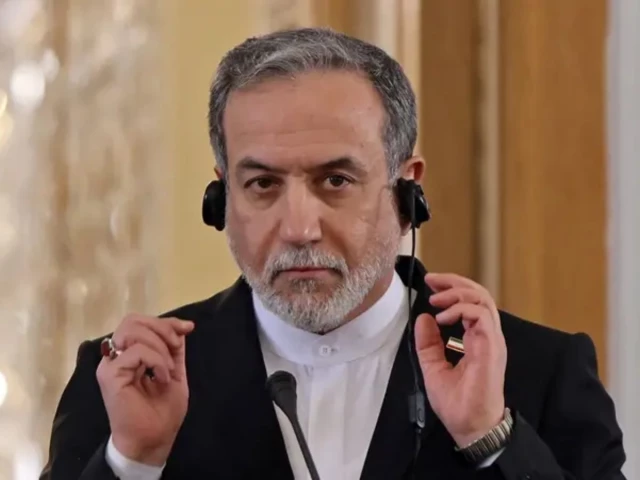
Iranian Foreign Minister Abbas Araghchi attends a press conference in Tehran on January 18, 2026. PHOTO: AFP
Iranian Foreign Minister Abbas Araghchi said the assassination of senior Iranian official Ali Larijani would not deal a fatal blow to the country’s leadership, stressing that the Islamic Republic’s political system was designed to withstand such losses.
In an interview with Al Jazeera aired after Larijani’s assassination, Araghchi dismissed suggestions that the killing could destabilise Iran’s governing structure.
“I do not know why the Americans and the Israelis still have not understood this point,” Araghchi said. “The Islamic Republic of Iran has a strong political structure with established political, economic, and social institutions. The presence or absence of a single individual does not affect this structure.”
Iranian state media confirmed late Tuesday that Larijani had been killed, following earlier claims by Israeli Prime Minister Benjamin Netanyahu that Israel carried out a targeted strike against the senior Iranian figure. Activity on Larijani’s official X (formerly Twitter) account also appeared to acknowledge developments surrounding his death.
Larijani was regarded as a key political figure within Iran’s leadership and often served as a mediator between the country’s clerical establishment and government institutions. During negotiations leading to the 2015 Joint Comprehensive Plan of Action (JCPOA), former European Union foreign policy chief Federica Mogherini described him as “a sophisticated and highly intellectual negotiator who understands the cost of isolation better than anyone in the Iranian establishment.”
Read: Iran hits Tel Aviv with cluster missiles after security chief’s assassination
Journalist Osama bin Javaid, who met Larijani ahead of recent nuclear talks with the United States, said in an interview with Al Jazeera that Tehran sent him to negotiations because of the political weight he carried.
While analysts say Larijani’s death may not topple the Iranian regime – similar to how the system continued after the killing of Supreme Leader Ayatollah Ali Khamenei – they expect its impact to be felt politically. Araghchi argued, however, that institutional continuity remains central to Iran’s governance.
“Of course, individuals are influential, and each person plays their role. Some better, some worse, some less. But what matters is that the political system in Iran is a very solid structure,” he said. “We have not had anyone more important than the leader himself. And even the leader was martyred. Yet the system continued to work and immediately provided a replacement.”
Araghchi added that even if other senior figures – including the foreign minister – were killed, replacements would quickly fill any power vacuum.
Separately, Iran’s paramilitary Basij force commander Gholamreza Soleimani was also assassinated in what Tehran described as US-Israel attacks, according to the Fars News Agency.
In a post on X, the Islamic Revolutionary Guard Corps described Soleimani as a “devoted and sincere fighter” and a “dear martyr”.
In Iranian political culture, martyrdom has often been framed as reinforcing leadership legitimacy and public mobilisation. Javaid said, “Ali Larijani was killed while he was not in hiding. This is a regime which processes martyrdom as a strategy of maintaining control. The person who comes after him, the popular support for him, and for the regime, grows.”