
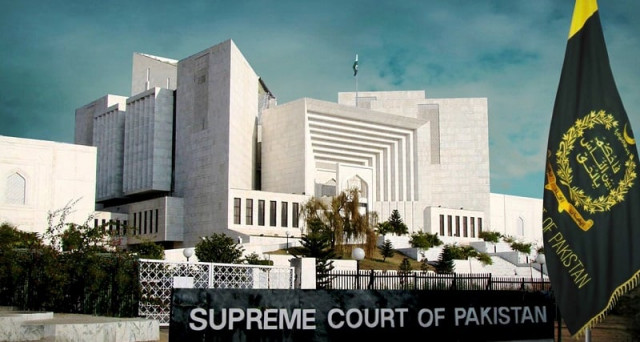
ISLAMABAD:
The Supreme Court has held that litigants and their lawyers share responsibility for delays in the disposal of cases, observing that the judiciary alone cannot be blamed for the mounting backlog when parties and their counsel frequently contribute to prolonged proceedings.
“The solitary criticism or unfounded fault of the judiciary by the public at large for delays in the disposal of cases is not good enough without acknowledging the ground reality and/or real-life situation that the parties and their advocates cannot be exonerated outrightly but, as a matter of fact, they are equally responsible and subject to blame for such delays,” observed the court.
The remarks came in an eight-page judgment authored by Justice MuhammadAli Mazhar, through which a Supreme Court division bench upheld the dismissal of a civil suit after the petitioner repeatedly failed to produce evidence despite warnings and opportunities granted by the trial court.
“If truth be told, one of the major causes of delay is innumerable loads of adjournment applications as done in this case,” the judgment said, noting that the petitioner had availed repeated adjournments, including last and final opportunities, but still failed to produce evidence.
The court observed that a litigant’s conduct was highly relevant in determining responsibility for delays. A party could be held accountable where the record showed that its own actions had substantially obstructed the progress of proceedings.
Such conduct, it said, included failure to appear for recording evidence despite warnings or final opportunities; failure to produce witnesses or secure their presence on scheduled dates; non-compliance with court orders; filing frivolous or misconceived applications to delay decisions on merits; and repeatedly changing counsel with the sole intention of prolonging proceedings.
It also identified circumstances in which lawyers could become instrumental in delaying cases.
These included seeking repeated and unnecessary adjournments, requesting postponements on crucial hearing dates without lawful justification, avoiding the production of evidence or cross-examination despite the presence of witnesses, and filing unnecessary interlocutory applications.
Other practices cited by the court included failing to prepare a brief within a reasonable time and seeking adjournments to obtain instructions, as well as remaining absent despite notice and an opportunity to appear.
The court further observed that where multiple advocates had been engaged and had signed the vakalatnama or power of attorney, proceedings should continue through another available counsel instead of being adjourned merely because one lawyer was unavailable.
However, the bench cautioned against automatically attributing every delay to litigants or their lawyers, noting that courts themselves could also contribute to the problem through their acts or omissions.
The judgment identified several such shortcomings, including granting repeated adjournments without sufficient cause, failing to proceed despite the parties being ready, and refusing to record evidence even when witnesses were present without any valid justification.
Other factors included failure to comply with statutory timelines or directions of superior courts, keeping interlocutory applications pending indefinitely without just cause, and failing to identify jurisdictional or procedural defects at an early stage.