‘This is not just one astronaut’s journey, but the journey of 240 million Pakistanis’, says PM Shehbaz
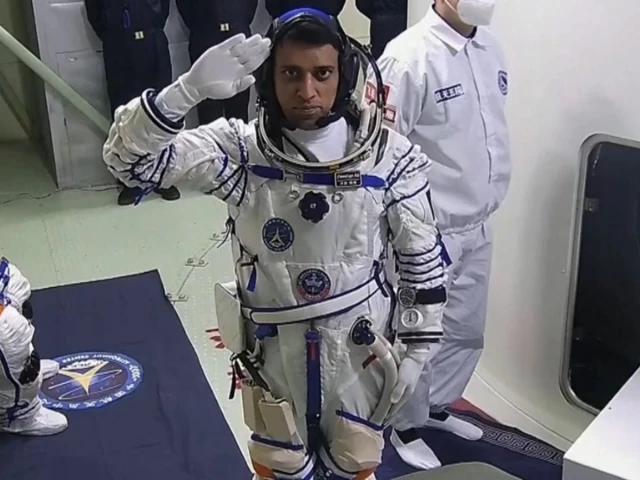
Astronaut Zeeshan Ali. SCREENGRAB
In a historic moment for Pakistan, Zeeshan Ali on Wednesday became the first foreign astronaut to board China’s Tiangong space station, marking a signficant moment for the country’s science ambitions.
The Shenzhou-24 space flight docked at Tiangong at 11:56am (0356 GMT) Wednesday, roughly 3-1/2 hours after it took off from the Jiuquan Satellite Launch Centre in northwest China using a Long March-2F rocket.
The 40-year-old pilot, who has become the first Pakistani in orbit, will work as a payload specialist and is set to stay at the station for five to 10 days. He is accompanied by Chinese commander Tang Hongbo and flight engineer Wu Yi.
To prepare for the flight, Ali trained for seven months in Beijing, during which he underwent intensive Chinese-language classes, learning Chinese songs and reading Chinese poetry. He also practised calligraphy and played table tennis.
“I’m not flying for myself. I carry the name of Pakistan on my shoulder,” Ali told reporters on Tuesday.
PM Shehbaz congratulates nation
Prime Minister Shehbaz Sharif congratulated the nation on Ali’s departure, saying that “today Pakistan has begun its journey beyond the stars.”
“This is not the journey of just one astronaut, but the journey of 240 million Pakistanis,” PM Shehbaz said, adding that it was “the journey of our young generation, our scientists and our dreams.”
He stated that both Ali and Khurram Daud, who was selected alongside Ali for the final training programme, “both completed their training in China with unmatched hard work, discipline, and dedication.”
According to the Prime Minister’s Office (PMO) on X, the premier noted that Pakistan would become the first country after China to go from the Tiangong space station. “This is living proof of the ironclad friendship between Pakistan and China,” PM Shehbaz said. “We are grateful to our brotherly country China, which made Pakistan part of this historic mission,” he added.
ستاروں سے آگے: پاکستان کا پہلا خلاباز چین کے تیانگونگ خلائی اسٹیشن روانہ.
وزیرِ اعظم پاکستان محمد شہباز شریف کی پاکستانی خلاباز ذیشان علی کی چین کے شینزو-24 مشن کے ذریعے تیانگونگ خلائی اسٹیشن سے خلائی سفر پر روانگی پر قوم کو مبارکباد۔ وزیرِ اعظم نے کہا کہ آج پاکستان نے ستاروں سے…
— Prime Minister’s Office (@PakPMO) November 25, 2026
PM Shehbaz noted that China and Pakistan were “not only in harmony on establishing peace on earth and mutual development, but are now also moving in step in the journey into space,” terming this “an expression of the breadth and closeness of our friendship.”
The PMO noted that PM Shehbaz also paid tribute to the Space and Upper Atmosphere Research Commission (SUPARCO), along with the universities and scientists whose scientific experiments were “going into space with this mission.”
“Through the joint efforts of the armed forces of Pakistan, national institutions, scientists and youth, Pakistan is advancing toward new heights in space research and the modern scientific field,” he noted.
According to the PMO, the premier also addressed the nation’s youth, saying that “if a Pakistani can reach a space station today, tomorrow a Pakistani will reach the moon too.” He added, “Never stop dreaming, keep working hard, believe in Pakistan. Our destination is beyond the stars.”
PM Shehbaz also cited national poet Allama Muhammad Iqbal who “exhorted the youth years ago that they must go beyond the stars and discover the secrets hidden in this universe.” He stated, “That dream is being fulfilled today.”
“The Government of Pakistan considers science, technology and space research its top priority. This mission is a big step toward a new Pakistan, where our youth will not compete with the world, but will lead the world,” the PMO’s post concluded.
Ahsan Iqbal describes mission as beginning of new era
Planning Minister Ahsan Iqbal witnessed in person the launch of Ali aboard the Shenzhou-24 spacecraft, describing the landmark mission as the beginning of a new era in Pakistan’s space programme and the Pakistan-China friendship.
Representing the government and people of Pakistan, Iqbal attended the official send-off ceremony at the Jiuquan Satellite Launch Centre, alongside a high-level Pakistani delegation and thousands of spectators who gathered to witness the launch of the three-member crewed mission.
As Ali boarded the spacecraft and embarked on his journey into orbit, Iqbal congratulated the nation on what he described as Pakistan’s “URAAN” into space.
Read: ‘The universe has no borders’: Pakistan’s historic space mission draws global praise
Speaking at the launch site, the minister said Ali was not only Pakistan’s first astronaut but also the first international astronaut to travel into space in collaboration with China and become the first international guest aboard China’s space station.
Describing his presence at the historic occasion as a moment of immense pride and joy, he said in a post on X that Ali was “carrying the Pakistani flag on his shoulders—lifting the dreams of 260 million Pakistanis into orbit.
Addressing Pakistani youth watching the rocket soar, Iqbal said “let your ambitions rise just as high. Quoting Allama Iqbal’s poetry, he reminded the youth, “You are a falcon; soaring is your calling, there are yet more skies ahead of you.”
My feelings at the launch site will always remain with me. Standing there watching Pakistan’s first astronaut, Zeeshan Ali, prepare to lift off as the first international guest aboard China’s space station was a deeply emotional and historic moment for our entire nation.
Zeeshan… pic.twitter.com/sGaQH1hTnx— Ahsan Iqbal (@betterpakistan) November 25, 2026
Commenting on the longstanding friendship between Pakistan and China, the minister said the mission was the finest tribute to the 75th anniversary of diplomatic relations between the two countries.
He recalled that during 2017-18, he had proposed to his Chinese counterparts that following the completion of transformative infrastructure projects on the ground under the China-Pakistan Economic Corridor (CPEC), bilateral cooperation should be extended into space through a Pakistani astronaut joining a Chinese mission. “From highways to information superhighways, and now to skyways, Pakistan-China friendship and CPEC are rising even higher than the skies,” he said, adding that witnessing the realisation of that vision in person was a dream come true.
He also said he hoped the flight marked the start of further space cooperation with China, including potentially a joint lunar mission. “This shows the way forward how developing countries can cooperate to have capability in areas which are very critical for future economic development,” he said.
The minister also paid tribute to Ali for his hard work, discipline and outstanding performance. He acknowledged the dedication and capabilities of the backup Pakistani astronaut, who had also completed rigorous training with exceptional proficiency alongside Ali.
Iqbal said although only one seat was available for the mission, the entire nation equally valued and appreciated the backup astronaut’s efforts and capabilities.
The minister prayed for the successful completion of Ali’s space mission and expressed the hope that Pakistan-China friendship would continue to reach new heights. “Long live Pakistan-China friendship!” he said.
International cooperation
China is promoting Tiangong, which means Celestial Palace in Chinese, as a hub for international cooperation while the NASA-led International Space Station faces possible retirement by 2030.
Though Ali’s planned stay is much shorter than the usual six-month rotation for a Chinese astronaut, it has been cause for huge celebration in Pakistan.
Space cooperation between China and Pakistan dates back to the early 1990s. China has launched Pakistani satellites and a Pakistani-built rover is also set to fly on a Chinese lunar mission around 2028.
While in space, Ali will help conduct experiments, including one that will look at how self-healing carbon fiber composites can automatically repair small cracks in spacecraft.
A long stay for one Chinese astronaut
China’s self-built Tiangong station has been fully operational since late 2022. It can host up to six astronauts during handovers when an arriving three-person crew overlaps with the departing crew. This time, the handover will be different.
Shenzhou-23 commander Zhu Yangzhu will stay on to support Beijing’s study of how the human body copes in space — a crucial step towards a planned crewed mission to the moon and a potential journey to Mars. The rest of the Shenzhou-23 crew will depart Tiangong alongside Ali.
Zhu, who will stay for a year, will hold the record for the longest single stay in orbit by a Chinese astronaut by the time he leaves.
China’s goal of human presence on the moon by 2030 remains unchanged following the delay to its Chang’e-7 lunar mission, which failed to meet launch conditions this year amid adverse weather linked to a tropical storm.
That compares with the US target of 2028 to return humans to the moon amid a tense race for a moon base buildup, a stepping stone to eventual human exploration of Mars. China plans to establish a research base on the moon by 2035 with Russia.
Washington has warned that Beijing could seek to dominate access to resource-rich areas of the moon. Beijing rejects such allegations, saying it advocates peaceful use of outer space.
With additional input from Reuters and APP