Ishaq Dar and former US diplomat Robin Raphel discuss bilateral ties, encourage dialogue
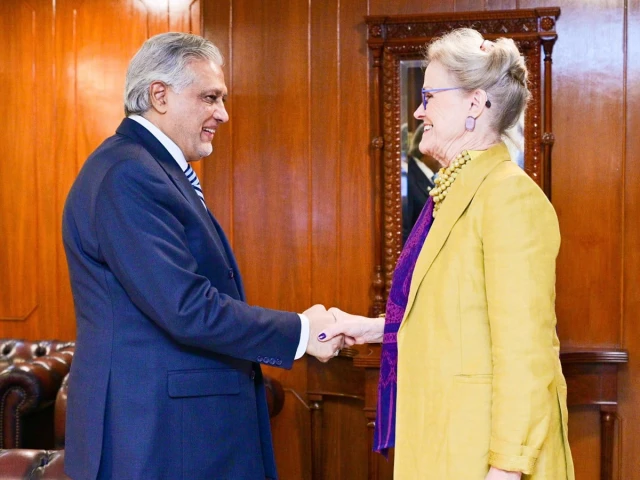
Deputy Prime Minister and Foreign Minister Ishaq Dar shakes hands with former US assistant secretary of state for South Asian affairs Ambassador Robin Raphel during a meeting in Islamabad on Tuesday. Photo: X
Pakistan and the United States on Tuesday agreed to promote closer exchanges between think tanks and academic institutions to deepen mutual understanding and encourage dialogue on regional and international issues.
The understanding was reached during a meeting between Deputy Prime Minister and Foreign Minister Senator Ishaq Dar and former US assistant secretary of state for South Asian affairs Ambassador Robin Raphel, according to a statement issued by the Foreign Office.
Ambassador Robin Raphel, former U.S. Assistant Secretary of State for South Asian Affairs, called on Deputy Prime Minister/Foreign Minister Senator Mohammad Ishaq Dar @MIshaqDar50 today.
Discussions covered matters of mutual interest. The DPM/FM appreciated the positive… pic.twitter.com/dgjjmNvM4Q
— Ministry of Foreign Affairs – Pakistan (@ForeignOfficePk) November 10, 2026
The statement said the two sides discussed matters of mutual interest.
Dar appreciated the positive trajectory of Pakistan-US relations and underscored the importance of sustained engagement to further strengthen bilateral cooperation.
Both sides agreed to encourage closer exchanges between think tanks and academic institutions in the two countries to promote mutual understanding and dialogue on regional and international issues.
Earlier today, US President Donald Trump nominated Chargé d’Affaires Natalie A Baker as the next US ambassador to Pakistan, paving the way for the appointment of a permanent envoy to Islamabad after a gap of nearly two years.
The White House announced the nomination in a list of appointments sent to the US Senate on Monday.
Read: Trump nominates Natalie Baker as next US ambassador to Pakistan
Her nomination is subject to confirmation by the US Senate. If confirmed, Natalie will become the first US ambassador to Pakistan since Donald Blome left the post in early 2025.
The Pakistan-US relationship experienced a significant thaw in 2025–2026, transitioning from a cold period to warm, strategic, and pragmatic engagement during Trump’s second term. This shift was largely driven by a major reset in relations following President Trump’s intervention in regional conflicts, particularly his role in brokering a ceasefire between Pakistan and India in May 2025.
The first thaw in Pakistan-US relations came via secret counterterrorism exchanges, signalling substantive cooperation. In March last year, Trump unexpectedly praised Pakistan’s counterterrorism efforts during a national address, prompting a policy shift.
The short but intense May skirmish with India in May 2025 became a decisive turning point, showcasing Pakistan’s military discipline, strategic focus, and asymmetric capabilities — qualities that reportedly surprised Trump.
Despite India’s repeated denials, Prime Minister Shehbaz Sharif continued to praise President Trump for his role in brokering a ceasefire between the two nuclear-armed neighbours, and nominated him for the Nobel Peace Prize, saying his intervention had helped save millions of lives.
The praise was reciprocated, with Trump commending the premier and also lauding CDF Munir, as he reiterated claims that he had helped avert a war between Pakistan and India in May 2025.
Ties between the countries took a further turn when Trump invited CDF Munir to a luncheon — the first such meeting for a Pakistani military chief — followed by a red-carpet visit to US Central Command headquarters for high-level talks.
Following a ceasefire after the prolonged war in Gaza, Trump announced the formation of a “Board of Peace” that included Pakistan, again singling out PM Shehbaz for praise during its inaugural summit.
Addressing the event, Trump said, “I like this guy,” referring to the premier, as he recounted efforts that led to last year’s ceasefire between Pakistan and India. He also praised CDF Munir during his remarks.
In June this year, President Trump credited Pakistan with “really helping” the United States secure a peace deal with Iran while especially praising Chief of Defence Forces Field Marshal Asim Munir and PM Shehbaz.
“In Pakistan, you have Field Marshal Asim Munir, who is great, and you have the Prime Minister Shehbaz Sharif, and they just get along great,” he said during an interview with Axios.