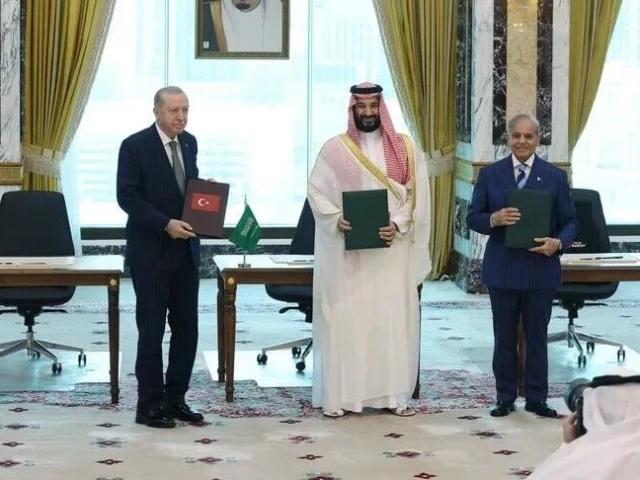
Turkish President Recep Tayyip Erdogan, Saudi Crown Prince Mohammed bin Salman and PM Shehbaz Sharif pose after signing a joint defence agreement in Makkah, Saudi Arabia. — SAUDI PRESS AGENCY
ISLAMABAD:
Pakistan is expected to host the third meeting of the Strategic Political and Defence Committee of the Makkah Defence Alliance in the last week of November, as the three member countries seek to strengthen their security coordination amid mounting regional tensions and uncertainty surrounding the Iran conflict, diplomatic sources told The Express Tribune here on Monday.
The meeting is expected to bring together the foreign and defence ministers as well as the military chiefs of Pakistan, Saudi Arabia and Türkiye, with discussions likely to focus on the implementation of the trilateral defence agreement and the evolving regional security situation.
The meeting comes at a particularly critical juncture, with the possibility of renewed military strikes against Iran still looming even as diplomatic efforts to find a way out of the conflict remain on the table. The three countries are expected to discuss the implications of these developments for regional stability and their collective security arrangements.
The Islamabad meeting will be the first gathering of the committee since the Turkish parliament formally ratified the Makkah Joint Defence Agreement on November 7, completing a major step towards bringing the trilateral arrangement into effect.
The Turkish parliament approved the agreement by 279 votes to 119, following a debate in which government lawmakers maintained that the pact was defensive in nature and was not directed against any third country.
The agreement was signed on August 7 by Prime Minister Shehbaz Sharif, Saudi Crown Prince Mohammed bin Salman and Turkish President Recep Tayyip Erdogan. It provides for collective assistance in the event of an armed attack against any of the three countries, with the nature and extent of assistance to be determined collectively.
The upcoming meeting will be the third session of the committee established under the agreement to translate the political commitment into practical defence cooperation.
The first meeting was held in Istanbul on August 31, bringing together the foreign ministers, defence ministers and military chiefs of the three countries. The meeting agreed to institutionalise cooperation through a permanent secretariat in Riyadh, which would initially be headed by a Pakistani secretary general for three years.
It also envisaged greater cooperation in the defence industry, joint technology development and production, and measures to strengthen the capabilities and coordination of the three armed forces.
The second meeting was convened on an emergency basis in Riyadh on October 5, following escalating security threats to Saudi Arabia, including attacks attributed to Yemen’s Houthi movement.
The committee condemned attacks targeting Saudi cities and civilian and economic infrastructure, including threats to Makkah and Madinah. More significantly, it agreed to move towards the practical implementation of collective defence commitments, including measures to provide agreed military forces and capabilities and ensure their rapid deployment in Saudi Arabia, subject to the national laws of the member states.
The Riyadh meeting also appointed retired Lieutenant General Nauman Mahmood as the alliance’s first secretary general for a three-year term.
The November meeting is expected to take stock of progress on these decisions and consider further steps to strengthen military coordination, intelligence-sharing and defence cooperation.
The Turkish parliament’s ratification has added significance to the upcoming deliberations. While Pakistan and Saudi Arabia had completed their respective ratification processes earlier, Türkiye was awaiting parliamentary approval under its domestic constitutional requirements.
However, ratification does not automatically authorise the deployment of Turkish troops abroad, which would require a separate parliamentary mandate.
The alliance has also attracted attention because of the wider geopolitical circumstances in which it was formed. The agreement brings together Pakistan, the only nuclear-armed Muslim-majority country, Saudi Arabia, a major Gulf power, and Türkiye, a NATO member with one of the region’s largest militaries.
All three countries have maintained that the arrangement is defensive and intended to strengthen regional stability rather than target any particular state.
For Islamabad, the challenge will be to advance the collective defence framework while maintaining its diplomatic engagement with Tehran and supporting efforts to prevent another escalation in the wider Middle East.