Ambassador Jadoon calls for parties to exercise restraint, choose path of peace, security and stability
Pakistan on Tuesday urged Iran and the United States to honour their commitments under the Islamabad Memorandum of Understanding (MoU) and return to negotiations as the United Nations Security Council (UNSC) debated Iran’s nuclear program.
Pakistan is a key mediator between the US and Iran. Its earlier mediation efforts with both parties resulted in an interim peace agreement signed in June but which quickly faltered, amid new fighting between Iran and the US weeks after.
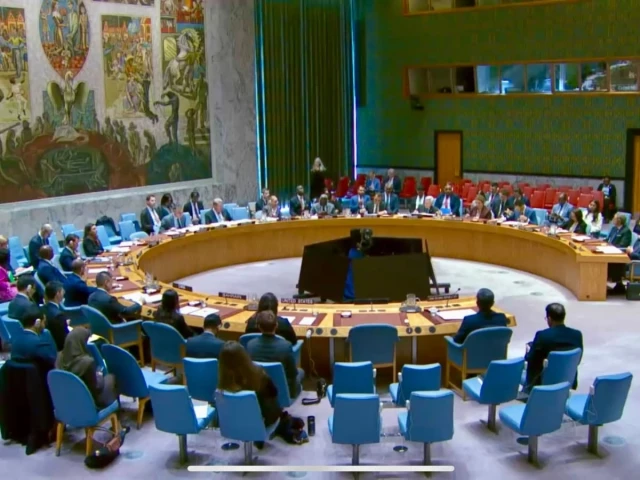
Acting Permanent Representative of Pakistan to the UN Ambassador Usman Jadoon addressed a UNSC briefing on Iran/non-proliferation, highlighting Islamabad’s continued concern “that the situation regarding the Iran nuclear file has sharply deteriorated, negatively impacting the consideration of the issue, including in the Security Council.”
He also warned that further escalation could undermine regional and international peace, calling for all sides to exercise restraint and “choose a path that delivers peace, security and stability for all.”
Jadoon stated that on one hand, “the ground situation in the past few months has been marked by deep tensions and continued hostilities,” while on the other, “profound mistrust and difference of opinion have led to a breakdown of consensus within the council on this matter.” He also noted that recent developments had “once again illustrated the fragility of the situation and the risk of escalation,” stressing that “a diplomatic settlement of the issue has become more critical than ever.”
Statement by Ambassador Usman Jadoon,
Acting Permanent Representative of Pakistan,
At Security Council Briefing on Iran/Non-proliferation
(27 October 2026)
******Mr.President,
I thank [Director General Grossi] for his comprehensive briefing.
2. Pakistan remains concerned… pic.twitter.com/DznHb5Tm6C
— Permanent Mission of Pakistan to the UN (@PakistanUN_NY) October 27, 2026
The ambassador underscored the need to “revive the spirit of cooperative multilateralism and mutual understanding to break the deadlock,” expressing hope that the UNSC “will act with unity of purpose and back efforts towards a pacific settlement.”
He reaffirmed Pakistan’s call for “all sides to exercise restraint, refrain from irresponsible and destabilising rhetoric, actions, and postures that could escalate tensions and increase the risk of conflict, and choose a path that delivers peace, security and stability for all.” Further, he reiterated Islamabad’s “support for the resolution of all outstanding issues through peaceful means, diplomatic engagement and sustained dialogue,” saying that a a negotiated settlement must be pursued regarding the Iranian nuclear issue “in accordance with the rights, obligations and responsibilities of the parties concerned, in a manner that upholds the non-proliferation regime, while ensuring regional and international peace and security.”
Jadoon noted that Pakistan had “consistently maintained that any issues of non-compliance must be addressed through competent technical bodies like the IAEA, without politicisation and consistent with the relevant parties’ rights and obligations,” arguing that the nuclear watchdog “must be enabled to carry out its work without any hindrance and within its technical mandate.”
Read: Khawaja Asif hints at ‘progress’ in Makkah alliance’s talks with Iran on Saudi-Houthi conflict
The ambassador added that Pakistan had also been “undertaking constructive diplomatic engagement to promote de-escalation, ceasefire, and the broader pursuit of stability in the region,” saying that it had been “consistently seeking to encourage dialogue, facilitate the exchange of messages, and help create the requisite space and conditions conducive to the conduct of meaningful negotiations.”
Jadoon highlighted the Islamabad MoU as a “successful manifestation of this approach,” noting that the framework “demonstrates that progress on the diplomatic track is possible.” He also thanked the involved parties for their confidence and positive engagement, and also extended appreciation for the support of regional partners including Qatar, Saudi Arabia, Turkiye, Egypt, and China.
“We believe that diplomacy can once again deliver results in paving the way for settling contentious issues peacefully,” Jadoon said, adding that “to that end, earnest and painstaking work is required.”
He concluded his address by reaffirming that the Pakistani leadership remained committed to a diplomatic resolution of hostilities. “As we speak, our leadership continues these efforts with sincerity, determination and conviction,” he said.


