Says Chromebooks to be distributed across schools and seminaries over two years, based on merit
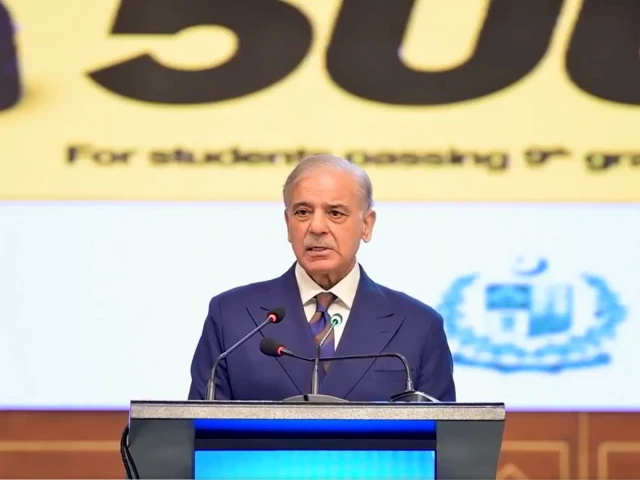
Prime Minister Shehbaz Sharif addresses a ceremony marking the distribution of Chromebooks to students across Pakistan under the Prime Minister’s Youth Programme. SCREENGRAB
Prime Minister Shehbaz Sharif on Sunday said access to technology and education should not be restricted by “wealth or poverty” as he launched the distribution of 500,000 Chromebooks and internet facilities to talented students from schools and religious seminaries across Pakistan over the next two years.
Addressing a ceremony under the Prime Minister’s Youth Programme, the prime minister said, “Intelligence and hard work should not be held captive by wealth and poverty,” stressing that merit and effort should determine which students received the devices.
The selected students were also being provided with bags and MiFi devices to enable them to access the internet, attend classes remotely, and use electronic libraries from home, he said.
“Through these Chromebooks, you will be able to acquire knowledge and, as you grow up, become some of the most distinguished and capable people in this country,” PM Shehbaz told the students.
He said the government was determined to ensure that talented children were not left behind in an increasingly technology-driven world.
“Thank you very much for your participation. You are here witnessing a great journey towards the empowerment of our youth. Our boys and girls from all over Pakistan are the true assets of our country. It is my duty and our collective responsibility to put the most modern… pic.twitter.com/3SE9KOSRAM
— Prime Minister’s Office (@PakPMO) October 25, 2026
Recalling the previous distribution of laptops under former prime minister Nawaz Sharif, PM Shehbaz said 600,000 laptops had been distributed on merit across Punjab, Sindh, Balochistan, Khyber-Pakhtunkhwa, Gilgit-Baltistan and Azad Jammu and Kashmir.
That programme had taken approximately 10 years to complete, he said, adding that the government now planned to distribute 500,000 Chromebooks to talented students across Pakistan within two years.
“This is a remarkable instrument that will be in your hands so that you do not fall behind anyone in the world in terms of ability and intelligence,” he said.
The prime minister said the earlier laptop scheme had benefited students from different backgrounds and regions, including children whose fathers had died and those whose parents worked as labourers.
Recalling an interaction with a student at the ceremony, he said he had asked the child about his father’s occupation. “Prime Minister, my father is a labourer,” the student had replied.
PM Shehbaz said such circumstances should not prevent children from developing their abilities or pursuing education.
چند دن پہلے اسلام آباد میں دانش سکول کا افتتاح کیا گیا اور اس وقت پورے پاکستان میں 27 دانش سکول زیرِ تعمیر ہیں۔
یہ سکول پڑھائی کے معیار، بہترین اساتذہ، کلاس روم میں سمارٹ بورڈز اور ای-لائبریریز کے لحاظ سے پورے پاکستان میں ممتاز ہوں گے۔
~ وزیراعظم محمد شہباز شریف کا پرائم… pic.twitter.com/qp7hjQsQwD
— Prime Minister’s Office (@PakPMO) October 25, 2026
He thanked Rashid Minhas, founder of the Tokyo Care Foundation, for donating towards the initiative, expressing gratitude on behalf of himself, his government and the students who would benefit from the programme.
The contribution demonstrated the confidence of overseas Pakistanis in the country’s young people and their abilities, he said, adding that Pakistanis living abroad worked hard to raise the country’s profile internationally.
He said the donation had been made in recognition of the students’ intelligence and potential, and thanked the foundation for its support.
The prime minister also spoke about the government’s efforts to provide quality education through the Daanish schools programme. He said he had inaugurated a Daanish school in Islamabad a few days earlier, while 27 more were under construction across the country.
“These schools will be distinguished for their quality of education, their teachers and the facilities they provide,” PM Shehbaz said, adding that classrooms would have smart boards and electronic libraries, alongside sports grounds, residential dormitories and food facilities.
“No child has to spend a single penny at these Daanish schools,” he said, stressing that financial circumstances should not stand in the way of a child’s education.
“It is our responsibility to ensure that our children receive the education and facilities they deserve,” the prime minister said. “It should be the foremost duty of any government to build the future of the children of this nation, help them become great individuals and great Pakistanis, and remove the obstacles standing in their way.”
PM Shehbaz also referred to two students who had spoken at the ceremony, highlighting the challenges they had overcome to continue their education.
He mentioned Syed Shams Raza, who belonged to a tribal area and whose father had been martyred, “Just consider how this child is facing the hardships of life; you and I cannot even imagine it.”
Referring to the Quranic teaching on martyrs, he said Islam held those who had sacrificed their lives in high regard, while emphasising the resilience required of a child growing up without a father.
“I believe there are not just one or two, but thousands and hundreds of thousands of remarkable children like Syed Shams Raza in this country,” he said.
He also referred to the student’s determination to work hard despite his circumstances, become a capable Pakistani and serve the nation when he grew up.
The prime minister praised another student, a girl from Baltistan who attended a religious seminary, for speaking confidently about her education and ambitions.
She had told the gathering that she was passionate about studying but had been given to understand that students from religious seminaries would not receive laptops or Chromebooks.
PM Shehbaz said he wanted to correct that impression, pointing out that earlier laptop distribution programmes had also included some prominent religious seminaries alongside universities and colleges.
He said the current Chromebook programme would likewise cover students from both schools and seminaries, with selection based solely on merit and hard work.
“Only your hard work and ability will be the criteria,” he said.
The prime minister added that the devices would not only help students pursue further education but could also become a source of livelihood when they entered the workforce.
PM Shehbaz said the benefits of the earlier laptop distribution programme had become particularly evident during the Covid-19 pandemic, when students had relied on technology to continue their education.
The laptops had proved extremely useful for students during that period, enabling them to attend university classes and continue learning despite the disruption caused by the pandemic, he said.
Read: PM Shehbaz stresses equal opportunities in education to realize Quaid’s vision
He added that many beneficiaries had subsequently secured employment and become qualified doctors, engineers and professionals.
The experience, he said, demonstrated the importance of ensuring that talented students had access to the tools needed to pursue their ambitions.
“Education is an adornment that makes you stand out in society, regardless of where you come from,” PM Shehbaz said.
“Wealth can be stolen, prosperity can disappear, and there can be profit and loss, but no one can steal education, and no one can steal ability,” he added.
Concluding his address, Shehbaz invoked the poetry of Allama Iqbal, linking the development of new ideas with the progress of nations.
The prime minister also recited verses about determination and confidence, saying that when a nation’s caravan moved forward with resolve and conviction, it would find a way ahead.
He ended by expressing confidence in Pakistan’s potential, emphasising the importance of nurturing talented young people and giving them the opportunities to contribute to the country’s future.
Background
The government has previously distributed around 600,000 laptops to students on merit under the Prime Minister’s Youth Laptop Scheme, which began in 2014. In 2024 alone, 100,000 laptops were distributed, while a further 100,000 were announced for talented students in 2025.
The latest Chromebook scheme comes alongside efforts to expand local technology production. In November 2025, Google began manufacturing Chromebooks in collaboration with the Ministry of Defence Production and the National Radio and Telecommunication Corporation (NRTC) in Haripur, with plans to produce around 600,000 devices annually.
Pakistan also signed an agreement with Google in August 2026 to provide students with one year of free access to advanced AI tools, including Gemini, and offer 150,000 Google Career Certificates to young people in 2026.


