
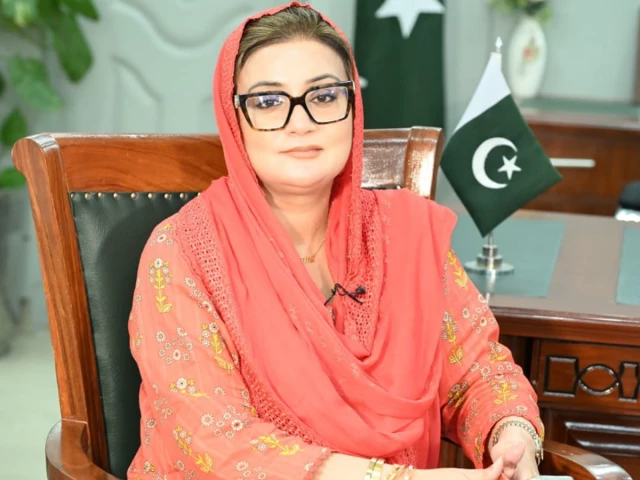
Azma Bokhari defends CCD, says cases involving organised crime are referred to CCD for better investigation
Punjab Minister for Information and Culture Azma Bukhari. Photo: File
Punjab Information Minister Azma Bokhari on Wednesday rejected the criticism surrounding the alleged police encounter in which a man accused of killing a 15-year-old boy was himself killed, categorically denying that Chief Minister Maryam Nawaz had ordered the Punjab Crime Control Department (CCD) to carry out encounters and asserting that the provincial government stood with the oppressed, not the oppressors.
The suspect, Tauqeer Nazir, had allegedly chased Waseem Abbas in his car after a dispute over work and run him over in a private housing society in Multan on Monday. He was arrested and handed over to police on a four-day physical remand by a judicial magistrate the following day. Earlier today, police said the suspect fled custody and was then killed by his accomplices when a police party tried to re-arrest him.
Hours before the incident, the prime suspect in the case involving the death by suicide of former International Islamic University Islamabad student Laiba Ejaz also died after being wounded by gunfire allegedly by his accomplices during an attack on a police team in Islamabad. The developments were met with criticism, with calls for justice through the legal route and the courts.
In an interview on local television programme Aaj Shahzeb Khanzada Kay Sath about the killing of Multan incident’s primary suspect, the minister was asked about hundreds of alleged extrajudicial killings by the CCD, in which the main suspect was reportedly killed while accomplices escaped, rejecting the suggestion that this pattern occurred in every case.
She said that even when a suspect was killed, the remaining suspects were subsequently traced, arrested and brought before the police.
“When a suspect is killed, the investigation slows down a little. When suspects flee, it takes some time to trace them. But this does not mean that this happens in every incident,” she said.
Asked whether the chief minister had directly ordered the CCD to carry out encounters against such suspects, the minister categorically denied it.
“Why would the chief minister order an encounter? It is not as if she has foreknowledge of such incidents,” she said.
“The state has a responsibility to stand with the oppressed. You may consider this a mistake on the part of the state or an allegation against it; you may call it whatever you like, but the Punjab government does not stand with the oppressor. It stands with the oppressed,” she said.
She added that there was no backdoor for the powerful in the province to evade the law or avoid facing legal proceedings.
Also Read: Man accused of running over Multan teenager killed in CCD encounter
Bokhari said an investigation had revealed that the Multan incident suspect was short-tempered and ill-mannered and had treated Abbas harshly. She said the boy had tried to flee three times but was caught each time.
She said the suspect’s actions demonstrated his mindset, alleging that he chased the teenager and killed him while the latter was attempting to escape through a gate. The minister added that the brutality was such that the victim’s face had become unrecognisable.
Bokhari further alleged that Nazir was a violent person who did not treat his own children properly and subjected them to violence as well.
The minister acknowledged that he had no previous criminal record and that, given the evidence against him, including CCTV footage, a court could have sentenced him. However, she said, he chose to flee rather than face trial.
“These are criminal-minded people. He could have been punished by a court, but if someone tries to escape from the court, or his accomplices help him flee, what can the police do?” she said.
Read: Primary suspect in Laiba Ejaz suicide case dies after being shot by accomplices: police
When asked about a post on X by PML-N MPA and Punjab government official Hina Pervez Butt that was later deleted, Bokhari questioned the seriousness of the former’s statements.
“I do not want to talk about her, but she has posted such things before, perhaps out of a lack of seriousness. She has also made statements that created problems for her and caused embarrassment for the government,” she said.
Earlier in the day, Hina had shared screenshots of a television report about the Multan encounter on X, drawing criticism for her supportive remarks.
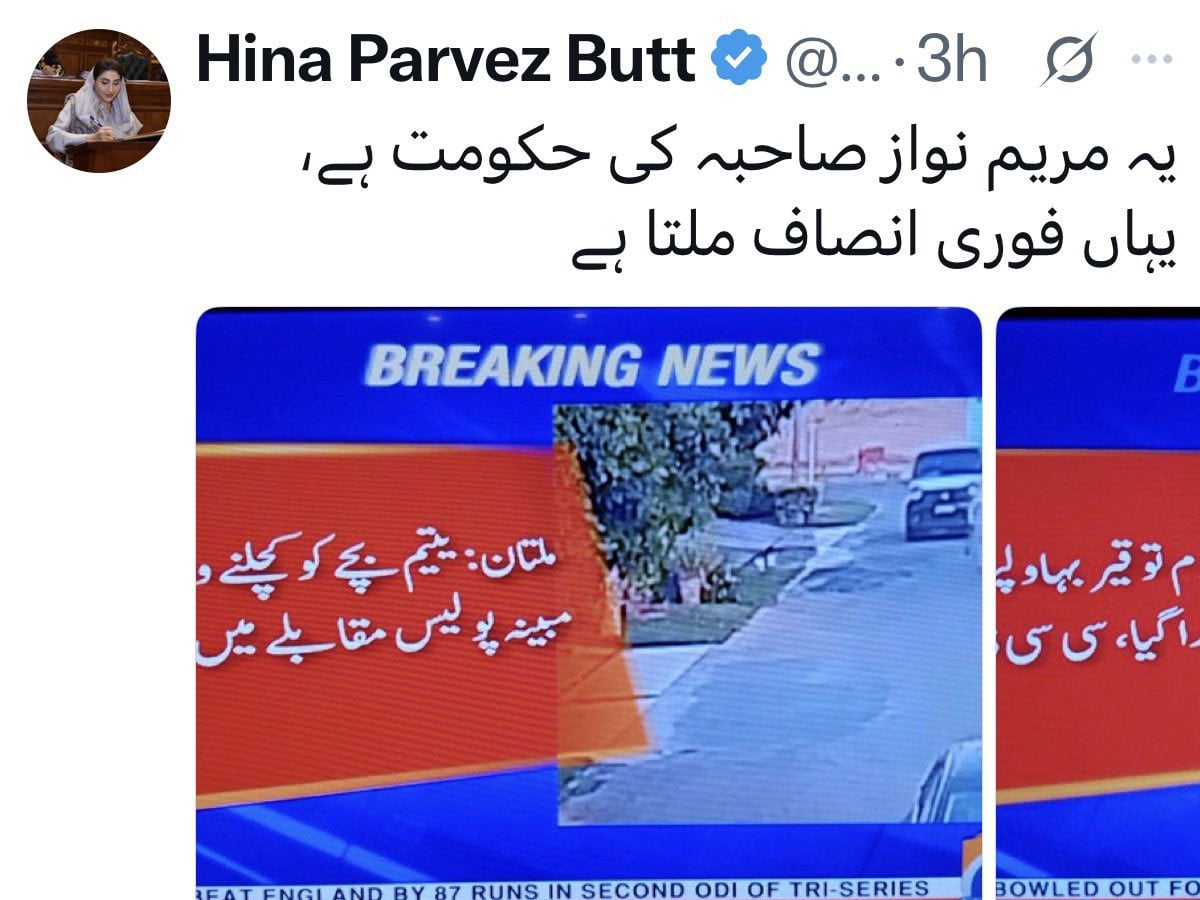
“This is Maryam Nawaz sahiba’s government; justice is served immediately here,” she wrote in a post that was later deleted amid criticism over its perceived endorsement of an extrajudicial killing under the provincial government’s watch.
Bokhari said cases involving organised crime were referred to the CCD rather than the regular police to ensure more effective investigation and prosecution and to meet all legal requirements for delivering justice.
She said the CCD had arrested hundreds, possibly thousands, of criminals, adding that public discussion should also focus on those who had been prosecuted and punished rather than only on the few hundred suspects who had allegedly tried to flee.
The minister reiterated that the chief minister had not ordered any encounter, adding that the government stood with the oppressed rather than the oppressors.
On judicial reforms, Bokhari said Pakistan was among the few countries with a large number of judicial laws, but the key issue was their implementation.
She added that the chief minister was also working to revamp the prosecution system and that considerable progress had been made in this regard.
Allegations of extrajudicial killings and increasingly unlawful conduct by Punjab’s CCD have long been a source of concern for human rights organisations, which have repeatedly raised the issue.
According to figures released by the Human Rights Commission of Pakistan in June, the organisation had documented 808 police ‘encounters’ since the CCD was established in April 2025, in which at least 1,100 suspects were killed.
Earlier today, it expressed concern over Abbas’s killing and the subsequent death of the primary suspect in an alleged police encounter, calling for an independent and transparent investigation into the case.
The commission said extrajudicial killings violated the right to due process and deprived victims and their families of the opportunity to establish the truth and seek justice.
It added that the perception that such killings were an acceptable means of controlling crime suggested that vengeance without accountability was being prioritised over justice.
The HRCP called for an independent and transparent investigation into the case and urged the authorities to bring an end to extrajudicial killings in all forms.