NA, Senate resolutions endorse president’s order; Achakzai urges reversal of governor’s rule
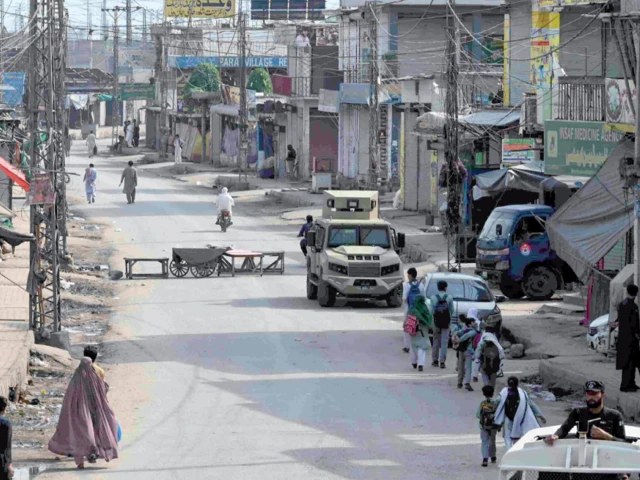
following violent clashes triggered by the imposition of emergency rule in Khyber-Pakhtunkwa. PHOTO: AFP
ISLAMABAD:
Both houses of parliament on Wednesday approved President Asif Ali Zardari’s proclamation of emergency in Khyber-Pakhtunkhwa by majority vote, despite opposition lawmakers’ objections to the measures.
The NA session began under the chairmanship of Speaker Ayaz Sadiq as Minister for Parliamentary Affairs Tariq Fazal Chaudhry presented the resolution before the House. During the proceedings, Chaudhry moved a separate motion seeking the suspension of question hour to allow the House to take up other parliamentary business. Opposition lawmakers opposed the motion, but it was adopted by a majority vote.
The Lower House later debated the emergency measures imposed in the province, with opposition lawmakers strongly opposing the Centre’s decision and raising a hue and cry during the proceedings. However, the resolution was passed by a majority vote. The NA session was subsequently adjourned until 11am on Friday.
Following the approval from NA, the Senate session was held under the chairmanship of Chairman Yousaf Raza Gilani. During the proceedings, the Senate also approved a motion moved by Senator Shahadat Awan to defer the question-and-answer session scheduled for the day.
Speaking in the upper house, Law Minister Azam Nazeer Tarar said Rules 132 and 133, which govern ordinary resolutions moved by private members, did not apply to a resolution introduced under a constitutional requirement. He added that the seven-day notice requirement was not applicable in this case.
Rejecting objections to the procedure, the law minister also said the government could not deviate from the Constitution or the rules and regulations of the House.
He maintained that members opposing the resolution should participate in the debate and, if they disagreed with it, reject it through a vote.
The minister called for the matter to be put to a vote after discussion so that the opinion of the House could be ascertained. Following this, the Senate approved the imposition of emergency in K-P as the opposition walked out in protest.
Later in the day, the president summoned a joint session of Majlis-e-Shoora (Parliament) tomorrow morning at 11 under Clause 1, Section 54 (Summoning and prorogation of Majlis-e-Shoora) of the Constitution of Pakistan. The notification regarding it was issued by the NA today.
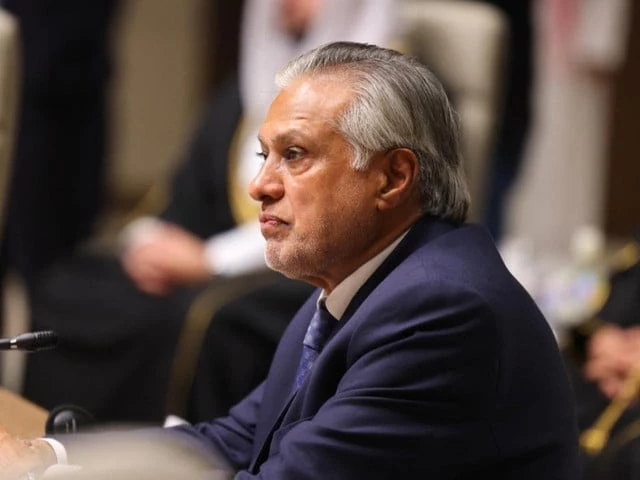
Earlier, while speaking on the NA floor, the law minister had said the K-P government’s approach to combating terrorism had become a “threat to national security”, as the federal government tabled a resolution in the NA seeking parliamentary approval of the emergency imposed in the province under Article 232 of the Constitution.
PPP Chairman Bilawal Bhutto-Zardari renewed his call for dialogue with the PTI, saying he would personally request Prime Minister Shehbaz Sharif to end the emergency in Khyber-Pakhtunkhwa (K-P) if political conditions were created that made the measure unnecessary.
“Even today, I invite you to come and hold talks with the government and political parties and create conditions in which there will be no need for this emergency in K-P. If you create these political conditions. I will personally stand in this House and request the prime minister that the time has come to end this emergency,” said Bilawal while addressing the National Assembly (NA).
Bilawal maintained that the federal government had made every possible political effort to engage the opposition before taking the constitutional step, saying that the opposition had every right to speak against the decision and oppose it, but argued that PTI could not deny its own role in creating the political, legal and constitutional circumstances that led to the situation.
The PPP chairman accused PTI of carrying out a “political suicide attack” on its own government in K-P, adding that opposition leaders could blame the federal government or President Asif Ali Zardari for the loss of their provincial government, but maintained that PTI, particularly its provincial leadership, had played a significant role in creating the circumstances.
He said responsible figures within the opposition were aware of these circumstances, even if they were unwilling to acknowledge them publicly. He argued that if the federal government had concluded that K-P was facing war-like conditions and that its internal situation prevented an effective response to terrorism, the provincial government should have provided political, legal or constitutional grounds for rejecting the proposed measure.
The PPP chairman questioned why PTI’s provincial leadership had failed to provide any justification that would have allowed President Zardari or the PPP to oppose the decision.
Bilawal said that when the proposal first came before the president and the PPP, their position was that the government should engage PTI and the opposition before resorting to what he described as a “constitutional atom bomb”. He said the objective was to address the federal government’s objections and allegations that the provincial government was not cooperating in the fight against terrorism, thereby removing any legal, constitutional or political justification for taking the step.
Speaking during the session, Minister Tarar said the Constitution required a presidential proclamation of emergency under Article 232 to be laid before both houses of parliament – the National Assembly and the Senate – for approval within 10 days of its issuance. Responding to criticism that the imposition of emergency had resulted in the removal of an elected provincial government, Tarar said the decision had been taken after extensive deliberations and a thorough assessment of the security situation in K-P.
He said the federal cabinet had held a two-and-a-half-hour discussion before recommending the emergency measures to the prime minister, citing internal disturbances and cross-border incursions as major factors behind the decision.
Meanwhile, Pashtunkhwa Milli Awami Party (PkMAP) Chairman Mahmood Khan Achakzai described the government as “a terrorist government”, alleging that it had been formed through money and coercion with the support of uniformed institutions, and defended non-functional chief minister Sohail Afridi’s opposition to what he termed oppression.
Achakzai accused the government of undermining the electoral mandate, alleging that the assemblies had been bought to install a government that did not represent the people’s will. He argued that the PTI had been prevented from contesting the elections under its party symbol and that its candidates had subsequently contested using around 200 different symbols.
“Whether PTI founder Imran Khan was good or bad, whatever he was, I don’t go to the past; you went to such an extent to compete with him that you even snatched the party’s election symbol. You stopped the party from participating in the election,” he said.
Questioning whether the government was punishing the entire country for the PTI’s electoral success, Achakzai asked, “Are you punishing Pakistan’s 240 million people for this?”
He defended Afridi’s stance against the government, saying K-P’s people had shown courage in opposing what he described as terrorism. He maintained that the Afridi had called on people to resist oppression rather than resort to violence. Achakzai also criticised the authorities over Afridi’s treatment, alleging that the Afridi had been arrested and restrained but not brought before the assembly.
“You have done us a great favour, a very great favour! After arresting Afridi and binding his hands and feet, you didn’t bring him here. Do it, do this too. What was he doing, Mr Speaker?” he asked.
Achakzai warned that political confrontation over provincial rights could extend beyond K-P, saying people in Balochistan and Punjab could also resist what he described as the forcible denial of their rights.
He expressed regret over the participation of political representatives from Sindh in the current political situation and warned that the province could face governor’s rule over disputes concerning water and mineral resources.
“Next, governor’s rule will be imposed in Sindh over water, minerals, Canals, and then you will remember what mistake we made,” he said.
Referring to the history of East Pakistan, Achakzai recalled that Mujibur Rehman had worked for the Muslim League before being branded a traitor. He said more than 48% of the people of East Pakistan had voted in favour of Pakistan, invoking the episode to criticise what he described as the denial of political representation.
He also criticised what he called the “Throne of Lahore”, describing it as cruel, and urged the government to reconsider its approach towards the provinces.
Addressing the NA speaker, Achakzai called for the reversal of the government’s decisions and urged lawmakers to restore parliament’s position as the centre of political authority. “Mr Speaker, there is still time; reverse it, reverse these decisions. Come, make this house a fountainhead of power, ” he said.
Speaking on the floor of the NA, Defence Minister Khawaja Asif said 3,900 people had been martyred in K-P over 14 months, in addition to 2,700 over three years, as he criticised the provincial government for prioritising political interests over counterterrorism efforts.
Asif called for a united national response to terrorism, saying the province was bearing the greatest burden of violence and could not effectively confront the threat without political cohesion.
He alleged that the non-functional K-P chief minister was more concerned about retaining power than addressing terrorism.
Asif said the Afridi had remained in office for 13 to 14 months and questioned whom he had taken instructions from, alleging that the individual directing him was now in Afghanistan. Asif also criticised the province’s governance, comparing its development over the past 13 years with that of other provinces.
Referring to a Taliban statement condemning an emergency and the deployment of security forces in certain areas, the minister urged the opposition to clarify its political alignments.
“The opponent is the Pakistan state, and the ally is the Taliban whose hands are stained with the blood of our children,” he highlighted during his speech in the lower house.
Alluding to a relative of former premier Imran Khan, whom he said was living in the United States, Asif questioned the extent of that individual’s influence over the province’s affairs, including health-related matters..