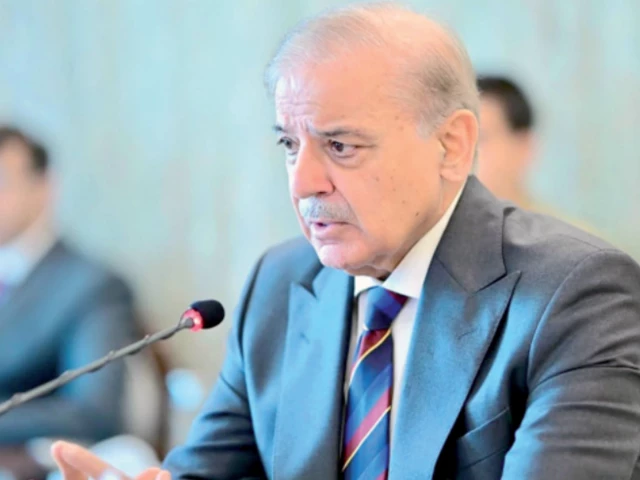
PM Shehbaz Sharif addresses a federal cabinet meeting. PHOTO: PPI
RAWALPINDI:
Prime Minister Shehbaz Sharif said on Tuesday that the federal government was left with no option but to take constitutional measures to impose an emergency in Khyber-Pakhtunkhwa (K-P) after efforts to resolve the deteriorating security situation in the province through dialogue failed.
Shehbaz took lawmakers from his Pakistan Muslim League-Nawaz (PML-N) and coalition partners – the Balochistan Awami Party (BAP), Istehkam-e-Pakistan Party (IPP), PML-Zia, PML-Q and Muttahida Qaumi Movement-Pakistan (MQM-P) – into confidence over the imposition of emergency in K-P.
The PML-N parliamentary party and the allied leaders endorsed Sunday’s proclamation of emergency and governor’s rule in K-P, as the prime minister explained that the decision followed consultations with coalition partners and detailed deliberations in the federal cabinet.
Addressing a meeting of the PML-N parliamentary party, Shehbaz said the government had repeatedly offered negotiations and cooperation to the provincial leadership but had failed to secure a positive response. “It’s now or never,” he recalled telling the cabinet, explaining the urgency of the situation.
He said the government’s priorities were to restore peace, improve law and order and accelerate development in the province. The PML-N parliamentary party endorsed the government’s strategy, while a National Assembly resolution concerning the emergency was planned for Wednesday (today).
Separately, the prime minister told a parliamentary delegation comprising representatives of the PML-Q, BAP, IPP and PML-Zia that the federal cabinet had decided to take constitutional measures under Articles 232 and 234 of the Constitution.
He accused the Pakistan Tehreek-e-Insaf (PTI)-led K-P government of failing to take a clear stance against terrorism and act effectively against terrorist groups. He said attacks had intensified, targeting civilians, police and security personnel, while abductions and other incidents had deepened insecurity.
Shehbaz said the federal government had provided more than Rs800 billion to K-P but the provincial government had failed to adequately strengthen its Counter Terrorism Department (CTD) or establish Safe City projects to improve law enforcement and surveillance.
He also criticised the PTI’s performance during its 13 years in power in the province, accusing it of failing to deliver adequately on public welfare and protect citizens’ lives and property. He said long marches, sit-ins and political protests had taken precedence over counterterrorism efforts.
The prime minister said the federal government intended to focus on education, healthcare, infrastructure and other essential services alongside restoring security. “Peace and stability are essential to sustaining improvements in economic indicators, reducing poverty and creating employment,” he said.
Shehbaz said a technocratic advisory council had been established to assist the governor in improving governance, strengthening the economy and tackling terrorism. “The council includes professionals from fields such as health, education and finance,” he added.
The allied parties’ delegation said the people of K-P had been deprived of adequate development in health, education and infrastructure during the PTI’s tenure. It expressed confidence that federal cooperation would help bring the province’s development closer to that of other parts of the country.
The prime minister told the delegation that the government aimed to strengthen the police and CTD, expand their capacity and establish Safe City projects as part of its broader response. The delegation expressed support for the proposed measures.
The move also received backing from the MQM-P, whose delegation, led by party convener and Federal Minister for Education Dr Khalid Maqbool Siddiqui, called on the prime minister and expressed support for the government’s proposed measures concerning K-P.
During the meeting, Shehbaz briefed the MQM-P leadership on the provincial situation and the government’s future course of action. Discussions covered the broader political situation, the security crisis and the potential consequences of the proposed measures.
The MQM-P also urged the prime minister to address what it described as poor law and order and governance in Sindh. Its leaders called for an immediate meeting involving the Sindh chief minister and the party’s two federal ministers to discuss problems confronting the province’s urban areas.
According to sources, MQM-P leader Dr Farooq Sattar urged the government to devise a strategy to address the tendency to stage protests in Karachi following incidents elsewhere in the country. The government assured the party that its concerns would be addressed and responded positively to its request.
In a related development, PML-N leader Rana Sanaullah told reporters that the government had been compelled to act, adding that K-P needed to demonstrate improved performance. He rejected the possibility of negotiations with those advocating the breakup of Pakistan.
“Terrorists had only one demand: that Balochistan be separated from Pakistan. How can negotiations be held with those who talk about breaking up Pakistan?” he asked, adding that this was also the narrative being advanced by the PTI.
Information Minister Attaullah Tarar, meanwhile, said terrorism in K-P had increased by 200% over the past five years. He said Jamiat Ulema-e-Islam-Fazl (JUI-F) chief Maulana Fazlur Rehman had attempted to resolve the situation through negotiations, but the PTI had abandoned dialogue.
Tarar accused the PTI government in K-P of prioritising social media activities over education and institutional development. He said the federal government’s measures were intended to restore security, improve governance and accelerate development in the province.
(WITH INPUTS FROM APP AND OUR KARACHI CORRESPONDENT)