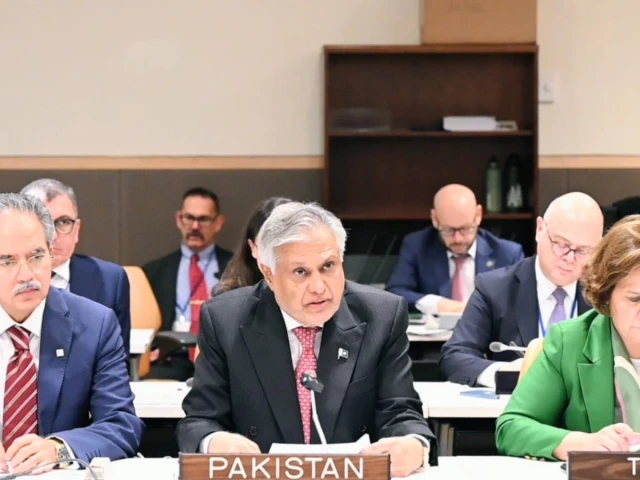
Deputy Prime Minister and Foreign Minister Ishaq Dar addresses the OIC Contact Group’s ministerial meeting on Jammu and Kashmir in New York. PHOTO: FOREIGNOFFICE/X
Deputy Prime Minister and Foreign Minister (FM) Ishaq Dar on Wednesday said India’s unilateral attempt to hold the Indus Waters Treaty (IWT) in abeyance had introduced another “dangerous dimension”, adding that international obligations cannot be set aside when they become inconvenient.
“India’s unilateral attempt to hold the Indus Waters Treaty in abeyance has introduced another dangerous dimension. The Treaty is a binding international agreement and contains no provision permitting its unilateral suspension,” FM Dar said while addressing the OIC Contact Group’s ministerial meeting on Indian Illegally Occupied Jammu and Kashmir (IIOJK) in New York, on the sidelines of the 81st session of the UN General Assembly.
He said the Court of Arbitration had reaffirmed that unilateral action by one party could not deprive the court of its competence and had underscored the continuing force of the Treaty’s obligations, including those governing the Western Rivers.
“International obligations cannot be set aside when they become inconvenient. India cannot invoke domestic law to negate Security Council resolutions on Jammu and Kashmir, any more than it can resort to unilateral measures to evade its binding obligations under the Indus Waters Treaty,” the foreign minister said.
FM Dar further said treaties and international commitments must be respected in good faith.
🔈 PR No. 2️⃣5️⃣6️⃣/2️⃣0️⃣2️⃣6️⃣
Remarks by the Deputy Prime Minister/Foreign Minister Senator Mohammad Ishaq Dar @MIshaqDar50 at the Ministerial Meeting of the OIC Contact Group on Jammu and Kashmir, on the sidelines of the 81st Session of the UN General Assembly, New York
🔗⬇️ pic.twitter.com/LcT2Uf5eU1
— Ministry of Foreign Affairs – Pakistan (@ForeignOfficePk) September 23, 2026
FM Dar urged the Organisation of Islamic Cooperation (OIC) to intensify diplomatic efforts over IIOJK, saying the bloc’s “principled solidarity” needed to be translated into “sustained diplomatic action”.
He urged OIC member states to maintain a “unified and visible OIC position” at the UN and other international forums.
The foreign minister called for intensified efforts to implement relevant UN Security Council resolutions and urged the OIC to press India to reverse “illegal measures” taken since August 2019.
FM Dar also called for the release of “all political prisoners and those arbitrarily detained” and demanded unrestricted access to the disputed territory for the OIC special envoy, fact-finding missions, UN special procedures, international media and independent observers.
He said the people of IIOJK had waited for almost eight decades for the international community to honour what he called a “solemn promise” — their right to determine their own future through a free and impartial process under UN auspices.
According to FM Dar, India, since August 2019, pursued measures to change the “demographic, political and cultural character” of Jammu and Kashmir.
He said that political and civic space had been systematically restricted, with Kashmiri leaders, activists, journalists and young people facing arbitrary detention and persecution under laws including the Public Safety Act and Unlawful Activities Prevention Act.
Video of the remarks by the Deputy Prime Minister/Foreign Minister Senator Mohammad Ishaq Dar @MIshaqDar50 at the Ministerial Meeting of the OIC Contact Group on Jammu and Kashmir, on the sidelines of the 81st Session of the UN General Assembly in New York. pic.twitter.com/bwzNScL5fr
— Ministry of Foreign Affairs – Pakistan (@ForeignOfficePk) September 23, 2026
FM Dar also said changes to domicile and land laws, electoral constituencies and voter rolls, along with property demolitions and measures affecting the region’s cultural and religious heritage, were used to alter “realities on the ground”.
On media freedoms, he said journalists faced “intimidation, surveillance and detention”, while the Kashmir Press Club had been forcibly closed and social media accounts blocked.
“These are not isolated violations. Taken together, they reveal a sustained effort to silence a people, transform the identity of their homeland and foreclose their right to self-determination and their own future,” he said.
FM Dar cited a joint communication by UN special procedures in October 2025, which he said had referred to the detention of about 2,800 people, including journalists and human rights defenders, as well as home demolitions, the blocking of about 8,000 social media accounts and incidents of hate speech, intimidation and dehumanisation targeting Kashmiris and Muslims.
He also referred to the Pakistan-India military conflict in May 2025 following the Pahalgam incident, saying it had highlighted the dangers of leaving the Kashmir dispute unresolved.
Read: Pakistan, seven other Muslim countries demand Israel to fulfil Gaza ceasefire commitments
The minister said the confrontation between the two countries had demonstrated the risks of allowing the dispute to remain unresolved.
“Two nuclear-armed states came into direct military conflict over a dispute that has remained unresolved for almost eight decades,” he said.
FM Dar said the confrontation showed that “military force cannot resolve long-standing political disputes”, while “dialogue, diplomacy and the just resolution of the root causes in accordance with international law” remained the sustainable way forward.
Read More: Pakistan, Saudi Arabia sign visa waiver agreement for diplomatic, official passport holders
He said Kashmir remained an “internationally recognised dispute” on the UN Security Council agenda and argued that no domestic legislation, judicial verdict, electoral exercise or demographic change could replace the Kashmiri people’s “inalienable right to self-determination”.
“Pakistan remained committed to a just and peaceful settlement of the dispute in accordance with relevant Security Council resolutions and the wishes of the Kashmiri people,” he said.
He urged the OIC to strengthen coordinated diplomacy in New York and Geneva and support its call for an updated report on Jammu and Kashmir.
“The Kashmiri people are only asking the international community to deliver what was provided to them decades ago,” FM Dar said.
He said their right to self-determination was already recognised and that the mechanism for its exercise had been prescribed by the UN Security Council.
FM Dar urged the OIC to maintain its “unwavering solidarity” with the Kashmiri people while keeping Jammu and Kashmir high on the international agenda.
The meeting concluded with the OIC Contact Group considering a joint communique, FM Dar said.