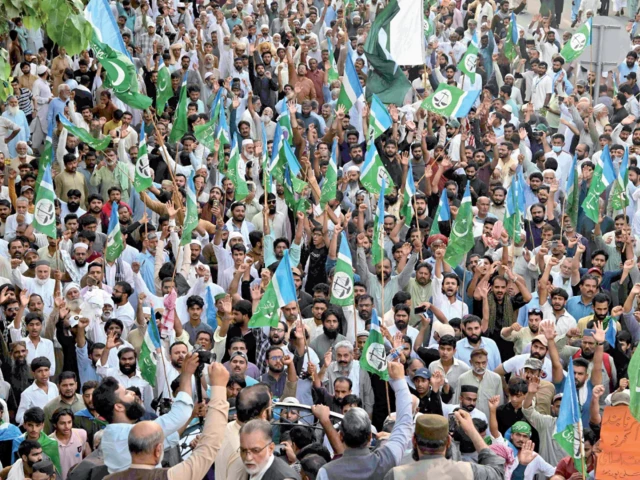
RISING COSTS: Jamaat-e-Islami supporters chant slogans as they block the motorway in Lahore during a protest against increased petroleum levy, rising fuel prices and inflation. PHOTO: AFP
LAHORE:
A protest is one of the most basic ways citizens can make their grievances heard. Yet in Pakistan, the state’s response often changes with the nature of the disruption: when a road is blocked, the machinery of the state becomes active; when a sit-in continues for weeks, silence can prevail; and when violence enters the picture, the negotiating table is suddenly set.
The ongoing Jamaat-e-Islami sit-ins in Lahore, Karachi and Peshawar have once again raised a critical question: does a peaceful voice become a government priority only when it turns into a law-and-order problem?
Jamaat-e-Islami has been protesting against the petroleum levy and demanding relief for the public. In Lahore, protesters have gathered near the Chief Minister’s House, while sit-ins are being held outside the Governor Houses in Karachi and Peshawar.
The party says its protests are peaceful. However, no clear progress has been made on its demands. The government formed a negotiating committee at the outset, but formal talks could not begin.
According to Human Rights Commission of Pakistan (HRCP) Secretary General Harris Khalique, Article 16 guarantees the right to peaceful assembly, subject to reasonable restrictions. Experts say protests are often treated as law-and-order issues rather than expressions of public grievances, with major state action typically following violence or disruption.
Peter Jacob, Executive Director of the Centre for Social Justice, says violence does not justify a protest but raises questions about the state’s response. He argues that early negotiations and a clear government position could prevent peaceful protests from becoming crises.
The same pattern is visible in smaller demonstrations. At Lahore Press Club, rickshaw union workers, government employees, students and other groups regularly protest over their demands. Some face arrests, while others leave without receiving a clear administrative response.
Senior analyst Faisal Hussain says major political protests receive sustained media coverage, while demonstrations concerning ordinary citizens receive comparatively little attention.
The HRCP confirms that many protests are ignored when they remain small and peaceful. Once traffic, businesses or public order are affected, however, law-enforcement agencies are quickly mobilised.
The right to protest is not unlimited. In Punjab, Section 144 and other laws allow restrictions in certain circumstances. Police say action becomes necessary when roads are blocked, property is damaged or citizens’ movement is affected.
Former Superintendent of Police Malik Owais says the police’s primary responsibility is to maintain law and order and keep traffic moving.
Civil society representative Abdullah Malik, however, questions whether the same standards are applied to different protest groups. He points to previous protests by farmers, teachers and visually impaired people on Mall Road, where strict action was taken, while police are providing security to Jamaat-e-Islami’s current sit-ins.
Jamaat-e-Islami Deputy Ameer Liaqat Baloch says the state’s responsibility is not merely to stop illegal protests but also to protect peaceful assembly and respond to legitimate grievances.
Meanwhile, Prime Minister’s Adviser Rana Sanaullah said the sit-in was against the federal government and that a three-member committee comprising himself, Ahsan Iqbal and Bilal Kiani had been formed for talks.
He said he had invited Liaqat Baloch to meet either at the sit-in or elsewhere, adding that the government was ready to negotiate once Jamaat-e-Islami responded.
A government delegation met Jamaat-e-Islami Ameer Hafiz Naeemur Rehman and his team at Mansoorah on September 3. It was agreed that Jamaat’s experts would meet government experts in Islamabad on September 7 to explore a technical solution for providing relief on petroleum prices. The team will be led by Liaqat Baloch.