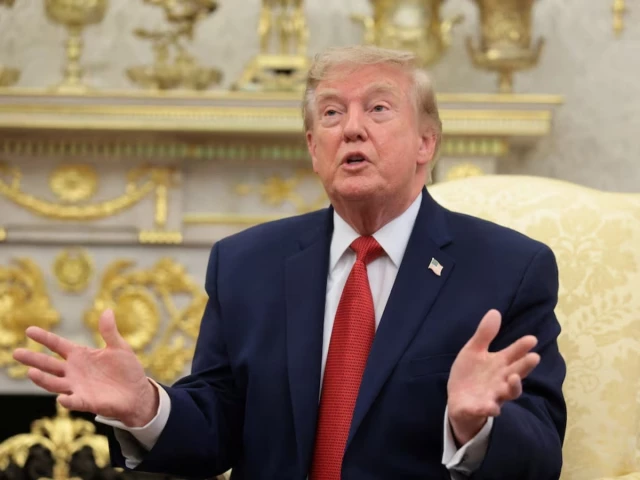
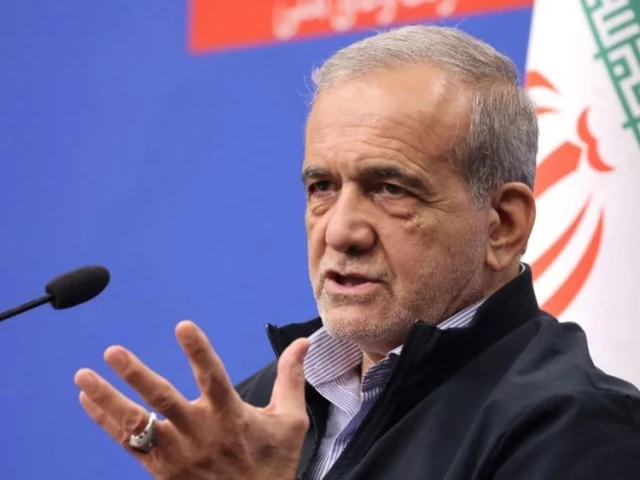
Iranian President Masoud Pezeshkian said Israel tried to assassinate him during 12-day war. PHOTO: AFP
President Masoud Pezeshkian asserted that Iran will not accept pressure aimed at forcing the country into submission, stressing that the Islamic Republic would continue to defend what it regards as its rights and maintain its military and defensive capabilities, Press TV reported on Saturday.
“If they seek to force us into submission, we will fight. We will not back down, nor will we bow our heads. When we are capable of securing our rights, why should we travel down a path that is desired by Israel?” the chief executive said in the third and final part of a televised broadcast aired on Friday, marking the second anniversary of his inauguration.
Pezeshkian rejected the prospect of Iran giving up its military capabilities and defensive power, describing their preservation as a matter that the country would not compromise on.
“Would it be right for us to accept having all our military capabilities and defensive power taken away from us and to bow before them (the adversaries)? We will not do such a thing,” he said.
“Armed forces astonished the world”
He also described Iran’s military response during the latest bout of unprovoked American-Israeli aggression as an act of defence and praised the country’s Armed Forces for their performance.
“We were forced to defend ourselves, and, by God, our fighters – our Aerospace Forces, the Army, the IRGC, and all our servicemen – put up a fierce defence and astonished the world,” Pezeshkian said.
“Israel, US seeking to unite Persian Gulf states against Iran”
The president denounced the Israeli regime and the United States for seeking to bring Persian Gulf countries together against Iran.
“Now, with the war that has unfolded, Israel and the United States are seeking to unite the Persian Gulf countries against us, and we, for our part, are working to prevent that from happening,” he said.
Despite the provocations attempted by Tel Aviv and Washington, Iran believes in Muslim unity and does not view divisions between Shia and Sunni Muslims as a basis for separating Muslims from one another, the senior official stated.
“This is my belief and conviction, and I say it not as a slogan, but because I genuinely believe in it: Muslims are brothers to one another.”
Pezeshkian rejected the idea that Iran seeks territorial expansion or intends to attack neighbouring countries, contrasting this official position with the Israeli regime’s territorial ambitions.
“We have no intention of attacking other countries, seizing territory, or expanding our borders. Unlike the Zionists, who are in fact seeking a ‘Greater Israel…’ We are neighbours with the countries of the region, we share borders with them, and we must live alongside one another…”
He further addressed the role of regional countries in the latest foreign aggression targeting Iran, saying US forces had used those states’ respective territories to target the Islamic Republic.
“The question is: From where did they (the aggressors) strike Minab School?” he asked, referring to a school that was targeted in southern Iran in the early stages of the aggression, claiming the lives of 168 people. “From those very Muslim and friendly countries.”
“Why should they allow them to come and attack us? We do not want to target those countries; we strike the place from which we are attacked,” Pezeshkian noted, referencing Iran’s retaliatory strikes on American interests in the countries that had let their territories be used as launch pads for aggression against the Islamic Republic.
Trump’s top general seeks path out of Iran war as military options narrow: report
US Chairman of the Joint Chiefs of Staff Gen Dan Caine has privately urged senior Trump administration officials to seek a way to de-escalate the war with Iran, amid concerns that available military options could produce limited results and trigger wider retaliation, according to a report on Friday.
Citing three sources familiar with the discussions, CNN reported that Caine raised his concerns with senior officials including CIA Director John Ratcliffe, Secretary of State Marco Rubio and Vice President JD Vance.
The report said Caine and other officials believe airpower alone is unlikely to force Tehran to accept US demands, despite President Donald Trump’s continued preference for avoiding a ground invasion.
Caine and other senior officials were reportedly skeptical of a proposed escalation in late July, partly due to concerns about Iranian retaliation against US allies and regional energy infrastructure. Trump ultimately postponed the operation after Gulf partners warned of possible attacks, said the report.
It also highlighted growing concerns about depleted US weapons stocks, including air-defense interceptors and other precision munitions, which could constrain Washington’s ability to sustain a prolonged conflict.
Noting that Caine has warned Trump about the military risks, CNN said he also emphasized US forces could inflict significant damage on Iran if ordered to escalate.
The report said administration officials are now looking for an outcome Trump could portray as a political victory while leaving room for diplomacy, including a possible agreement to reopen the Strait of Hormuz.
US expects deal soon on Strait of Hormuz; Sunni powers unite in defence pact
A US official on Friday reported progress between Iran and Oman that could soon reopen the Strait of Hormuz, potentially restoring oil exports that have been disrupted by the five-month-old US war with Iran.
The US official, who declined to be identified, said Washington anticipated an agreement soon between the two countries, which sit on either side of the strait, so that normal oil traffic could resume.
A deal between Iran and Oman over control of the strategic waterway is seen as crucial to a wider peace agreement.
Read: Iran’s top negotiator slams US’s ‘theatre diplomacy on loop’
“There is progress between Oman and Iran on the strait, and we expect a deal soon,” a US official told Reuters on Friday. “Once the deal is announced to restore commercial shipping without impediments, the United States will lift the blockade of Iranian ports.”
“As always, US actions will continue to be performance-based and tied to Iran’s implementation of its commitments,” the official said.
Before the US and Israel launched the war on Iran on February 28, about one out of every five barrels of oil consumed worldwide transited the strait, but Iran has used the hostilities to justify charging a toll on oil tankers and firing on ships that attempt to cross the strait without permission.
That disruption in oil shipments has caused energy prices to surge and fueled inflation.
In recent weeks, the Trump administration has repeatedly signaled that a deal to open the strait could be close, only to have Iran deny that talks are under way. It was unclear whether the latest flurry of negotiations would yield a more lasting arrangement.
Iranian strikes on Strait of Hormuz shipping have been coupled with increased attacks by its Yemen-based allies, the Houthis, who have targeted ships at another oil chokepoint on the other side of the Arabian Peninsula between the Red Sea and Gulf of Aden.
Abu Dhabi National Oil Company, one of the world’s largest energy producers, said on Friday that 15 of its vessels had been struck in what it called unprovoked attacks while transiting the Strait of Hormuz since the start of the conflict. The attacks have killed one crew member and wounded 20 others, it said.
New security pact
Alarmed at a regional conflagration that has brought Iranian missile fire onto Gulf oil exporters, Saudi Arabia, Pakistan and Turkey signed a joint defence agreement in Makkah on Friday.
The pact among three US allies with majority Sunni Muslim populations is intended to strengthen collective deterrence against aggression and stipulates that an armed attack against any of the three would be regarded as an attack on all, the countries said in a statement.
Turkey said the agreement was not aimed at any specific country and was purely defensive. But it comes at a time of heightened tensions with Shi’ite-majority Iran.
Read more: Pakistan, Saudi Arabia, Turkiye sign joint defence pact in Makkah
Meanwhile, the US has been trying to broker an end to fighting on another front of the war between Israel and Iranian-backed Shi’ite group Hezbollah in southern Lebanon.
A Lebanese official said on Friday that Lebanon and Israel agreed on a shortlist of countries that could send troops to verify the disarmament of Hezbollah under a US-brokered agreement. The United States would pick countries from the list.
Iran president defends diplomacy
Washington and Tehran have not engaged in direct high-level talks since US Vice President JD Vance met Iranian officials in Switzerland in June, shortly after the two sides reached a ceasefire agreement. That short-lived June 17 memorandum of understanding established terms for resuming Strait of Hormuz oil shipping and led to a ceasefire.
Amid internal opposition to the deal in the US and Iran, hostilities resumed on July 7, only to be put on hold again. The US military’s Central Command has not reported any strikes on Iran since July 29.
Also read: Iran threatens to ‘black out’ Gulf if power plants hit by US
Analysts have said signs of fissures between Iran’s civilian president, Masoud Pezeshkian, and the other power centers in Iran, notably Supreme Leader Ayatollah Mojtaba Khamenei and the Islamic Revolutionary Guard Corps, may be complicating peace efforts.
In an interview with state television broadcast on Friday, Pezeshkian defended his government’s policies against hardliners who have opposed negotiations with the United States. He said that most senior military commanders supported talks towards a deal to stop the fighting.
“America’s biggest enemy is China; why don’t they fight? China is doing its own thing and is getting stronger day by day. When we can get our rights through dialogue, why not do it?” he said.