FM to call on King Abdullah II, hold series of bilateral meetings with fellow foreign ministers
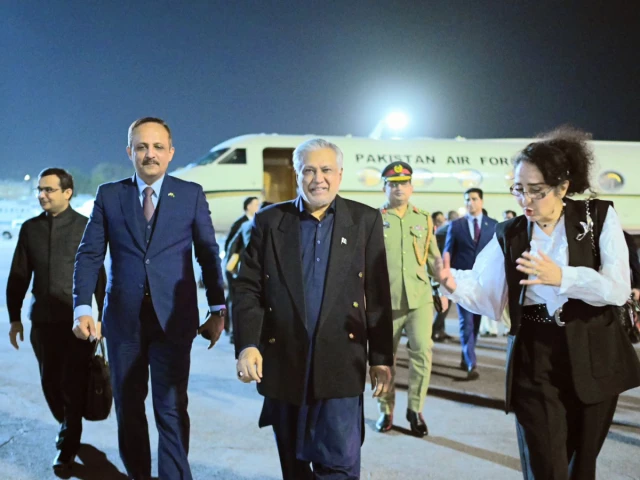
Deputy Prime Minister and Foreign Minister Senator Mohammad Ishaq Dar arrives in Amman to attend the Ministerial Meeting on Jerusalem. PHOTO: FO
Deputy Prime Minister and Foreign Minister Ishaq Dar arrived in Amman on Wednesday to participate in the Ministerial Meeting on Jerusalem, convened by Jordan, the Ministry of Foreign Affairs (MoFA) said.
According to a post by MoFA on X, Dar was received upon arrival by Jordan’s Director of the Human Rights Directorate at the Ministry of Foreign Affairs and Expatriates Saja Almajali, Pakistan’s Ambassador to Jordan Major General (retd) Khurram Sarfraz Khan, and officials of the Pakistani embassy.
MoFA stated that Dar has “a full programme of engagements” during his visit, centred on discussions over the deteriorating situation in the Occupied Palestinian Territory and broader regional developments.
Deputy Prime Minister/Foreign Minister Senator Mohammad Ishaq Dar @MIshaqDar50 arrived in Amman, Jordan, to participate in the Ministerial Meeting on Jerusalem, convened by the Hashemite Kingdom of Jordan.
Upon arrival, the DPM/FM was received by H.E. Ms. Saja Almajali, Director… pic.twitter.com/K6vxawaGyy
— Ministry of Foreign Affairs – Pakistan (@ForeignOfficePk) August 5, 2026
The foreign minister’s schedule includes participation in the Ministerial Meeting on Jerusalem, a call on Jordan’s King Abdullah II, and a series of bilateral meetings with fellow foreign ministers.
The statement said these meetings will focus on “the situation in the Occupied Palestinian Territory, as well as regional and bilateral issues of mutual interest.”
“The meeting will bring together foreign ministers from the Arab League and a group of Islamic countries, including Pakistan, to formulate a unified position on the fast-deteriorating situation in occupied Jerusalem,” MoFA had said earlier.
Read: Pakistan, Egypt condemn Israeli military actions in Gaza, occupied West Bank
It added that Dar would also hold bilateral meetings on the sidelines of the conference with participating foreign ministers to exchange views on regional developments, including Palestine, as well as other issues of mutual interest.
Dar’s participation, MoFA had said, was a “manifestation of Pakistan’s principled support for the Palestinian people” and its “unwavering commitment” to the establishment of an independent, sovereign and contiguous State of Palestine, based on the pre-1967 borders, with Al-Quds Al-Sharif as its capital.
Alongside Dar, senior officials from Turkiye, Jordan, Palestine, Egypt, Saudi Arabia, Qatar, Indonesia, Bahrain, Iraq, Morocco, Tunisia, Algeria, Somalia and Malaysia, as well as the secretary-general of the Arab League, were expected to attend.
Anadolu reported that participants were expected to discuss preserving the historical and legal status of Jerusalem’s holy sites, developments in occupied East Jerusalem and the West Bank, Israel’s actions that are deemed contrary to international law, the Gaza ceasefire process, recent developments concerning the Palestinian issue and international efforts to implement a two-state solution.
Last week, 14 Arab and Palestinian institutions and organisations issued an urgent appeal calling for collective action to protect occupied Jerusalem amid what they described as escalating Israeli violations targeting Al-Aqsa Mosque and the city’s historic identity.
Read More: Pakistan, Turkiye express concern over Israeli actions in Gaza, Al-Aqsa Mosque violations
The appeal warned of an unprecedented Israeli escalation targeting Al-Aqsa Mosque, Jerusalemites, and the city’s Arab, Islamic and Christian identity, saying the measures sought to create new realities on the ground and consolidate control by force.
Al-Aqsa Mosque is the world’s third-holiest site for Muslims. Jews refer to the area as the Temple Mount, claiming it was the site of two Jewish temples in ancient times. Israel occupied East Jerusalem, where Al-Aqsa Mosque is located, during the 1967 Arab-Israeli War. It annexed the entire city in 1980, a move never recognised by the international community.
The appeal said Jerusalem was facing one of the most critical periods in its modern history, citing increased incursions into Al-Aqsa Mosque by extremist Israeli occupiers under the protection of Israeli forces, along with efforts to impose a temporal and spatial division of the mosque.