Negotiations between the parties are continuing to normalise the situation, FO says
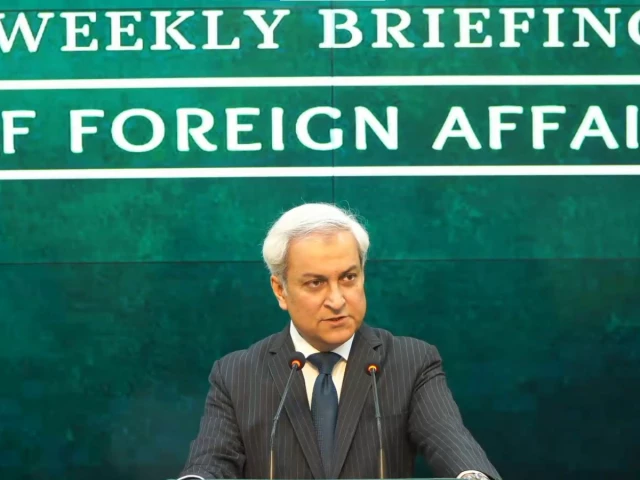
Foreign Office spokesperson Tahir Hussain Andrabi speaking at the FO weekly press briefing. SCREENGRAB
Pakistan was making efforts to bring the concerned parties back to the Islamabad Memorandum of Understanding (MoU) as part of ongoing efforts to reduce regional tensions, the Foreign Office (FO) said on Thursday.
Addressing a weekly press briefing, FO spokesperson Tahir Andrabi said, “We are doing our utmost to bring the parties back to the Islamabad MOU so that all irritants can be removed in the light of the Islamabad MOU and the Pakistan-Qatar Joint Statement of June 22.”
He said negotiations between the parties were continuing to normalise the situation, particularly in the Strait of Hormuz, and to support de-escalation.
“The negotiations between the parties are ongoing to normalise the situation, particularly the situation in the Strait of Hormuz, and as well as to de-escalate,” he said.
Reiterating Pakistan’s position, Andrabi said, “We note with concern that the security situation remains precarious, despite the relative calm of the past few days, which had rekindled hopes that this positive development, this calm, would consolidate into a durable and fully respected ceasefire and pave the way for dialogue.”
He added, “Amid the prevailing tensions and hostilities, Pakistan reiterates that dialogue and diplomacy remain the only viable path forward. We welcome all efforts aimed at sustaining cessation of hostilities and resumption of dialogue between Iran and the United States. Pakistan is engaged and will continue to play its role in this regard.”
Calling for restraint, the spokesperson said, “We encourage the parties to exercise maximum restraint and fully adhere to their commitment to resume technical-level talks for the implementation of the Islamabad MOU in line with the Pakistan-Qatar Joint Statement of June 21, 2026.”
Referring to Pakistan’s diplomatic engagements, Andrabi said Prime Minister Shehbaz Sharif recently spoke with Saudi Crown Prince Mohammed bin Salman bin Abdulaziz Al Saud, during which both leaders agreed to continue working closely to maintain regional peace, stability and the uninterrupted flow of lawful maritime commerce through the Red Sea and the Strait of Hormuz.
He said Deputy Prime Minister and Foreign Minister Ishaq Dar subsequently held a telephone conversation with Saudi Foreign Minister Prince Faisal bin Farhan Al Saud, during which they discussed the latest regional developments, reaffirmed the close and brotherly ties between Pakistan and Saudi Arabia, and underscored the importance of continued diplomacy and constructive engagement for regional peace and stability.
🔴LIVE: Spokesperson’s Weekly Press Briefing 30-07-2026 at Ministry of Foreign Affairs, Islamabad https://t.co/2VazEzza1f
— Ministry of Foreign Affairs – Pakistan (@ForeignOfficePk) July 30, 2026
Andrabi said Dar also held a telephone conversation with Jordanian Deputy Prime Minister and Foreign Minister Ayman Safadi, during which the two leaders discussed the worsening situation in Palestine, condemned Israeli actions and reaffirmed their commitment to regional peace and security.
On bilateral ties with Kuwait, the spokesperson said, “Pakistan and Kuwait reaffirmed their strong and longstanding bilateral partnership and agreed to deepen cooperation, particularly in trade, investment, energy, IT, agriculture, education, health and other priority sectors through sustained high-level engagements and the establishment of joint working groups.”
Read: US, Iran trade rival claims over fragile truce
He added, “The DPM welcomed Kuwait’s ratification of the Pakistan-Kuwait Defence Cooperation Agreement, describing it as a significant step towards strengthening institutional defence ties and collaboration between the two countries.”
The spokesperson said Dar also participated in the Shanghai Cooperation Organisation (SCO) Council of Foreign Ministers meeting in the Kyrgyz Republic, where he reaffirmed Pakistan’s commitment to the SCO Charter, regional connectivity, the China-Pakistan Economic Corridor and China’s Belt and Road Initiative, while conveying Pakistan’s readiness to assume the SCO chairmanship for 2026-27.
On Pakistan-US relations, Andrabi said Dar met a US congressional delegation and a 33-member American business delegation on July 28, during which he highlighted the positive momentum in bilateral ties and reaffirmed Pakistan’s commitment to strengthening relations through enhanced parliamentary engagement, economic cooperation and people-to-people exchanges.
Turning to Palestine, Andrabi said, “On July 24, 2026, the foreign ministers of eight Arab-Islamic countries, including Pakistan, issued a joint statement strongly condemning Israel’s actions and restrictions in Jerusalem, particularly concerning the Al-Aqsa Mosque. They called on the international community to uphold international law, protect the rights of Palestinians, and preserve the religious and historical status of the holy city.”
He said Dar also held a telephone conversation with Egyptian Foreign Minister Dr Badr Abdelatty, during which both sides expressed grave concern over the situation in Palestine, called for an immediate end to hostilities, unhindered humanitarian assistance and respect for international law, and discussed coordinated diplomatic efforts in support of the Palestinian people.
The spokesperson said Pakistan and Egypt also held the 10th round of their annual bilateral consultations virtually last week, during which the two sides reviewed cooperation in trade, investment, education, culture, science and people-to-people contacts, while reaffirming their commitment to stronger regional coordination and cooperation on multilateral issues.
Read more: Dar urges Iran, US to build on Islamabad MoU
Highlighting another initiative, Andrabi said, “On 24 July, the Ministry of Foreign Affairs, in collaboration with COMSTECH, launched the first issue of the Journal of Science, Communication, and Diplomacy for 2026, marking the second year of its publication.”
He said the journal provides a platform for diplomats, scientists, academics and policy practitioners to engage in discourse at the intersection of science, technology and international relations, adding that the inaugural 2026 issue features 11 articles, including seven authored by officers of the Ministry of Foreign Affairs and one by Foreign Secretary Amna Baloch.