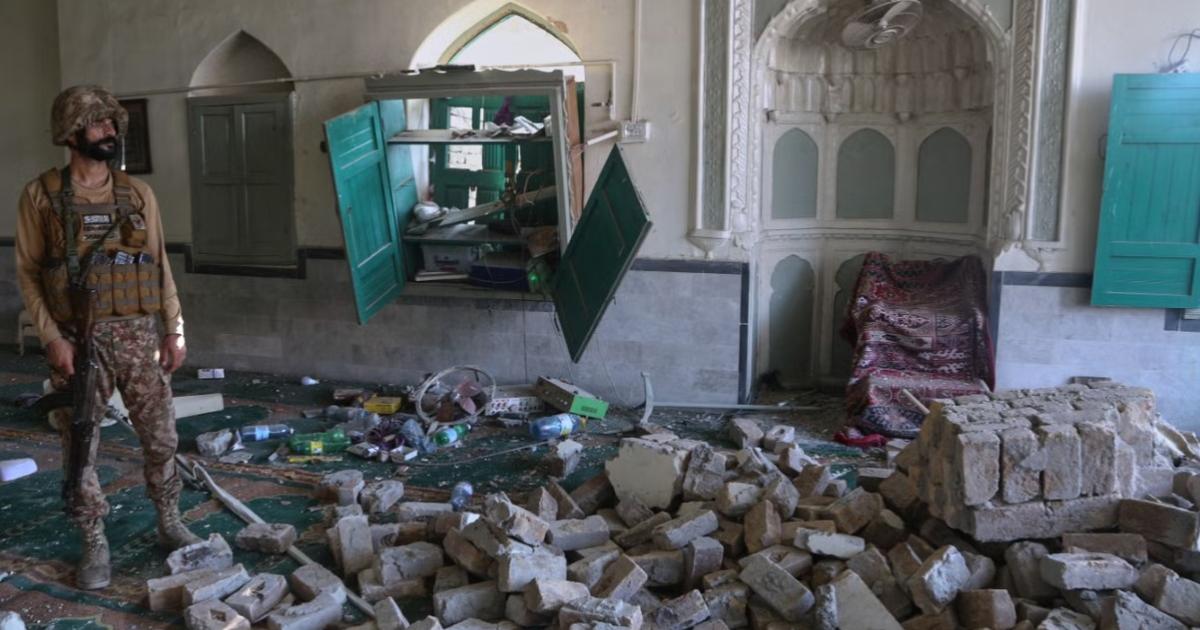

NDMA reports at least 107 people have died and 297 others have been injured since the rains began on June 26
Climate Minister Musadiq Malik speaking at the National Disaster Management Authority (NDMA). SCREENGRAB
Pakistan must shift its focus from simply storing water to regulating it year-round, Climate Minister Musadiq Malik said on Tuesday, as federal ministers outlined the government’s monsoon preparedness strategy and warned that better water management would be critical to protecting food security and reducing the impact of climate-related disasters.
The briefing came as Pakistan continued to battle a deadly monsoon season, with the National Disaster Management Authority (NDMA) reporting that at least 107 people had died and 297 others had been injured since the rains began on June 26. The Pakistan Meteorological Department (PMD) has forecast another strong monsoon spell from July 29, warning of heavy rain, urban flooding and flash floods in parts of Islamabad, Punjab, Khyber-Pakhtunkhwa (K-P), Azad Jammu and Kashmir (AJK) and Gilgit-Baltistan (G-B).
Speaking at the NDMA headquarters alongside other ministers, Malik said the government had moved away from a one-size-fits-all disaster response, adopting a strategy tailored to the different risks faced by various parts of the country.
“Our strategy is separate. It has been further segmented,” he said, explaining that dedicated plans were being developed with the provinces for cities vulnerable to extreme heat, alongside separate strategies for the northern regions, agricultural plains and rural areas to protect food security and strengthen agricultural productivity.
Climate Change Minister Musadik Malik says Pakistan is among the world’s 10 most climate-vulnerable countries, with more than 6,000 lives lost to climate-related disasters. He says Pakistan has presented its case to the international community.#ClimateChange #Pakistan… pic.twitter.com/rIXMucmq2b
— Pakistan TV (@PakTVGlobal) July 28, 2026
The minister argued that Pakistan’s biggest challenge was not simply storing more water but ensuring it was available when farmers needed it.
“If you allowed the equivalent of ten Mangla dams’ worth of water to flow away during the last floods and did not retain it for the time when you actually needed it, what wisdom was there in that?” he asked.
“We do not just have to collect water. We have to regulate water.”
He said dams should be viewed as instruments for regulating water supplies rather than merely storing them, warning that without sufficient water during the Rabi and Kharif seasons, food security would inevitably suffer.
Calling water infrastructure a matter of national security, Malik said the government would focus on improving water regulation, telemetry and storage systems while also working with provinces to tighten zoning and construction standards.
“If a roof collapses, tell me what any government can do afterwards,” he said, adding that although building regulation primarily falls under provincial governments after the 18th Amendment, the federation would provide whatever technical support was required.
Read: Ten more die as monsoon death toll tops 100
National Food Security Minister Rana Tanveer Hussain, addressing the same panel, said, “Pakistan will especially need much greater water storage in the coming days.”
He said the country must prepare for two parallel challenges: “how to deal with floods and how to overcome water shortages.” Describing food security, water management and disaster preparedness as “interdependent and interrelated”, he said expanding storage capacity remained a priority.
Tanveer said the Diamer-Bhasha Dam would add around 6.4 million acre-feet of storage capacity, while Mohmand Dam would contribute nearly one million acre-feet. He also pointed to progress on the Dasu project and expressed hope that Karachi’s K-IV water supply project would be completed by the end of this year or early next year.
Echoing calls for a coordinated approach, Finance Minister Aurangzeb described climate change and population growth as Pakistan’s two “existential issues”, saying, “There has to be a whole-of-government approach.”
He credited NDMA’s National Emergencies Operation Centre (NEOC) for significantly improving Pakistan’s ability to anticipate disasters, recalling that officials had accurately forecast glacial lake outburst floods, flash floods and heatwaves during briefings last year. “I was here in November and December. We were given minute-by-minute presentations on when glacial lake outburst floods would occur, when flash floods would happen and when heatwaves would arrive.”
Aurangzeb also said Pakistan was now in a stronger financial position to respond to disasters than it had been during the catastrophic 2022 floods. “The prime minister and the cabinet have decided that we now have sufficient resources so that whenever such disasters occur we can use our own resources for rescue and relief.”
Warning that climate change posed a direct threat to economic growth, he said, “If we do not properly address these two issues, then whether we grow at 4%, 5%, 6% or 8% becomes irrelevant.”
Information Minister Attaullah Tarar said preparations for the monsoon season had begun well before the rains under Prime Minister Shehbaz Sharif’s directives, with NDMA coordinating closely with federal ministries, provincial governments, Gilgit-Baltistan and Azad Jammu and Kashmir.
Information Minister Attaullah Tarar says the NDMA and other relevant agencies have developed an effective early warning system that has helped provide timely alerts and reduce monsoon-related damages. He says the government’s response to this year’s monsoon rains remained… pic.twitter.com/sjGraLVYJL
— Pakistan TV (@PakTVGlobal) July 28, 2026
He credited the NEOC forecasting technology and early warning systems with helping reduce casualties and property damage during this year’s monsoon.
“This NEOC is one of the few facilities of its kind in the world,” Tarar said, describing it as “an asset” that enabled authorities to provide timely alerts through traditional media and the NDMA Alert mobile application.
Read More: Monsoon keeps Punjab rivers swollen
He urged citizens to remain vigilant and respond promptly to official warnings, noting that several cities had received months’ worth of rainfall within just a few days.
Thanking the media for amplifying weather alerts and public awareness campaigns, Tarar said the government would continue working with broadcasters and digital platforms to keep citizens informed throughout the monsoon season.
“Under the prime minister’s supervision, we are pursuing an effective whole-of-government approach,” he said. “We will protect infrastructure, ensure rapid response wherever damage occurs and reduce hardship for the people.”
Monsoon in full swing
Several rivers in Punjab continued to experience flooding due to monsoon rains, although the flood situation in the Chenab River showed signs of improvement over the past 24 hours, the Provincial Disaster Management Authority (PDMA) said on Monday.
The PDMA said river flows had remained stable during the past 24 hours. Low-level flooding persisted in the Indus River at Kalabagh, Chashma and Taunsa, where water flows were recorded at 273,000, 313,000 and 364,000 cusecs, respectively.
Punjab and K-P have borne the brunt of the fatalities, many of them caused by collapsing mud houses, electrocution and lightning strikes. Gilgit-Baltistan has also suffered extensive damage, with flash floods and mudslides destroying homes, bridges and road infrastructure in several districts.
The government has also been preparing for another spell of heavy rain. The PMD has forecast a strong monsoon system from July 29, warning of widespread rainfall in Islamabad, upper Punjab, K-P, Azad Jammu and Kashmir, Gilgit-Baltistan and the upper catchment areas of major rivers.
The weather department has cautioned that the system could trigger urban flooding, flash floods in hill torrents and nullahs, and a rise in river flows, prompting authorities to step up preparedness and emergency response measures ahead of the fresh spell.
Meanwhile, G-B remains among the worst-affected regions, where flash floods, mudflows and landslides have damaged 184 houses, destroyed nine bridges and washed away nearly eight kilometres of roads, according to the Gilgit-Baltistan Disaster Management Authority.
It said 60 disaster incidents have been recorded across the region, with Astore reporting the highest number of damaged houses, Diamer suffering extensive destruction and Skardu recording the greatest bridge losses.