
Policy 2030 targets paperless governance, online public services, AI skills for 100,000 youth
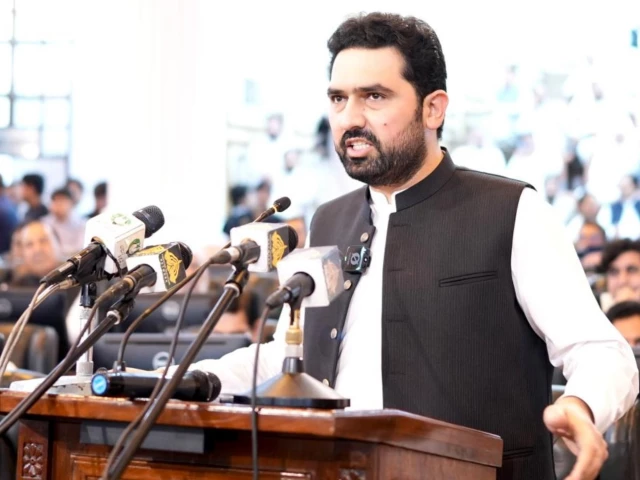
Khyber Pakhtunkhwa Chief Minister Sohail Afridi presents the provincial budget for fiscal year 2026-27 in the assembly on Friday. Photo: X
PESHAWAR:
Khyber-Pakhtunkhwa Chief Minister Muhammad Sohail Afridi officially launched the Khyber-Pakhtunkhwa Digital Transformation Policy and Roadmap 2030 at the Chief Minister’s House on Thursday.
Terming it a decisive breakthrough for digital governance, transparent administration, and a robust digital economy in the province, Afridi said the policy stands among Pakistan’s most comprehensive digital frameworks. “This roadmap provides a complete blueprint to transition Khyber-Pakhtunkhwa toward modern, efficient, transparent, and citizen-friendly governance in the coming years,” he told the inaugural ceremony.
The Chief Minister emphasized that the provincial government was actively working to realize Pakistan Tehreek-e-Insaf founder Imran Khan’s vision of a Digital Khyber Pakhtunkhwa. He praised the K-P Information Technology Board and relevant departments for their efforts, noting that the roadmap had been developed through extensive consultations, keeping in view international best practices and future requirements.
The Digital Transformation Policy and Roadmap 2030 comprises five strategic pillars, nine core objectives, 32 thematic domains, and 915 strategic interventions. It incorporates clear targets, actionable timelines, institutional responsibilities, and a comprehensive monitoring framework to ensure the transformation process is phased, integrated, and sustainable.
Afridi asserted that paperless governance and digital reforms would significantly improve transparency, accountability, speed, and efficiency in the bureaucratic system. “The lesser the human intervention in official matters, the stronger will be merit, transparency, and accountability,” he maintained.
The Chief Minister said the government would gradually make all public services online and citizen-centric, enabling citizens to access easy, fast, and quality facilities through a single platform. He highlighted that one of the most positive aspects of the proposed interventions was that people in remote areas would be spared unnecessary visits to government offices and could avail required services and information from their homes.
Afridi said the government was focusing specially on equipping youth with globally competitive digital capabilities.