Party spokesperson says police have placed Fazl under house arrest at his residence in Multan
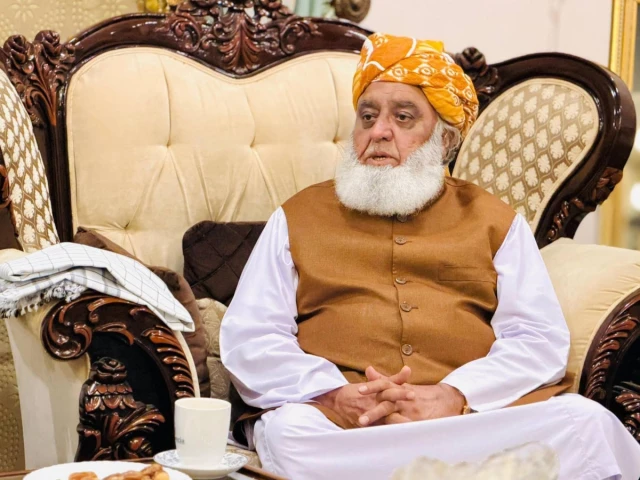
Jamiat Ulema-e-Islam-Fazl (JUI-F) chief Maulana Fazlur Rehman. Photo: Facebook
Jamiat Ulema-e-Islam-Fazl (JUI-F) chief Maulana Fazlur Rehman was detained again by Punjab police near Rahim Yar Khan while travelling to Sindh, the party claimed in a post on X on Sunday, while Punjab Education Minister Sikandar Hayat denied the detention.
On Saturday, the Capital Development Authority (CDA) sealed the Islamabad residence of the JUI-F chief over alleged irregularities in property ownership documents, amid escalating tensions between the government and the JUI-F. Fazl’s family was reportedly given 30 minutes to vacate the residence before it was sealed by the magistrate and the CDA officials.
The party’s spokesperson said the Punjab government had once again placed Fazl under “illegal detention”, despite Lahore police having lifted his house arrest a day earlier and allowed him to travel.
According to the post, Fazl had set off for Sindh by road in line with his scheduled programme. He was due to attend a conference in Larkana on November 30 in memory of Shaheed-e-Islam Allama Dr Khalid Mahmood Soomro.
The spokesperson said police had subsequently placed Fazl under house arrest at his residence in Multan. His staff and JUI-F Punjab Secretary General Hafiz Naseer Ahrar were also accompanying him.
پنجاب حکومت نے امیر جےیوآئی مولانا فضل الرحمان کو ایک بار پھر غیر قانونی طور پر نظر بند کر دیا۔ ترجمان جےیوآئی
لاہور پولیس نے گزشتہ روز مولانا فضل الرحمان کی نظربندی ختم کرکے انہیں سفر کی اجازت دی تھی۔ اسلم غوری
مولانا فضل الرحمان طے شدہ شیڈول کے مطابق بذریعہ سڑک سندھ روانہ…
— Jamiat Ulama-e-Islam Pakistan (@juipakofficial) November 29, 2026
JUI-F Sindh Secretary General Allama Rashid Soomro, who had travelled to welcome Fazl, was also arrested near Rahim Yar Khan, the party said, adding that its central Secretary General Maulana Abdul Ghafoor Haideri and Punjab provincial chief Maulana Amjad Khan were already in the undeclared custody of Punjab police.
The party accused the Punjab government of following the Islamabad administration’s example by concealing facts and misleading the public. It demanded the immediate release of Fazl and all other detained party leaders and workers.
JUI-F said it was continuing its peaceful public outreach campaign according to its announced schedule, but alleged that the government was unable to tolerate even the routine constitutional and democratic activities of opposition parties.
“If political activities have been banned in the country, the government should have the courage to issue a formal notification,” the spokesperson said.
The party questioned whether a “civilian martial law” had been imposed in the country, preventing political parties from holding public meetings and rallies.
Read: Bilawal asks DPM Dar to review raid on Fazl’s residence, treatment of family members
It said the blackout of opposition leaders’ speeches in parliament and restrictions on public gatherings contradicted the government’s claims of upholding democracy.
The spokesperson urged the government to explain why political activities were being restricted instead of creating divisions between provinces. He also demanded that it tell the public “at whose behest” JUI-F and the opposition were being pushed against the wall.
The party said attempts to push the country towards political confrontation and provocation were deeply concerning, adding that the government’s “undemocratic tactics” could not deprive political parties of their constitutional and democratic rights.
“We must face the government’s oppression with patience, restraint and steadfastness,” Aslam Ghauri said, urging workers to remain determined and maintain their confidence in the leadership.
He asked party workers not to be provoked and to continue the movement in accordance with the instructions of their respective provincial organisations.
“Perseverance, continuous struggle and patience will bring an end to this dark night,” the spokesperson said. He added that the party’s peaceful struggle against inflation and for the protection of public rights would continue under all circumstances.
JUI-F said it was prepared to make every sacrifice for the defence of the Constitution, restoration of democracy and protection of Islam, and would not compromise on its constitutional, democratic and political rights.
Sikander Hayat denies Fazl’s detention
Meanwhile, Hayat questioned the circumstances surrounding Fazl’s alleged detention, saying the JUI-F chief had not been detained.
Speaking at a press conference, the minister rejected claims that the government had taken him into custody or placed him under house arrest, saying that, as of around 2:45pm, Fazl had not been arrested and had been moving between Islamabad and Thokar Niaz Baig of his own choice.
Hayat questioned the JUI-F chief’s claims of being ready for arrest, asking why he had not led a march or sit-in if he had the public support he claimed.
He said the protests had prevented people, including schoolchildren, from reaching their homes on time and caused difficulties for commuters, transporters and patients needing to reach hospitals. He also questioned why the protest had been called on a Friday, alleging that people going to mosques for prayers were being used as a shield.
Read more: Fazl’s Islamabad residence sealed after CDA cancels property transfer over alleged irregularities
Hayat said the roads and motorways had been blocked despite the impact on thousands of transporters carrying goods with limited shelf lives, as well as people travelling for weddings and other commitments.
Referring to reports and videos of commuters stranded until late evening, he questioned whether blocking roads and restricting ambulance access was consistent with the teachings of Islam. He said he had read the Quran with translation and that it called on people to ease others’ difficulties and fulfil their rights, rather than create obstacles for them.
He further challenged the JUI-F chief to demonstrate the strength of his support by gathering protesters alongside the motorway rather than blocking it and disrupting public movement.
Hayat claimed that the protest call had been rejected by people across the country’s provinces and federal territories, arguing that the public was not willing to respond to the party’s call. He warned against using students as a shield, blocking ambulances, or disrupting law and order, saying that the state was supreme.
Background
On Thursday, Fazl warned of a “nationwide shutdown” if the party’s convoy was impeded en route to Sargodha, as news emerged of the party blocking roads and highways across the country in a protest call.
On the same day, the Sargodha district administration imposed a 30-day ban on the entry of the JUI-F chief and eight others, citing concerns over public safety and the maintenance of law and order.
The JUI-F chief announced nationwide protests against restrictions imposed on the party’s planned conference in Sargodha, alleging that party workers had been arrested and senior leaders placed under house arrest.
The confrontation between the government and Fazl intensified on Tuesday after he was prevented from leaving his residence in Lahore, where Punjab police had deployed a heavy contingent ahead of his scheduled address to lawyers at the invitation of the High Court Bar Association. Subsequently, the party approached the LHC against the confinement of the party chief and the cordoning off of his residence in Lahore.
The flurry of recent meetings also comes amid a renewed debate on new provinces, which gained momentum on July 31, when Naqvi called for the creation of additional administrative units, arguing that Pakistan’s existing governance structure was outdated and required a comprehensive overhaul. He renewed his proposal in November, suggesting that political parties hold a referendum to gauge public opinion on the issue, while maintaining that no decision would be taken without the consensus of coalition partners.
Also read: JUI-F stages protest in Karachi over Fazl’s alleged house arrest, detention of workers
The proposal has drawn differing responses from political parties, with the PPP strongly opposing any move to divide Sindh, while the MQM-P has continued to advocate the creation of additional provinces, particularly in the province. The Sindh Assembly also passed a resolution on September 4 rejecting attempts to divide the province or alter its geographical boundaries.
Bilawal’s speech at the Karachi Press Club stirred up a storm after he said a bloodbath was imminent if Sindh was administratively divided. The PPP scion said he acknowledged a system collapse and was up for a reset “only” through political interventions. Naqvi, an avid supporter of new administrative units in the country, has remained at the centre of Bilawal’s tirade against the government.
Meanwhile, Defence Minister Khawaja Asif has supported the idea of creating as many as 12 provinces, arguing that smaller administrative units could improve governance and service delivery.
Subsequently, in an attempt to reduce political temperatures, Prime Minister Shehbaz Sharif and Zardari agreed to resolve all outstanding issues through dialogue.