Farooq Sattar alleges Sindh govt’s discriminatory treatment; Mustafa Kamal says party prioritised public safety
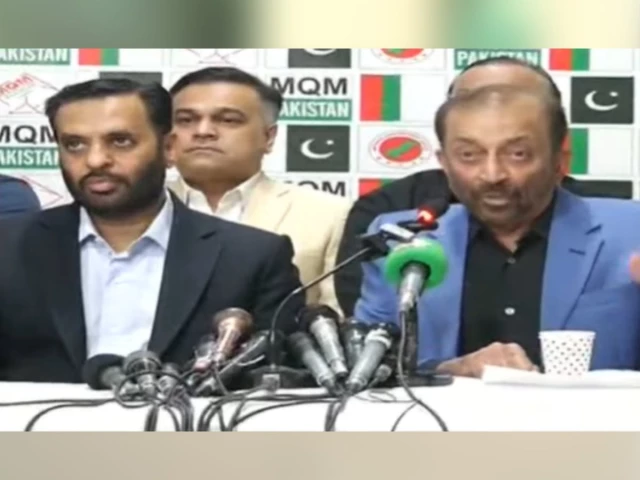
MQM-P leaders Syed Mustafa Kamal and Farooq Sattar addressing a press conference in Karachi on November 28, 2026. Screengrab
KARACHI:
Muttahida Qaumi Movement-Pakistan (MQM-P) leader Dr Farooq Sattar on Saturday announced the postponement of the party’s November 29 rally, saying it was forced to cancel it by the Karachi commissioner citing security threats.
On November 23, the PPP said Sindhi nationalist leader Dr Qadir Magsi had announced his November 29 rally nearly a month ago and requested MQM-P not to hold its event on the same day, warning that two simultaneous political gatherings could lead to tensions or clashes in Karachi.
Addressing a press conference alongside Health Minister Mustafa Kamal and others, Sattar said, “The Sindh government’s decision is extremely discriminatory and unjust. If there were security concerns, rallies of all political parties should have been banned on Nov 29.”
He further alleged that nationalist groups were planning to hold a rally on the said date.
“Through this decision, the Sindh government has revealed its true intentions. They are not merely creating obstacles to the establishment of administrative units; instead, attempts are being made to evade the establishment of administrative units,” the senior MQM-P leader asserted.
Sattar said MQM-P had decided to cancel its rally because it did not want to risk an untoward incident or provide an opportunity to blame the party for any confrontation.
Read: MQM thankful to Bilawal for accepting guilt: Sattar
The decision, he said, had been taken in the broader interest of Karachi’s peace, business and commercial activities.
“The party would announce a new date for the rally in December,” he added.
Kamal said MQM-P had decided to postpone the Nov 29 rally because human life and public safety were more important than holding a political gathering.
“By cancelling the rally, we have demonstrated national and political maturity.”
He said reports from law enforcement agencies had indicated a possible threat of terrorism and that there was also a risk of confrontation with groups planning to raise slogans for Sindhudesh.
Kamal said the party would be willing to change the rally’s date even 10 times if there was a risk to the life or property of a single individual.
He described the campaign for smaller administrative units as a public movement supported by people from different ethnic and socioeconomic backgrounds.
“Sindhis, Pashtuns, Baloch, Muhajirs, Punjabis and Saraikis living in Karachi are all part of the city and should not be treated as rivals,” the MQM-P leader cautioned, maintaining that the city’s problems were not divided along linguistic or ethnic lines.
“The distinction is between the powerful and the disadvantaged. Whether it is the shortage of water in residential areas or the deteriorating condition of University Road,” he said, residents belonging to all communities suffered from the same governance failures.
Demand for new provinces
Sattar said the controversy surrounding the rally was part of a wider issue concerning the establishment of new provinces, adding that the party had suggested seeking public opinion on the issue through a referendum under Article 48(6) of the Constitution.
He questioned why there should be any objection to allowing people to express their views on new provinces, alleging that the PPP was threatening to create “Sindhudesh” only to avert administrative division of the province.
Sattar also referred to a resolution submitted by MQM-P against the establishment of Sindhudesh on September 4, saying the party opposed any move aimed at undermining the country’s integrity.
However, the MQM-P leader proposed new administrative units carved out of Sindh for Karachi, Larkana and Nawabshah.
Accusing the PPP of maintaining a feudal political structure and depriving people across Sindh of their rights, he said residents of Karachi, Larkana and Nawabshah deserve equal access to political representation, resources and public services.
Referring to a rally held on November 22, Sattar alleged that anti-Pakistan slogans had been raised but the provincial government had taken no notice even after Chief Minister Murad Ali Shah pledged punitive action.
The current debate over new provinces began on July 30, when Interior Minister Mohsin Naqvi called for additional administrative units or provinces as part of a broader overhaul of the country’s governance system. Naqvi argued that meaningful structural reforms were needed to improve governance, deliver justice and create opportunities for young people.
The proposal quickly became politically sensitive in Sindh, where the PPP strongly opposed any move to divide the province. Sindh Chief Minister Murad Ali Shah rejected Naqvi’s assessment that the governance system had collapsed and called the proposal outdated, warning that no bloodshed would be allowed over the creation of new provinces.
The debate widened in August when MQM-P backed the creation of new provinces and called for a national dialogue with political parties. The party argued that Pakistan’s growing population, poor governance and concentration of political power made greater administrative devolution necessary.
‘Even after 20 years of provincial autonomy, Pakistan has not become stronger’
Taking a jab at the PPP leadership, Sattar said, “Even after 20 years of provincial autonomy, Pakistan has not emerged stronger. During the past two decades, the country’s economic growth rate hovered between 2 and 3.5 per cent compared to 6-8% in years before that.”
The MQM-P stalwart argued that the experience of the past two decades demonstrated that neither a strong centre nor powerful provinces alone could guarantee effective governance.
“Local governments have been rendered ineffective through the withdrawal of powers and resources,” adding that elected representatives at the grassroots level cannot address public grievances without financial and administrative authority.
Sattar alleged that urban areas of Sindh had faced persistent discrimination during the PPP-led rule.
He further accused ‘a handful of influential families’ of creating obstacles to administrative reforms to protect their political and financial interests.
“The days of a handful of families monopolising Sindh are numbered. In 2027, a new dawn of participation for Pakistan’s 260 million people will emerge,” said Sattar.
Response to Bilawal’s remarks
Taking to task the PPP chairman for his remarks regarding bloodshed in urban areas of Sindh over the creation of new provinces, the health minister said he took the indirect threat “seriously” since the party was guilty of former incidents of violence.
Kamal claimed that Bilawal specifically mentioned unrest in cities where Urdu-speaking people were in the majority.
Also Read: Sindh moves to rewrite local government law
Asserting that it was not the first time that the PPP had issued threats against the ethnic minority in the province, Kamal cited killings, sexual violence and property damage during the protests that followed the assassination of former PM Benazir Bhutto.
“Properties belonging to Urdu-speaking residents were selectively targeted in Karachi and other parts of Sindh.”
He called for verification of the figures relating to the violence through historical records.
Quota system and governance woes
Kamal accused the PPP leadership of using the quota system to discriminate against Muhajirs and alleged that the Sindh government was not providing the community with its rightful share of jobs and opportunities. He claimed that fake domicile certificates were being used to occupy positions reserved for the urban quota.
He also criticised the provincial government’s handling of public safety, referring to incidents involving mobile phone snatching, fatal road accidents and the alleged failure to arrest suspects involved in street crimes.
Referring to the Gul Plaza tragedy, Kamal said people had continued to call for help while their families watched helplessly, alleging that the authorities had failed to respond adequately.
He described the situation as an example of what he termed democratic terrorism, arguing that citizens were being deprived of basic rights and protection under the existing governance structure.
The minister also devoted a significant part of his address to the water shortage in Karachi and the condition of public services across Sindh. He said potable water was unavailable in around 80% of Karachi and that residents had become dependent on private water tankers.
He alleged that the ‘tanker mafia’ was backed by influential individuals, including government officials, ministers and police personnel.
“If water can be supplied through tankers, why can it not be supplied through pipelines?” he asked, arguing that vested financial interests were preventing improvements in the city’s water distribution system.
“Even Bilawal House relies on water tankers,” he said, ridiculing the Bilawal-led PPP government in Sindh.
Kamal claimed that a Sindh government official had misappropriated Rs8 billion in World Bank funds and said the international lender had subsequently suspended funding. He also referred to the Supreme Court’s reported observations on the matter.
Turning to rural areas of the province, he said residents were deprived of clean drinking water and basic necessities, including adequate food, clothing and footwear.
“Sindh government bagged Rs22,000 billion over 17 years but never helped to improve the living conditions of ordinary citizens.”
He said the provincial government’s performance should be judged by the state of people in both urban and rural areas rather than political statements.
Kamal questioned Karachi’s census figures, alleging that 7.3 million residents were initially excluded from the 2023 count before the population was revised to 20.3 million following a 45-day extension. He probed the government’s reluctance to ensure an accurate population count.
He said Karachi and Hyderabad account for around 45% of Sindh’s population but lack adequate political representation.
“The existing system prevents these urban centres from electing their own chief minister, regardless of their combined population or electoral strength,” the federal minister lamented.
Reiterating the call for the establishment of smaller units, Kamal said these were necessary to address the host of problems faced by the country, particularly Sindh.
He said people from Karachi’s working-class neighbourhoods, middle-class localities, as well as affluent areas shared common problems and would support the demand for administrative reforms.
Concluding his remarks, Kamal said the party’s rescheduling of the rally should not be “interpreted as weakness” and vowed to continue its campaign for new provinces.