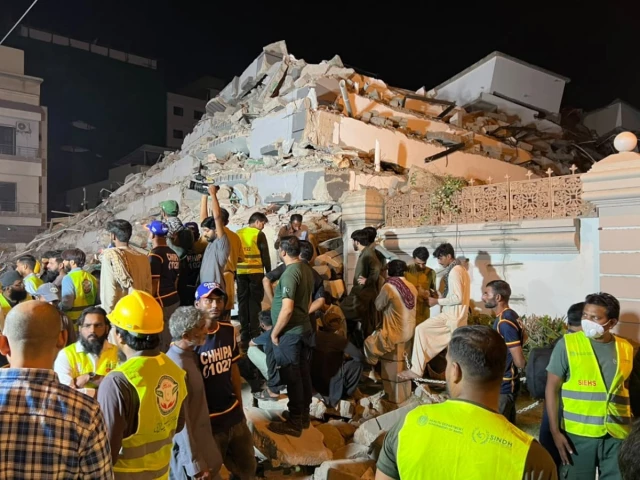
A view of the collapsed six-storey underconstruction building in Karachi’s Baloch colony area on November 25, 2026. Photo: Express
KARACHI:
The contents of the first information report (FIR) registered over the collapse of a multi-storey building in Karachi’s Baloch Colony area emerged on Friday, revealing that the case invoked six sections of the Pakistan Penal Code (PPC), including Section 302 pertaining to murder, but shied away from nominating a government official or department as a suspect.
A six-storey under-construction building in Karachi collapsed on Wednesday, killing eight people and injuring 14 others. Around 30 labourers were reportedly inside when the structure gave way. Initial findings indicated that the building had been approved for a basement, ground floor and one additional storey, but six extra floors had allegedly been constructed. Police detained six people, including the contractor and the structural engineer, as suspects in the case.
Sindh Chief Minister Murad Ali Shah held the Sindh Building Control Authority (SBCA) responsible for the tragedy. Following the incident, the provincial government removed the SBCA chief from his post and suspended 16 other officials. The authorities also sealed 12 other under-construction buildings in the area.
The FIR filed at the Tipu Sultan Police Station, seen by The Express Tribune, invokes Sections 34, 109, 119, 302, 337-H(1) and 427 of the PPC. It raises allegations relating to illegal construction, negligence, damage to property and criminal responsibility.
The absence of any government official among the nominated accused raises questions about the scope of the investigation, particularly the role of regulatory authorities responsible for overseeing construction and enforcing building regulations.
Read: Karachi building collapse: Death toll rises to eight as rescue efforts continue
Meanwhile, the death toll from the tragedy rose to eight today, while more than 10 people are still feared trapped beneath the rubble. Rescue operations are underway, with heavy machinery being used to clear debris and search for survivors.
According to the Edhi Foundation, seven of the deceased labourers have been identified as Farhan, Arsalan, Najeeb, Abid, Hassan, Allah Ditta and Baeed. The identity of the eighth victim, whose body was recovered on Friday afternoon, could not immediately be established.
Relatives of those feared missing have gathered near the site, anxiously awaiting news of their loved ones as rescue teams continue the search.
The building, located in Karachi’s East district, collapsed on November 25, trapping several people beneath the rubble.
Also Read: Karachi’s concrete sprawl defies building watchdog
It is worth noting that PPC Section 302 provides for the punishment of Qatl-i-Amd, which may include death as Qisas, death or life imprisonment as Ta’zir, or imprisonment of up to 25 years in circumstances specified by law.
Section 119 deals with a public servant concealing a design to commit an offence they are legally bound to prevent. Section 427 provides for imprisonment of up to two years, a fine or both, for causing damage to property.
Section 337-H(1) relates to injuries caused by a rash or negligent act and provides for imprisonment of up to three years, along with applicable Arsh or Daman.
Section 109 deals with abetment, while Section 34 provides for joint liability where a criminal act is committed by several persons in furtherance of a common intention.
The inclusion of these provisions, coupled with the absence of government officials among the nominated accused, has brought the role of private builders and regulatory authorities into focus. However, criminal responsibility will be determined through investigation and judicial proceedings.