High Commissioner Marriott notes Pakistan’s ‘extraordinary mineral potential’, urges exports, investment
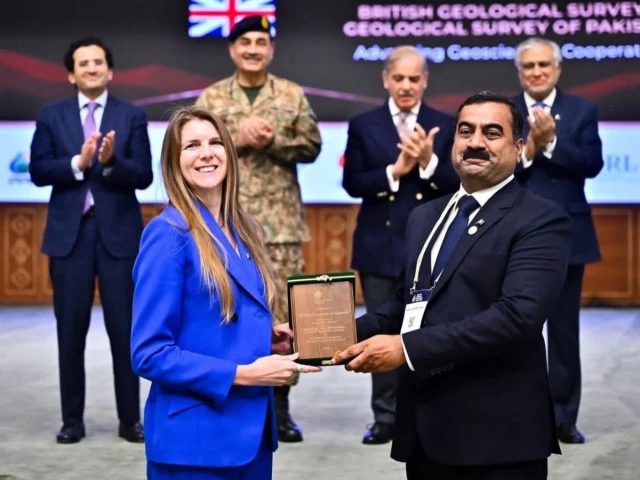
Geological Survey of Pakistan (GSP) and the British Geological Survey (BGS) draft agreement to work together, November 13, 2026. PHOTO: HANDOUT
The Geological Survey of Pakistan (GSP) and the British Geological Survey (BGS) drafted an agreement to work together on geological mapping, research and data, with “the aim to give Pakistan stronger evidence and skills for more responsible and transparent mineral development,” the British High Commission in Islamabad said in a press release on Tuesday.
The Memorandum of Understanding (MoU) between the GSP and the BGS is in draft form and subject to final institutional clearance. British High Commissioner Jane Marriott highlighted the plan at the Pakistan Minerals Investment Forum held at the Jinnah Convention Centre in Islamabad on November 13.
“Pakistan has significant mineral deposits, but mining contributes less than 2% of GDP,” the release said, adding that the draft agreement “would provide a framework for long-term cooperation including sharing knowledge, building skills, mapping, research, and better geological data.”
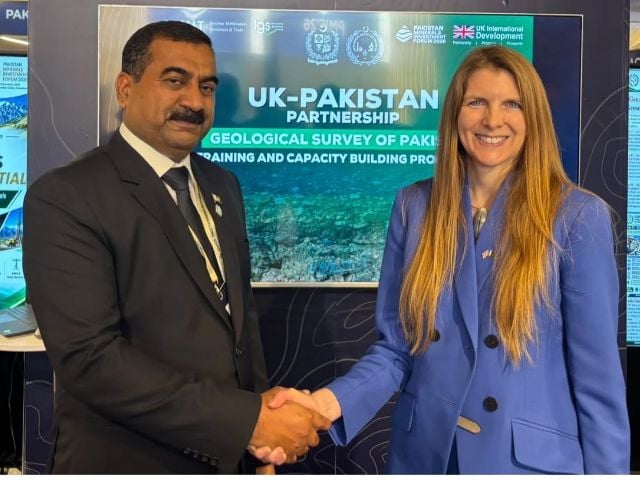
The plan also covers critical minerals and environmental sustainability, the release noted. The training, funded through the United Kingdom’s Revenue Mobilisation, Investment and Trade Programme (REMIT), “gave GSP staff practical skills in digital geological surveying, geochemical sampling, airborne geophysics, mapping software (Geographic Information Systems) and spectral remote sensing, using internationally-recognised methods,” it added.
Read: FM Dar, British envoy discuss Pakistan-UK ties, regional situation
According to the release, “REMIT is a UK-funded programme supporting Pakistan to build a stronger, more competitive and sustainable economy.” Working with the Pakistani government, the programme works to “strengthen revenue mobilisation, improve the business and investment environment, facilitate trade and exports, and support reforms that can unlock private investment and long-term economic growth.”
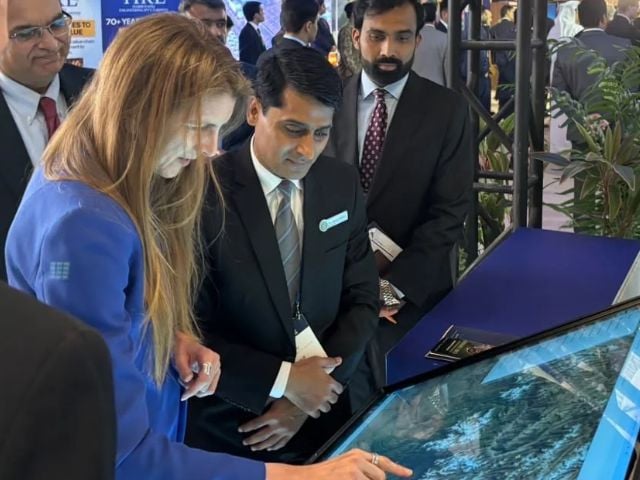
The release noted that within the minerals sector, REMIT has also supported institutional capacity building, including technical training for the GSP, which includes a 16-week institutional capacity-building programme for GSP, which was delivered by IGS.
Jane noted at the forum that “Pakistan has extraordinary mineral potential.” She stated that “turning that potential into sustainable jobs for the local community, exports, and investment requires credible geological data, strong institutions, and responsible, environmentally sustainable and transparent supply chains.”
Jane added, “The UK is proud to bring together world-class British expertise and Pakistani capability to strengthen these foundations, build investor confidence and create lasting economic opportunities for communities across Pakistan.”
Pakistan’s mining sector includes significant deposits of copper, gold, coal, chromite, salt and industrial minerals, the release noted.