US Embassy in Riyadh issues security alert for citizens in Middle East amid Houthi attacks
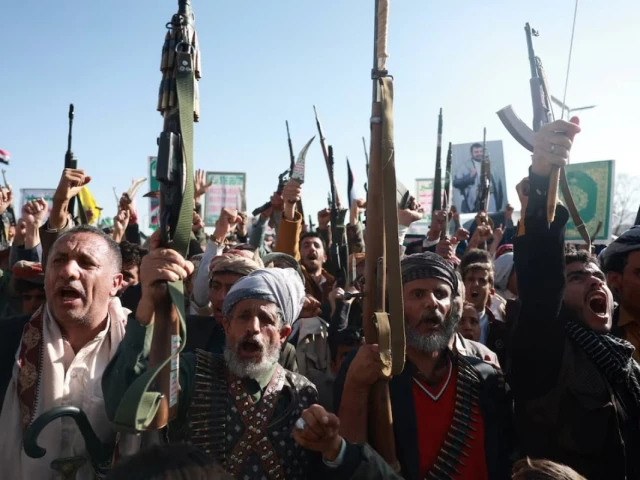
Houthi supporters rally to show support for the movement as fighting intensifies across several Yemeni fronts, in Sanaa, Yemen October 9, 2026. REUTERS
Fifty-three people were killed, and 200 were injured in an attack on Monday by the Iran-aligned Houthis on a government security forces training camp in Yemen’s Shabwa province, according to the local authority, as fighting in the impoverished country intensifies.
Video verified by Reuters from Shabwa province showed injured people and bloodied bodies scattered across the ground.
The Houthis and the internationally recognised government, which is backed by a Saudi-led coalition, have been trading attacks since the group advanced in September towards territory near the Bab el-Mandeb Strait, a shipping chokepoint at the mouth of the Red Sea.
Local authority sources who spoke on condition of anonymity said the Houthis had launched three ballistic missiles at security forces during a training exercise.
Shabwa, an energy-rich province in south-central coastal Yemen overlooking the Gulf of Aden, is home to the Balhaf liquefied natural gas facility, Yemen’s largest industrial investment.
Houthi military spokesperson Yahya Saree said on X that the group had targeted the training camp, which he said was run by Saudi forces. The Saudi authorities did not immediately respond to a request for comment.
Government forces this month began a campaign aimed at recapturing areas controlled by the Houthis, recovering ground near the strait, while the group besieges Taiz, the last major urban stronghold of anti-Houthi forces in the southern highland area of Yemen.
The conflict in Yemen has become another front line in the wider US-Israeli war on Iran as the Houthis have escalated their attacks on Saudi Arabia, the world’s largest crude exporter, targeting Riyadh’s international airport and the state oil company Saudi Aramco.
War broke out in Yemen in 2014 when the Houthis seized the capital Sanaa, driving the government south. A Saudi-led military intervention the following year led to a bloody stalemate until the sides agreed to a 2022 truce that held until this year.
Yemen is already one of the world’s worst humanitarian crises, with aid agencies warning of rapidly deteriorating conditions there.
US embassy issues security alert for citizens in Middle East
Earlier, the United States in Riyadh issued a security alert for Americans in the Middle East “due to the complex security environment,” amid attacks by the Houthis on civilian airports and other critical infrastructure.
According to the US Embassy in Riyadh, American citizens should “be aware of potential flight cancellations, airspace closures, and travel disruptions.” It added that the attacks by the Houthis resulted in civilian casualties and severe travel disruptions, noting that “the hostilities have the potential to escalate rapidly beyond that immediate area.”
“Americans travelling to or from the Middle East should monitor information about airport and airline operations and develop contingency plans in advance,” the embassy advised, adding that “Iran and groups supportive of Iran may target other US interests overseas or at locations associated with the United States and Americans throughout the world, including US businesses and other institutions.”
Earlier, it was reported that Egypt was ready to provide Saudi Arabia with the support it needs to defend its security and stability, the presidency said on Sunday, potentially raising the stakes in the Middle East war as Yemen’s Iran-allied Houthis intensify their attacks on the kingdom.
Egyptian President Abdel Fattah al-Sisi requested an urgent parliament session to authorise the military, one of the Arab world’s largest, to help defend its Gulf Arab ally if the kingdom requested its support.
A parliamentary vote had been expected on Sunday, but discussions were due to continue on Monday, two lawmakers and local media reports said.
Fighting between the Saudi-led coalition backing Yemen’s internationally recognised government and the Houthis, who control the capital Sanaa and much of the north, has escalated in recent weeks, becoming another front in the United States-Israeli war on Iran.
Any Egyptian military backing for Saudi Arabia could mark a major escalation in the wider Iran war, which has threatened global energy supplies and sent oil prices soaring since the US and Israel attacked the Islamic Republic in late February.
Hours after an announcement on further discussions by the parliament, Egyptian Foreign Minister Badr Abdelatty said in a post on X that he discussed regional developments and the importance of de-escalation during a phone call with his Saudi counterpart, Prince Faisal bin Farhan.
Houthis ramp up attacks on Saudi Arabia
The Houthis have in recent days attacked Riyadh’s international airport and the state oil company Saudi Aramco, amid renewed fighting with Saudi-backed forces. The Houthi advances threaten the strategic Bab el-Mandeb oil shipping route, following the collapse of a truce.
“Egypt will provide Saudi Arabia with all necessary and possible forms of support to defend its security and stability, protect its resources, territorial integrity and Islamic holy sites,” the Egyptian presidency said in a statement. The statement followed a meeting of Egypt’s National Defence Council chaired by Sisi and attended by the parliamentary speaker, the prime minister and the army chief.
Sisi said in a speech on Saturday that Egypt would act in accordance with guidance from Saudi King Salman and Crown Prince Mohammed bin Salman, who visited Sisi on September 15, after fighting in Yemen reignited.
If Egypt weighs in, it could face attacks by the Houthis, ragtag mountain fighters who have emerged as a deadly force of tens of thousands and whose missiles and drones threaten the region.
Arab countries, especially Gulf states hosting US bases, have faced repeated attacks by Iran and its allies, including the Houthis and pro-Iranian militias in Iraq, during the conflict.
Egypt’s Mediterranean port of Damietta came under a drone attack in July with no group claiming responsibility. Egypt has not blamed any party for the attack but said it was taking necessary measures to protect the country’s national security.
Read: Iran offers help to end Saudi-Houthi conflict through dialogue
Egypt and Saudi Arabia are close strategic and economic partners. Saudi Arabia and other oil-rich Gulf states including the United Arab Emirates provided Egypt with billions of dollars in aid, central-bank deposits and investments after the military ouster of Islamist President Mohamed Morsi in 2013. Sisi became president a year later.
Egypt had previously joined the Saudi-led coalition that intervened in Yemen in 2015 to support the government against the Houthis, but played a limited combat role in the civil war.
Riyadh has turned to regional allies and Pakistan after it sought US President Donald Trump’s help to fight the Houthis. Trump did not agree to US strikes, sources told Reuters last month. Washington instead offered targeting assistance and intelligence-sharing.
Saudi Defence Minister Prince Khalid bin Salman visited Abu Dhabi on Sunday and met with UAE President Mohammed bin Zayed Al Nahyan, with talks focusing on regional security, according to the Emirati state news agency.
The talks followed a visit to Riyadh last month by UAE Vice President Sheikh Mansour bin Zayed Al Nahyan, the first trip by a senior UAE official to the kingdom since a deep rift emerged between the two Gulf powers last year.