
Says it is unfortunate attempts are being made to link the emergency in K-P with things other than terrorism
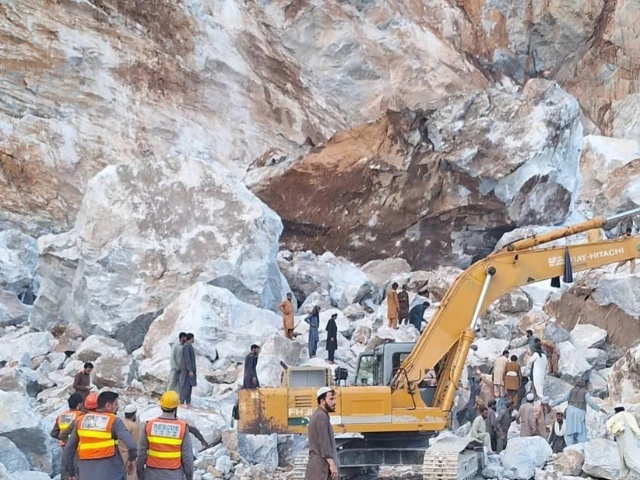
Landsliding due to a blast during mining operations in the Palodheri hills of Rustam in Khyber-Pakhtunkhwa’s Mardan district on March 31. PHOTO: EXPRESS
Parliamentary Affairs Minister Tariq Fazal Chaudhry on Monday rubbished linking governor’s rule and the imposition of an emergency in Khyber-Pakhtunkhwa (K-P) to mineral extraction in the province.
The emergency and governor’s rule were declared on October 11 after negotiations between the government and opposition failed, culminating in a PTI long march towards Islamabad that began on October 4. Last week, a joint session of parliament adopted two separate resolutions ratifying the presidential proclamations imposing a state of emergency and governor’s rule in K-P for two months, amid protests from the opposition. Before that, both houses of parliament had separately approved the emergency in the province by majority vote under Clause 1 of Article 232 of the Constitution, despite objections from opposition lawmakers.
The opposition has decried the move as an attempt to encroach on the province’s mineral wealth and vowed to resist what it has said is the forcible occupation of Pakhtun lands and the appropriation of their natural resources.
Speaking on the private television programme Capital Talk, Chaudhry said political parties were trying to link the emergency to the debate over minerals because they thought the emergency was imposed to gain power as part of a “power game”.
“It’s not a power game but a peace game, because of which an emergency has been imposed”.
Read: K-P is rich in minerals; we will ‘extract and sell them’, says Kundi
The minister noted it was unfortunate that attempts were being made to link the emergency in K-P with things other than terrorism, further adding that the emergency had been imposed in extraordinary circumstances and a constitutional option has been used for that purpose.
Chaudhry further said that the “expectations of certain political parties have not been met, including people in my own party who wanted a share of the authority in the new political setup. It was explained to them that the people selected in the advisory council were done so on merit and were experts in their respective fields.”
While explaining the reasons for the imposition of an emergency in K-P, the minister underlined that there were differences of opinion between the former provincial government and the federal government on the issue of counterterrorism, further adding that the former chief minister was not even willing to condemn terrorism and the TTP.
On the security situation in K-P, Chaudhry stated that Dera Ismail Khan was among the 12 districts in which operations would be conducted in the first phase. “There is no writ of the government there in DI Khan, and I can provide you the names of parliamentarians who give protection money to safely return to their home.”
Talking about US Chargé d’Affaires Natalie Baker’s statement in which she claimed that Pakistan possessed seven trillion dollars of mineral wealth, Chaudhry noted that Pakistan’s partnership with the US was old, further adding that Natalie took the names of both Balochistan and K-P.
Read More: Govt seeks US investment in minerals
“Mines and minerals that have been buried for the past 80 years, should they not be extracted to pay off Pakistan’s loans? The federal government has stressed that people from K-P and Balochistan will have the first right to the mineral wealth of their province, and the money will be spent on provincial development”.
The minister stated that the federal government would provide figures on how much money had been given to K-P and how much of it was actually spent, adding that numbers would also be shared for Balochistan.
On October 17, K-P Governor Faisal Karim Kundi said the province’s mineral resources would be extracted and sold to promote economic prosperity, urging domestic and foreign companies to invest in the sector through joint ventures to generate employment and support local businesses.
The governor defended the proposed exploitation of the province’s mineral resources, arguing that investment in the sector could generate employment, support local businesses and improve economic conditions.
Pakistan’s mineral reserves are estimated at around $8 trillion and spread over 600,000 square kilometres, according to the Institute of Cost and Management Accountants (ICMA). The vast mineral resources highlight the massive economic potential of the mining sector. The sector has historically contributed less than 3% to the gross domestic product (GDP). With strong governance and security, annual mineral exports could rise from about $3 billion to $8 billion, and GDP growth could climb from roughly 3% to 6%.
The challenge, however, is to turn the geological potential into bankable projects, exports, jobs and industrial capacity. This requires more than mining and greater focus on exploration, geological data, modern technology, infrastructure, financing, predictable regulation, environmental safeguards and partnerships with international companies.


